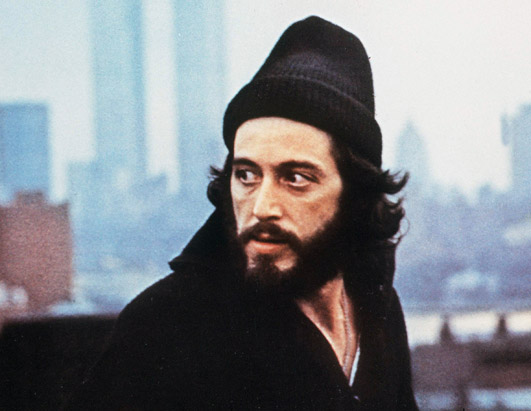
Al Pacino dominated the 1970s onscreen and never looked back
Film Forum
209 West Houston St.
February 18-24
212-727-8110
www.filmforum.org
Perhaps no actor has dominated a decade the way Al Pacino ruled over the 1970s. With five Oscar nominations in eight films, he experienced unprecedented breakout success, so it is with good reason that Film Forum has named its retrospective “Pacino’s ’70s,” because he owned the period onscreen. Born in East Harlem in 1940, Pacino, currently finishing up a celebrated Broadway run as Shylock in The Merchant of Venice, cut a brooding swath as gritty films came of age in the 1970s, particularly those made in New York City. The series — which includes all of Pacino’s work from 1971 to 1979 save for his one misstep, Bobby Deerfield (Sidney Pollack, 1977) — begins February 18 with The Godfather (Francis Ford Coppola, 1972), which seems to keep getting better with age, followed by the even better sequel-prequel, The Godfather Part II (Francis Ford Coppola, 1974), on February 19, both of which will be screened on Sunday. On Monday, Pacino and Kitty Winn are badly in need of a fix in The Panic in Needle Park (Jerry Schatzberg, 1971), while on Tuesday Pacino thinks a sex-change operation for his lover will fix things in Dog Day Afternoon (Sidney Lumet, 1975). On Wednesday he finds himself in quite another fix in Serpico (Sidney Lumet, 1973), then on Thursday discovers that nothing can fix the legal system in …And Justice for All (Norman Jewison, 1979). The festival concludes on February 24 with the small gem Scarecrow (Jerry Schatzberg, 1973); the 7:40 show will be introduced by Schatzberg. The series is a testament to Pacino’s immense talent, demonstrating his innate ability to immerse himself in memorable characters like few ever have, from the whirling dervish lawyer Arthur Kirkland to the deeply conflicted Michael Corleone, from the virtuous Frank Serpico to the anarchistic Sonny Wortzik, from drifter dreamer Lion Delbuchi to drifter addict Bobby.
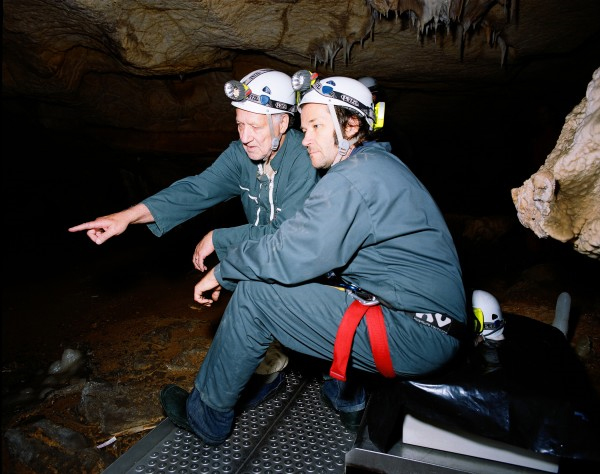
 An adventurer as much as a filmmaker, German director Werner Herzog has headed into the Amazon in Fitzcarraldo (1982), burning Kuwaiti oil fields in Lessons of Darkness (1992), and Antarctica in Encounters at the End of the World (2008). In his latest documentary, Cave of Forgotten Dreams, he goes where few have ever gone before. In December 1994, speleologists Jean-Marie Chauvet, Éliette Brunel, and Christian Hillaire discovered the Chauvet-Pont-d’Arc Cave in France, a vast series of chambers filled with remarkable paintings and engravings as well as animal bones, including the skulls of the extinct cave bear. The works were painted onto and carved into the walls, not limited to flat surfaces but around formations that jut out into the cavern. Dating back more than thirty thousand years, they are the oldest cave paintings ever found, well preserved through crystallization over the centuries and now by the intense and careful protection of the French government. Only a handful of scientists have been given access to the cave, until last spring, when Herzog, who has been entranced by cave paintings since he was twelve years old, was allowed to bring in a shoestring crew using specially devised equipment to film the space over the course of six four-hour sessions. The four-person crew — including Herzog manning the lights and his longtime cinematographer, Peter Zeitlinger, behind the 3-D camera — were not allowed to touch anything and had to stay on a narrow metal walkway that winds through the cave. They were accompanied by a team of specialists on the rare public journey: handprint expert Dominique Baffier, cave bear researcher Michel Philippe, the husband and wife team of Gilles Tosello and Carole Fritz, who map out the social connection between art and archaeology, Jean Clottes, the former director of the Chauvet Cave Research Project, and current director Jean-Michel Geneste. In true Herzog style, he also speaks with a master perfumer and two prehistoric flute archaeologists. Herzog’s decision to use 3-D — for what he says will be the only time in his career — was a stroke of genius, allowing viewers to feel like they’re walking through the cave with him, nearly able to reach out and touch the remarkable drawings, engravings, and skeletons. Herzog’s narration does get too dreamy at times, veering off on philosophical tangents before he adds a cool but silly coda, but, as always, he adds his trademark humor and charm.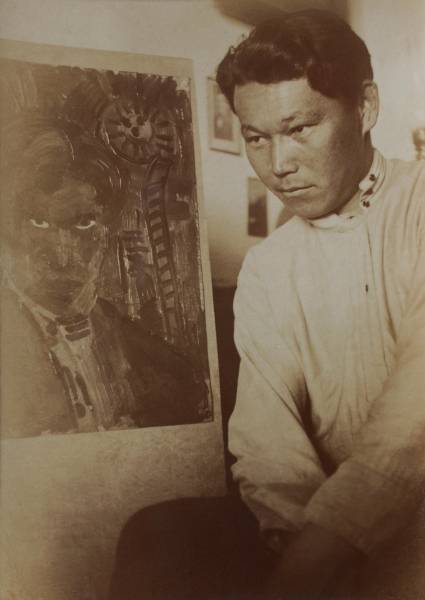
 While making a documentary about grass-roots political activism in the former Soviet Union, Amanda Pope and Tchavdar Georgiev learned of a remarkable museum in the middle of nowhere. Tucked away in the desert border town of Nukus in Uzbekistan is a monument built by one man’s fierce vision and refusal to give up, risking his freedom and security in the name of art. An archaeologist and wannabe painter, Igor Savitsky devoted his life to amassing a stunning collection of forbidden Soviet avant-garde art, primarily by little-known artists who were challenging the Fascist leadership on beautiful canvases loaded with social and historical relevance. Through interviews with surviving members of some of the artists’ families and friends of Savitsky’s, former New York Times Central Asia bureau chief Stephen Kinzer (the first Western journalist to write about the institution), art historians, longtime Savitsky Museum director Marinika Babanazarova, and others, supplemented by readings from Savitsky’s letters, Pope and Georgiev explore the power art can have in a repressed society as Savitsky, often getting funds from the very government that was banning the art he was collecting, put on public display works by such painters as Alexander Volkov, Kliment Redko, Victor Ufimtsev, Lyubov Popova, and Ivan Koudriachov from among the forty thousand pieces in the museum’s holdings (which now have passed the eighty-thousand mark). One of the most fascinating characters is Ural Tansykbaev, who was believed to have been collaborating with the Fascist government but is revealed to have had a subversive side as well. “I like to think of our museum as a keeper of the artists’ souls,” Savitsky is quoted as saying in the film. “Their works are the physical expression of a collective vision that could not be destroyed.” Sir Ben Kingsley supplies the voice of Savitsky, with Sally Field, Ed Asner, and Igor Paramonov providing voice-overs for various artists. As Pope and Georgiev note, the future of the Savitsky Collection is in jeopardy as it becomes more well known, more people look to profit from it, and Islamic fundamentalists seek to destroy it.

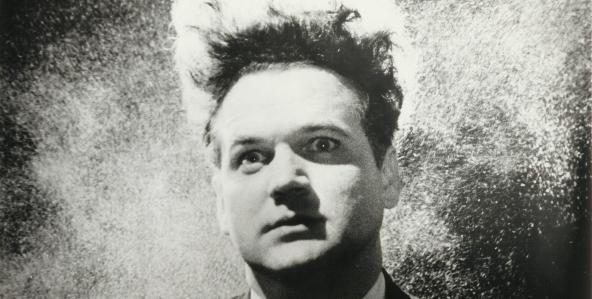
 David Lynch’s debut feature is about faith, fidelity, and fatherhood. Jack Nance stars as Henry Spencer, a lonely, scared man who suddenly has to raise his newborn child himself after his girlfriend, Mary X (Charlotte Stewart), leaves. Oh, it’s also about fear, fascination, and futility, the most bizarre film ever made by a major director. The avant-garde narrative seems to come from another dimension, with mutants, decapitation, a lady in a radiator, and a pencil-making machine. Everything about the movie, shot in creepy black and white, is strange, from the sound to the special effects to the bizarre score to the greatest hairstyles this side of BARTON FINK. It’s nearly a one-man show, with Lynch serving as writer, director, composer, producer, art director, production designer, editor, and special effects guru. ERASERHEAD is an amazing, unforgettable journey through the diseased mind of a madman. You haven’t truly lived until you’ve seen it at least once.