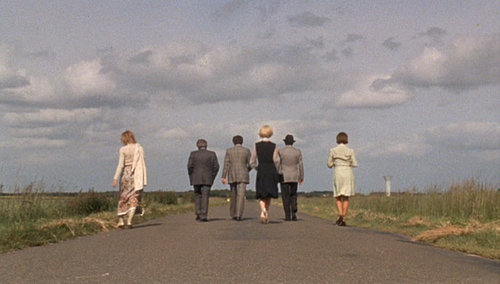
A group of restless bourgeoisie is in search of a dinner party in Bunuel classic
THE DISCREET CHARM OF THE BOURGEOISIE (Luis Buñuel, 1972)
Cabaret Cinema, Rubin Museum of Art
150 West 17th St. at Seventh Ave.
Friday, April 15, free with $7 bar minimum, 9:30
212-620-5000
www.rmanyc.org/cabaretcinema

Winner of the 1972 Oscar for Best Foreign Language Film, Luis Buñuel’s The Discreet Charm of the Bourgeoisie is a sharp, cynical skewering of the European power structure, taking on the high-falutin’ hypocrisy of the government, the military, religion, and, primarily, the wealthy class in hysterical vignettes that center around a group of rich friends trying to sit down and enjoy a meal. But every time they get close, they are ultimately thwarted by miscommunication, a corpse, army maneuvers, terrorists, and, perhaps most bizarrely, fake stage chicken. Buñuel regular Fernando Rey is a hoot as Rafael Acosta, the cocaine-dealing ambassador of Miranda who doesn’t take insults well. Stéphane Audran and Jean-Pierre Cassel play the Sénéchals, a lustful couple desperate to finish a romantic rendezvous even as their guests wait, Julien Bertheau is the local bishop who moonlights as a gardener, Claude Piéplu is an erudite colonel not afraid to share his opinion at a haughty cocktail party, and Maria Gabriella Maione is a sexy stranger who might or might not be a revolutionary after Acosta. Meanwhile, Acosta doesn’t mind making a play for Simone Thévenot (Delphine Seyrig) right under her husband’s (Paul Frankeur) nose. And Ines (Milena Vukotic), one of the Sénéchals’ maids, watches it all with a wonderfully subtle disdain. As if the first half of the film were not surreal enough, the second half includes a series of riotous dream sequences involving ghostly apparitions and a bit of the old ultra-violence, either outwardly related by characters or as cinematic surprises dished out by the masterful Buñuel. None too discreet about its myriad charms, The Discreet Charm of the Bourgeoisie is screening on April 15 at the Rubin Museum in conjunction with the Brainwave series of special programs and will be introduced by writer Kurt Andersen. (Admission to the museum is free on Friday nights, so be sure to check out the current exhibits as well, which include “Patterns of Life,” “Masterworks: Jewels of the Collection,” “Body Language,” and “The Nepalese Legacy in Tibetan Painting.”)
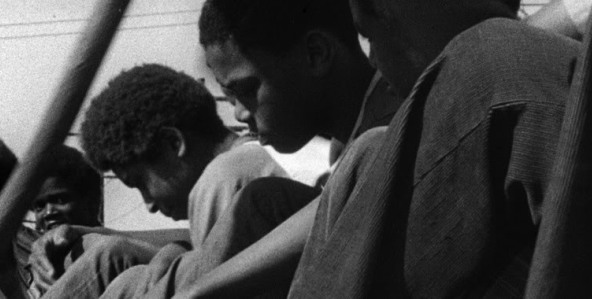
 In 2007, Milestone Films restored and released Charles Burnett’s low-budget feature-length debut, Killer of Sheep, with the original soundtrack intact; the film had not been available on VHS or DVD for decades because of music rights problems that were finally cleared. (The soundtrack includes such seminal black artists as Etta James, Dinah Washington, Little Walter, and Paul Robeson.) Shot on weekends for less than $10,000, Killer of Sheep took four years to put together and another four years to get noticed, when it won the FIPRESCI Prize at the 1981 Berlin Film Festival. Reminiscent of the work of Jean Renoir and the Italian neo-Realists, the film tells a simple story about a family just trying to get by, struggling to survive in their tough Watts neighborhood in the mid-1970s. The slice-of-life scenes are sometimes very funny, sometimes scary, but always poignant, as Stan (Henry Gayle Sanders) trudges to his dirty job in a slaughterhouse in order to provide for his wife (Kaycee Moore) and children (Jack Drummond and Angela Burnett). Every day he is faced with new choices, from participating in a murder to buying a used car engine, but he takes it all in stride. The motley cast of characters, including Charles Bracy and Eugene Cherry, is primarily made up of nonprofessional actors with a limited range of talent, but that is all part of what makes it all feel so real. Killer of Sheep was added to the National Film Registry of the Library of Congress in 1989, the second year of the program, making it among the first fifty to be selected, in the same group as Rebel Without a Cause, The Godfather, Duck Soup, All About Eve, and It’s a Wonderful Life, which certainly puts its place in history in context. Killer of Sheep will be screening at MoMA on April 13 at 4:30 as part of the series “Charles Burnett: The Power to Endure,” which continues through April 25 with such Burnett films as The Glass Shield (1994), The Annihilation of Fish (1999), America Becoming (1991), To Sleep with Anger (1990), and Finding Buck McHenry (2000), among other works, which include such cast members as Ruby Dee and Ossie Davis, Beau Bridges, Danny Glover, Ice Cube, Margot Kidder, James Earl Jones, Lynn Redgrave, Carl Lumbly, Elliott Gould, and Mr. Cub, Ernie Banks.