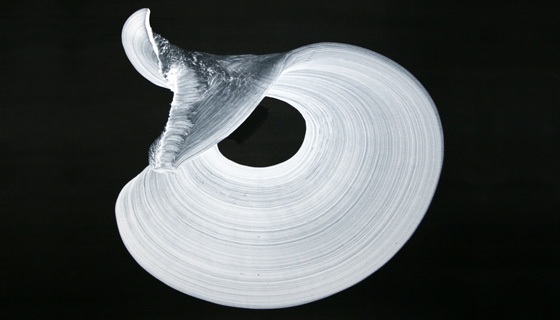
Najia Mehadji’s “Mystic Dance,” from the series Volutes, will be part of multidisciplinary site-specific Moroccan exhibit at FIAF Gallery
French Institute Alliance Française (and other venues)
Florence Gould Hall, 55 East 59th St.
Le Skyroom, 22 East 60th St.
Tinker Auditorium, 55 East 59th St.
April 30 – May 31, free – $40
212-355-6100
www.fiaf.org
in its annual World Nomads celebration of global culture, the French Institute Alliance Française journeyed to Africa in 2008, Haiti in 2009, and Lebanon last year; this year’s destination is Morocco, where the festivities began April 30 with a sold-out concert featuring the Orchestra of Fes with Françoise Atlan. Special events continue throughout May, with a pair of free literature talks Sunday with Abdellah Taïa (1:00) and Mahi Binebine (5:00) at the Cooper Union, screenings of Nour Eddine Lakhmari’s controversial 2008 film, Casa Negra, which deals realistically with contemporary social problems in Morocco, on May 3 ($10), a free concert with multi-instrumentalist Brahim Fribgane and trumpeter Ibrahim Maalouf on May 5 at 8:30 at Lincoln Center’s David Rubenstein Atrium, the New York debut of Rabat rapper Soultana at Joe’s Pub on May 6 ($15), and the installation “Untangling Threads: Soundwalk & Kantara Crafts” on May 7 that is also part of the Festival of Ideas for the New City. Other highlights include the panel discussion “Regenerating Morocco’s Architecture” on May 9 at 7:00 in FIAF’s Tinker Auditorium ($15), the May 11 keynote talk “Essaouira and Fes: Sustaining Cultures” with Royal Advisor André Azoulay and cultural critic Faouzi Skali at Le Skyroom (free with RSVP), a Master Gnaoua Musicians concert May 21 at 8:00 at Florence Gould Hall ($20, preceded by the free talk “Stories from the Gnaoua and World Music Festival”), and pianist Marouan Benabdallah performing at Zankel Hall on May 26 at 8:00 ($25). Additional screenings of Moroccan film will take place every Tuesday as part of FIAF’s regular CinémaTuesdays series, and the FIAF Gallery will hos the site-specific exhibition “Senses and Essence: Amina Agueznay, Safaa Erruas, and Najia Mehadji,” focusing on the work of three leading woman contemporary artists from Morocco (May 5-28, free).

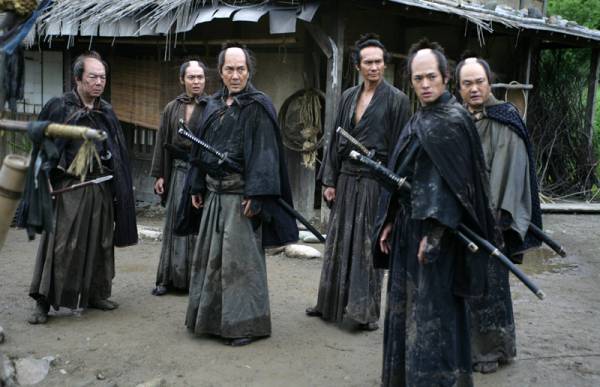
 Japanese director Takashi Miike’s first foray into the samurai epic is a nearly flawless film, perhaps his most accomplished work. Evoking such classics as Kurosawa’s Seven Samurai, Mizoguchi’s 47 Ronin, Aldrich’s The Dirty Dozen, and Eastwood’s High Plains Drifter, 13 Assassins is a thrilling tale of honor and revenge, inspired by a true story. In mid-nineteenth-century feudal Japan, during a time of peace just prior to the Meiji Restoration, Lord Naritsugu (Gorô Inagaki), the son of the former shogun and half-brother to the current one, is abusing his power, raping and killing at will, even using his servants and their families as target practice with a bow and arrow. Because of his connections, he is officially untouchable, but Sir Doi (Mikijiro Hira) secretly hires Shinzaemon Shimada (Kôji Yakusho) to gather a small team and put an end to Naritsugu’s brutal tyranny. But the lord’s protector, Hanbei (Masachika Ichimura), a former nemesis of Shinzaemon’s, has vowed to defend his master to the death, even though he despises Naritsugu’s actions. As the thirteen samurai make a plan to get to Naritsugu, they are eager to finally break out their long-unused swords and do what they were born to do. “He who values his life dies a dog’s death,” Shinzaemon proclaims, knowing that the task is virtually impossible but willing to die for a just cause. Although there are occasional flashes of extreme gore in the first part of the film, Miike keeps the audience waiting until he unleashes the gripping battle, an extended scene of blood and violence that highlights death before dishonor. Selected for the 2009 Cannes Film Festival and nominated for the Silver Lion at the 2010 Venice Film Festival, 13 Assassins is one of Miike’s best-crafted tales; nominated for ten Japanese Academy Prizes, including Best Picture, Best Director, Best Screenplay (Daisuke Tengan), Best Editing (Kenji Yamashita), Best Original Score (Koji Endo), and Best Actor (Yakusho), it won awards for cinematography (Nobuyasu Kita), lighting direction (Yoshiya Watanabe), art direction (Yuji Hayashida), and sound recording (Jun Nakamura).


 Winner of numerous awards at film festivals all over the country, Earthwork is an uninspiring, uninvolving look at the true story behind one man’s obsession with his unique brand of art. Based in Kansas, crop artist Stan Herd (John Hawkes) — who designs portraits, still-lifes, and corporate logos on the ground using grass, trees, bushes, soil, flowers, rock, and other natural elements, with the final work best seen from high above in airplanes and helicopters — was determined to make a name for himself in the New York art world. In 1994, he submitted a proposal for a public art project on an acre of wasteland on the West Side of Manhattan, part of the old Penn Central rail yards bought by Donald Trump. Herd got the job when he offered to do it for free, financing it himself by forging his wife’s (Laura Kirk) signature on a loan. He ends up working with a motley crew of homeless men who live in the nearby tunnels, consisting of young graffiti artist Ryan (Chris Bachand), elderly poet El-Trac (novelist Sam Greenlee), the mute Cage (Brendon Glad), the mentally unstable Lone Wolf (James McDaniel), and the dapper Mayor (Zach Grenier). As the obstacles continue to mount, Herd perseveres, but writer-producer-director Chris Ordal is unable to get any emotional depth out of the script or the actors. Flat and frustrating, Earthwork comes off more like a reality TV show reenactment than a full-fledged feature-length film. If it never feels like it’s set in New York, that’s because it was mostly shot in Kansas, killing off any chance of building the inherent dramatic tension that exists between the big city and the country and removing the irony of Herd’s creating a beautiful, colorful work of natural art amid a land of towering skyscrapers. Earthwork is like a chapter of a book way off in the corner by itself, desperately in need of the rest of the story. Ordal and Herd will be at the Angelika to talk about the film at several screenings on Friday and Saturday.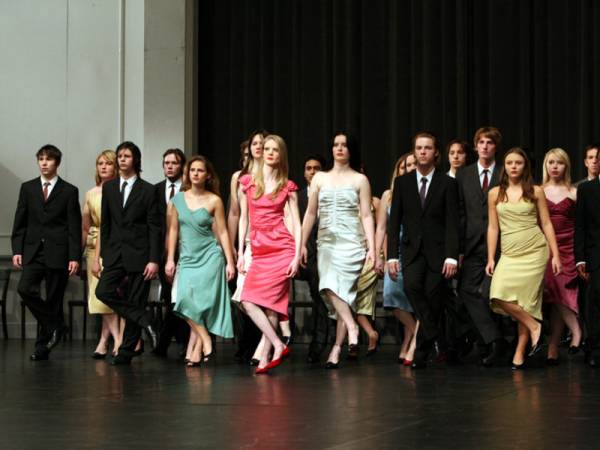
 From 1973 until her death in 2009, legendary dancer and choreographer Pina Bausch ran Tanztheater Wuppertal, the German company that changed the face of dance theater forever with such seminal productions as Rite of Spring, Café Müller, Danzón, Masurca Fogo, and so many more. In 1978 she staged Kontakthof, collaborating with Rolf Borzik, Marion Cito, and Hans Pop, set to music by Juan Llossas, Charlie Chaplin, Anton Karas, Sibelius, and other composers. In 2000, she revisited the piece with a cast of senior citizens, and eight years later she turned the roles over to a group of Wuppertal high schoolers, most of whom had never heard of her and had never danced before. Director Anne Linsel and cinematographer Rainer Hoffmann follow the development of this very different production in Dancing Dreams, speaking with the eager, nervous participants, who talk openly and honestly about their hopes and desires, as well as with rehearsal directors Jo-Ann Endicott and Benedicte Billet, who do not treat the teens with kid gloves but instead are trying to get them to reach deep inside of themselves and hold nothing back. When Bausch shows up to choose the final cast, telling the teenagers that she doesn’t bite, the tension mounts. Dancing Dreams is an intimate look at the creative process, about dedication and determination and what it takes to be an artist. It suffers at times from feeling too much like a reality television show, mixing American Idol and So You Think You Can Dance with the fictional Glee, but it also offers a last glimpse at Bausch, whose final interview is captured in the film. “You might think I’ve had enough of Kontakhtof,” she says at one point. “But every time it’s a new thing.” Dancing Dreams is screening May 1 & 2 as part of MoMA’s KINO 2011: New Cinema from Germany series, which runs April 27 – May 2 and also includes Gereon Wetzel and Jorg Adolph’s How to Make a Book with Steidl, Tom Tykwer’s Drei (Three), Friedmann Fromm’s Weissensee (The Weissensee Saga: A Berlin Love Story), Florian Cossen’s Das Lied in mir (The Day I Was Not Born), Philip Koch’s Picco, and a Next Generation presentation of short works.