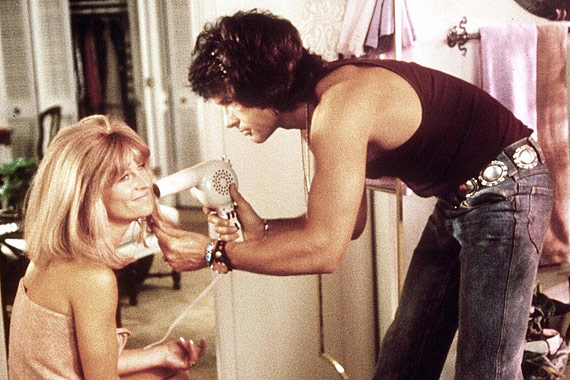
SHAMPOO kicks off Hal Ashby tribute at BAM in style
SHAMPOO (Hal Ashby, 1975)
BAMcinématek
BAM Rose Cinemas
30 Lafayette Ave. between Ashland Pl. & St. Felix St.
Friday, May 6, 2:00, 4:30, 6:50, 9:15
Series runs May 6-19
718-636-4100
www.bam.org
 To use George Roundy’s favorite adjective, Shampoo, which kicks off BAMcinématek’s Movies by Hal Ashby series, is “great.” Warren Beatty, who cowrote the screenplay with Robert Towne, stars as George, a Beverly Hills hairdresser who gives his wealthy clients more than just a cut-and-blow-dry. The film takes place primarily on November 4, 1968, as Nixon is battling Humphrey for the presidency, and George can’t keep it in his pants, running back and forth between Felicia (Lee Grant), Jackie (Julie Christie), and Lorna (Carrie Fisher) while trying to open his own shop, with help from business tycoon Lester (Jack Warden) — Felicia’s husband, Jackie’s lover, and Lorna’s father. The clothing is magnificent, as, of course, are the hairstyles. Ashby’s biting comedy perfectly captures the sexual awakening of the 1970s in all its glory — and in all its vapidity. Horror fans should keep an eye out for Lester’s friend Sid Roth, who is played by gimmickmeister William Castle. Ashby, who died in 1988 at the age of fifty-nine, made only eleven narrative films and two concert documentaries in his too-brief life and career, which is being honored at BAMcinématek with the retrospective that includes most of his directorial efforts in additional to several films he edited: Tony Richardson’s The Loved One (1965) and Norman Jewison’s The Cincinnati Kid (1965) and In the Heat of the Night (1967). The 6:50 screening of the underrated The Landlord on May 12 will be followed by a Q&A with filmmaker Robert Downey Sr. and star Lee Grant.
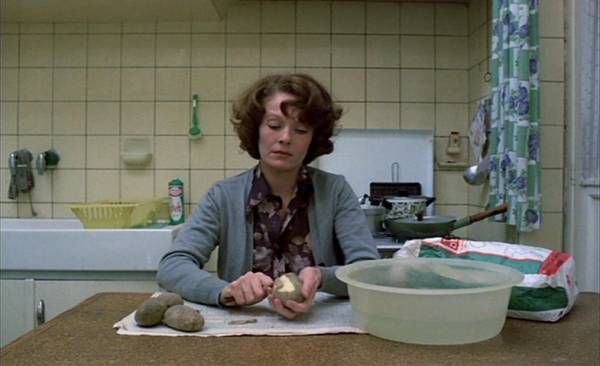
 Chantal Akerman’s groundbreaking film follows the drab life of the title character, a bored housewife who goes about her day nearly silently, moving agonizingly slowly, as she makes breakfast for her husband, sends him off to work, takes in a few johns, cleans the sink, etc. Just another ordinary day, not nearly as colorful as the one Séverine Serizy (Catherine Deneuve) experiences in Belle de Jour (Luis Buñuel, 1967). Delphine Seyrig (Stolen Kisses, The Discreet Charm of the Bourgeoisie, The Day of the Jackal) is mesmerizing as Jeanne Dielman — you won’t be able to take your eyes off her, and with good reason. This ultimate feminist film was made with an all-female crew, and if it’s anything, it’s absolutely memorable, love it or hate it. Oh, actually, it’s long too — nearly three and a half hours. Jeanne Dielman is screening on Friday and Saturday as part of the Museum of the Moving Image’s special Mother’s Day Weekend programming, which also includes the new HBO miniseries Mildred Pierce, which details one of the worst mother-daughter relationships ever filmed.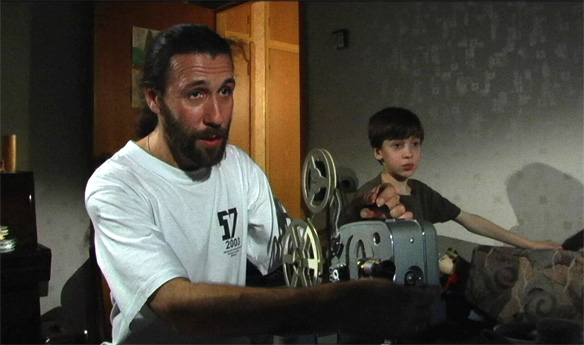
 Over the last fifty years, the former Soviet Union has experienced monumental social, cultural, economic, and political change, from the Cold War through Glasnost and Perestroika and its ultimate downfall as a world power. Making her feature-length directing debut, Robin Hessman gets up close and personal with five men and women who lived through those tumultuous years and share their fascinating experiences: Borya and Lyuba Meyerson, married history teachers who live with their son, Mark, in the apartment where Borya grew up; Ruslan Stupin, Borya’s childhood friend who was a punk rock star and is now passing on his counterculture values to his son, Nikita, who is worried about fitting in at school; Olga Durikova, a single mother also living in her childhoold apartment; and Andrei Yevgrafov, who has firmly embraced capitalism, owning a series of fancy men’s dress shirt stores. Combining archival footage and home movies with contemporary interviews, Hessman talks to the five protagonists about their early days as members of such Communist youth groups as the Octoberists, the Pioneers, and the Komsomol as well as how their lives changed as the Soviet leadership moved from Leonid Brezhnev to Mikhail Gorbachev and Boris Yeltsin. They speak open and honestly about the Soviet Union in ways rarely seen in the West, resulting in an intimate portrait of a momentous time of upheaval that is often misunderstood and has never before been so personalized on-screen.