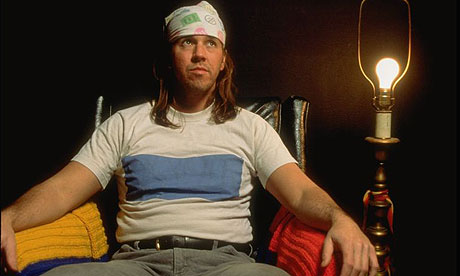
David Foster Wallace’s unfinished novel, THE PALE KING, will be explored in depth at the seventh annual PEN World Voices Festival of International Literature
Multiple locations
April 25 – May 1, $5 – $30
866-811-4111
www.pen.org
Celebrating the written word and freedom of expression while fighting censorship and human rights abuses, the seventh annual PEN World Voices Festival of International Literature will feature more than one hundred writers and artists from more than three dozen countries participating in seven days and nights of panel discussions, conversations, readings, and live performances. In addition, the Celluloid Literature Film Series will screen documentaries every night at the Instituto Cervantes New York, including such shorts and full-length works as Paul Bowles: Creating a Legend (Karim Debbagh, Coon Prager, 2006), Out of Place: Memories of Edward Said (Sato Makoto, 2006), Seamus Heaney: Out of the Marvellous (Charlie McCarthy, 2009), and The Erotic Man (Jørgen Leth, 2010). “We live in a time of great changes and challenges, and the need to remind ourselves of our basic values is as important as ever,” explain director László Jakab Orsós, chair Salman Rushdie, and PEN American Center president K. Anthony Appiah. “We have to reinforce our power to be able to analyze and understand the turbulent phenomena of our culture.” The festival runs April 25 – May 1, with the hubs the Standard, New York and the High Line, and consists of multiple events each day; below are our recommended highlights.
Monday, April 25, the Standard, $20, 11:00 pm: Yael Hedaya, Honor Moore, Irvine Welsh, Edmund White, and others will take part in the PEN Speakeasy “Sex; Erotic Readings,” hosted by Katie Halper, re-creating the feel of a speakeasy and sharing erotic stories.
Tuesday, April 26, St. Patrick’s Old Cathedral Gymnasium, 268 Mulberry St., $15, 7:30: Rick Moody, Michael Silverblatt, Sandro Veronesi, Michael Pietsch, and others will delve into the fascinating story behind the publication of David Foster Wallace’s unfinished final novel in “Everything and More: The Pale King by David Foster Wallace.”
Wednesday, April 27, Museum of the Moving Image, 36-01 35 Ave., $15, 7:00: HBO’s outstanding series In Treatment, starring Gabriel Byrne as a therapist in need of some treatment of his own, is based on the Israeli television series Be-tipul, written by novelist Yael Hedaya; Hedaya will be in Astoria to talk about therapy and television and screen an episode of the show.
Thursday, April 28, Westbeth Home of the Arts, Community Room, 155 Bank St., $12, 6:30: For “A Literary Safari: A Unique Experience,” sixteen writers will be situated throughout the Westbeth Center, reading from their works, including Nathacha Appanah, Rahul Bhattacharya, Abdelkader Benali, Amélie Nothomb, Ksenia Shcherbino, Teresa Solana, John Burnside, Mircea Cărtărescu, Manuel de Lope, Deborah Eisenberg, Marcelo Figueras, Jonas Hassan Khemiri, Hervé Le Tellier, Daniel Orozco, Gunnhild Øyehaug, and Lynne Tillman.
Friday, April 29, 92nd St. Y, 1395 Lexington Ave., $25, 7:30: Multidisciplinary artist and musician Laurie Anderson has curated “Poetry: The Second Skin,” an evening that explores the connections between poetry and music with John Burnside, Ernesto Cardenal, David-Dephy Gogibedashvili, Hasina Gul, Yusef Komunyakaa, Juan Carlos Mestre, Piotr Sommer, Joachim Sartorius, and Pia Tafdrup.
Saturday, April 30, the Cooper Union, Frederick P. Rose Auditorium, 41 Cooper Sq., $15, 12 noon: For “Get Super Lit: Comic Books Come Alive on Stage,” Jeff Newelt has put together a multimedia presentation of works that feature a wide range of superheroes created by Kate Beaton, Nick Bertozzi, Kevin Colden, Mike Dawson, Ludovic Debeurme, Dean Haspiel, Michael Kupperman, Benjamin Marra, R. Sikoryak, and Harvey Pekar, all of whom, save for the late Pekar, will participate in the program.
Sunday, May 1, New York Public Library, Celeste Bartos Forum, Fifth Ave. at 42nd St., $25, 3:00: Literary critic and deconstructionist Harold Bloom will talk with the NYPL’s Paul Holdengräber about writing and read some of his favorite poems, including his own, in “From the Anxiety to the Anatomy of Influence: A Conversation with Harold Bloom.”

 Based on a novel by Ma Shitu, Jiang Wen’s Let the Bullets Fly is a very funny action comedy set during the Warlord Era of the 1920s. After a train robbery doesn’t quite come off as planned, wanted gangster Pocky Zhang (Jiang) and his sidekicks team up with shady swindler Tang (Ge You) and a treasure-hunting woman (Carina Lau) to pose as the new county governor (Zhang) and his team, attempting to take over Goose Town and abscond with its money. But Goose Town already belongs to the crooked Huang Silang (Chow Yun-fat), who is not about to let Zhang take away what’s his. What follows is a goofy battle of wills that involves self-gutting, an idiot body double, some excellent gory violence, and lots of double entendres. A huge critical and commercial success in China, Let the Bullets Fly is way too long at 132 minutes, and the pacing often feels scattershot, perhaps the result of at least six screenwriters having poured out some thirty scripts before Jiang was ready to proceed. Jiang is wonderfully understated as Zhang, while Chow is a hoot as the local mobster whose domain is suddenly threatened. Filled with plenty of sly references and homages to Sergio Leone’s spaghetti Westerns, Let the Bullets Fly is a flawed but entertaining Chinese popcorner.
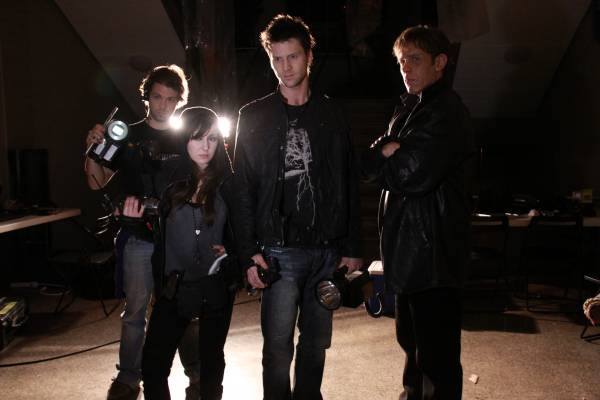
 In Grave Encounters, Sean Rogerson stars as Lance Preston, the host of a ghost-hunter reality TV series who is not averse to slipping locals a little cash to lie about having seen or heard creepy things at their latest location in order to pump up the drama. In this case, the Grave Encounters team — sound recordist Sasha Parker (Ashleigh Gryzko), tech expert Matt White (Juan Riedinger), cameraman T. C. Gibson (Merwin Mondesir), and pseudo-spirit medium Houston Gray (Mackenzie Gray), along with Preston — have committed to spending the night locked inside the long-abandoned Collingwood Psychiatric Hospital, which may or may not be haunted by the ghosts of doctors and patients pasts. Just when it’s looking like there actually might be something supernatural going on, they decide to take off early, but the building is not about to let them all go so easily. Shot in twelve days in a vacant mental facility in Vancouver, Grave Encounters, written, edited, and directed by the Vicious Brothers (Stuart Ortiz and Colin Minihan), presents a promising premise but takes way too long to start delivering the necessary thrills and chills. And when things finally do start happening, they lack any kind of shock or surprise, falling flat when then should have had audiences on the edge of their seats. Evoking such ghost stories as The Blair Witch Project, Paranormal Activity, and The Legend of Hell House, Grave Encounters is filled with potential that never reaches the scare levels of its far more successful predecessors.
 After the breakout success of Born to Run in 1975, Bruce Springsteen became embroiled in a lawsuit over control of his music that prevented him from going into the studio to make the highly anticipated follow-up. Springsteen found himself at a crossroads; “You didn’t know if this would be the last record you’d ever make,” he says in the revealing behind-the-scenes documentary The Promise: The Making of Darkness on the Edge of Town. Combining archival footage of the Darkness sessions shot by Barry Rebo with new interviews with all the members of the E Street Band in addition to producers Jimmy Iovine, Jon Landau, and others, editor and director Thom Zimny melds Bruce’s past with the present, delving deep into Springsteen’s complex, infuriating, and fiercely dedicated creative process. “I had to disregard my own mutation,” Springsteen says at one point, regarding his battle to avoid getting caught up in the hype that came with Born to Run, so he decided that his next album would be “a meditation on where are you going to stand.” Rebo captures Springsteen and the E Street Band — from a bare-chested Bruce to a bandanna-less Steve Van Zandt — rehearsing and recording alternate takes of familiar songs as well as tunes that would later wind up on such albums as The River and Tracks, opening up Bruce’s famous notebooks and examining his intense creative process, which included throwing away dozens and dozens of songs that he believed just didn’t fit within his vision of what Darkness should be. Two of the most fascinating parts of the The Promise involve Patti Smith discussing “Because the Night,” which is about her waiting for her boyfriend at the time, Fred “Sonic” Smith, to call her, and Toby Scott talking about mixing the Darkness record to get the sound pictures in Bruce’s head onto vinyl. The Promise: The Making of Darkness on the Edge of Town is screening April 25 at 8:00 at City Winery as a benefit for the American Red Cross, with all proceeds going to Japanese tsunami and earthquake relief; the screening is just one of many being held around the country over the coming week, all of which will include special giveaways.
 Avant-garde filmmaker Bill Morrison (Decasia) collaborates with Icelandic musician and composer Jóhann Jóhannsson in the elegiac The Miners’ Hymn, a tribute to the now-gone collieries, or coal mines, of Northeast England. The fifty-two-minute documentary opens with new aerial shots of the locations where the Durham coal mines were, since replaced by luxury housing and megastores. The film shows the birth and death dates of several collieries going back to the nineteenth century, then seamlessly blends into archival black-and-white footage of the miners at work underground, the community coming together for a local fair, and a union rally during a strike that includes a confrontation with the police. There is no text and no narration in The Miners’ Hymn; instead, Morrison’s savvy editing of the found footage, consisting of both moving pictures and still photographs primarily acquired through the British Film Institute and the BBC, brings the old-fashioned town and its old-fashioned ways to vibrant life even though they roll across the screen in slow motion. Jóhannsson’s score punctuates the proceedings with an occasional brassy flare when not sounding more funereal. Despite the lack of text and narration, Morrison’s point of view is clear and all too obvious, paying homage to something that has been lost, and he is never quite able to make an emotional or personal connection with the viewer. However, The Miners’ Hymn contains remarkable footage that still manages to tell an important story, even if it is one-sided and lacking at least a little more historical context.