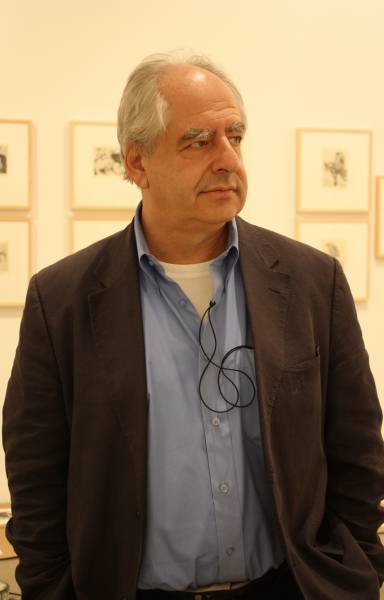
William Kentridge surveys his latest installation at Marian Goodman (photo by twi-ny/mdr)
OTHER FACES
Marian Goodman Gallery
24 West 57th St. between Fifth & Sixth Aves.
Tuesday – Saturday through June 18, free
212-977-7160
www.mariangoodman.com
In early 2010, South African visual artist William Kentridge was the toast of the town; his large-scale retrospective “Five Themes” was earning raves at the Museum of Modern Art, his production of Shostakovich’s The Nose was shaking up things at the Metropolitan Opera, his unique artist book “Sheets of Evidence” was on display at Dieu Donné, Ensemble Pi played live accompaniment to several of his animated films for “Sounds from the Black Box” at the World Financial Center, and he performed his one-man multimedia show, “I am not me, the horse is not mine,” at MoMA. The Johannesburg-based Kentridge is now back in New York with his latest exhibit, “Other Faces,” which is built around the world premiere of the tenth film in his “Drawings for Projection” series, animated shorts that examine the history and changing sociopolitical landscape of South Africa, many of which feature wealthy industrialist Soho Eckstein and common man / artist-lover Felix Teitelbaum. As always, the film is accompanied by a collection of drawings, fragments, and prints used in its creation, highlighting Kentridge’s process: He makes a charcoal drawing, photographs it with a 35mm camera, then alters it slightly for the next frame. A separate room at the gallery is dedicated to sketches and drawings and a cabinet of miniature character figures from The Nose.
We met with Kentridge as he was examining the installation in process for that evening’s official opening; he was generous with his time and thoughtful in his answers despite having just gone through emergency dental surgery. He took numerous pauses to carefully consider each question, including one about imprisoned Chinese artist Ai Weiwei, whose “Circle of Animals: Zodiac Heads” he had just seen at the nearby Pulitzer Fountain in Grand Army Plaza.
twi-ny: Last spring was quite a time for you here in New York City. What was that experience like? Is it more relaxing this time around?
William Kentridge: Well, I did have a sense that it’s not something that’s going to happen again. It was such a treat, such a privilege to have those together, and also I felt it’s the right way to see the work, which is about excess, about too many things jumping, shifting mediums, from drawing to sculpture to opera to performance. So very often, when they’re seen, you see one of those elements — you see just the performance, or just the opera, which is fine. They have to obviously stand up on their own. But to get a sense of the trajectory, what was here last year was, for me, a good way to look back and see how things were made.
twi-ny: You work in a myriad of media and disciplines, from films and drawing to tapestries and optics, from performance art and sculpture to theater and opera. What motivates you to try just about anything and everything?
William Kentridge: For many years, I followed the good advice of friends saying, “You have to specialize. If you try to do all these different things, you’ll just be an amateur and a dilettante; each one has its own specific set of skills, and traditions, and history. Just do drawing, or just do filmmaking, or just do theater.” I tried unsuccessfully to follow that advice, which seemed very sound, and then discovered that I was both working making drawings and making a piece of theater with some puppeteers, and there was projection behind it, and at a certain point I gave up. I said, “All right, I tried as hard as I can to just do one thing,” but temperamentally, it doesn’t work, and the only hope is that the sum of the parts will be more than the individual items. And not only that but that the drawings will be strengthened by the impulse that comes from the films.
In other words, images which are there at the service of something else apply to drawings, so you need an image for the narrative flow of the film, and that might make a drawing with an image that I would never have got to if I was simply saying, “Let me do a suite of drawings.” And there’s music that comes from a piece of theater which goes back to film, which suggests other images, so the direct pollination with the indirect provocation of different images, whether it’s in theater, in film, or in drawing, has been very productive.
twi-ny: Do you get different kinds of satisfaction from working in the different disciplines?
William Kentridge: The making feels very similar. The big difference obviously is that sometimes it’s me alone in the studio, or me with an editor, and a sound editor, and a composer; it’s just me if it’s drawings, a team of three of us if it’s an animated film, a team of five close collaborators and fifty other people if it’s an opera. So there’s that shift between working on one’s own and working with several people, which feels a good way to go up and down. They are different anxieties rather than different satisfactions with the different mediums.
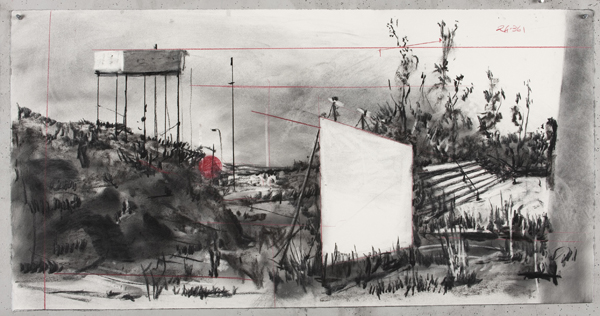
William Kentridge, “Drawing for ‘Other Faces,’” charcoal and colored pencil on paper, 2011 (© 2011 by William Kentridge / courtesy Marian Goodman Gallery)
Once an exhibition is done, there’s not an anxiety that the picture’s going to fall off the wall or the projector will switch off, whereas there’s an enormous anxiety that at the opening of a piece of theater the stage won’t move at the right place, the singers are going to forget where to stand, there’ll be a bad note here, the singer will miss an entrance there; there are four hundred contingencies that you have no control over, in the moment, whereas in the exhibition hall those contingencies have generally been before the opening. Once the pictures are up on the wall, you trust the nails will hold them. I suppose what all the projects have in common is that in some stage of their making, there are those nights where you lie awake saying, “If only I had said no to this project, then I could sleep calmly and be happy. . . . In the past, I’ve been able to sort of somehow pull the object out of the fire, but this one can only be a disaster.” So I would imagine that’s a kind of occupational hazard for being in the arts.
twi-ny: You were just walking around this installation; what are you most nervous about?
William Kentridge: Well, it’s the first time the film is being seen, so I’m most anxious about that which I can’t control, which is the balance between the sound of the audience looking at the exhibition and the level of sound in the room and the feeling that I really wish the sound mixer was here as the evening progresses to adjust the level and change things. I’m anxious about seeing the film through other people’s eyes. Particularly, this is a film that is very much set in Johannesburg, and it hasn’t been seen in Johannesburg, outside of the editor and the composer and myself, but to see if and what sense it makes to people outside of Johannesburg . . . That’s always been the case with the films, but usually they’ve been seen first in Johannesburg or somewhere else.
twi-ny: This is the first new film you’re showing since the retrospective at MoMA. So many more people are now familiar with your work —
William Kentridge: Yes, I haven’t thought about that. I have a sense it’s a finite size, this gallery. There are two lifts — How many people can fit in the lifts? — and the previous openings before the big MoMA and Metropolitan exhibition, those lifts were full. You can’t suddenly have three thousand people in here; even if they wanted to come, they don’t fit.
twi-ny: You are more of a celebrity now, more recognizable . . .
William Kentridge: I had two experiences of misreading the New York public last year. One was, I was about to cross Fifth Ave. and a woman in running shoes came up to me and said, “I’m sorry, I’m having a senior moment.” And I thought, “Oh God, she’s panhandling, she’s saying she lost her bus fare, can I give her ten dollars,” and I was about to say, “No no no no, I’m just arrived,” and she said, “You’re that artist from South Africa,” so it changed the conversation.
And then one evening I was going back to the hotel in deep Midtown and a woman in her forties or fifties came up to me, and I thought this was another person who would say I recognize you from your art, you’re Mr. Kentridge. I’m all ready to sign the autograph and she says, “Are you staying near here? Are you here for a while?” So I say, “Yes, yes, I’m just here for a while,” and then she says, “Don’t you want some company for tonight? I’m very good at it.” [Kentridge laughs.] So, two out of two misreadings, getting them both wrong.
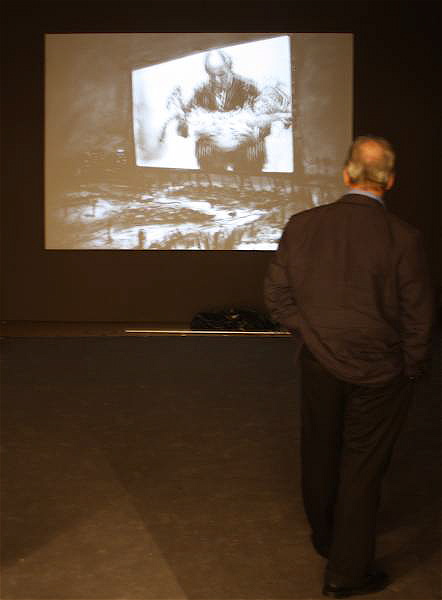
William Kentridge checks out the sound level in preparation for world premiere of his latest “Drawing for Projection” (photo by twi-ny/mdr)
twi-ny: Several of your works are included in MoMA’s current exhibition “Impressions from South Africa, 1965 to Now,” which looks at the melding of art and activism during apartheid. The show is filled with a tremendous amount of energy; where is that being channeled today in South Africa?
William Kentridge: First, you have to understand that South Africa is really a post-anti-apartheid society rather than a post-apartheid society. In other words, it’s off the map as a big international issue, but the legacy of three hundred years of discrimination has not been undone overnight. There are new tensions between a new small black elite that grows, a huge dissatisfaction from poorer black people, so there are enormous shifting currents of what the politics in South Africa are. There’s a sense among some of the white male artists in the show, like Anton Kannemeyer and Conrad Botes, the two artists from Bitterkomix, which are about the Afrikaaner anxiety and displacement but done in a very scabrous and energetic and funny and powerful and moving way. Diane Victor has done a very powerful set of small etchings, “The Disasters of Peace” as opposed to “The Disasters of War.” It does feel a bit like here’s the patient open on the table and anybody can examine this part of this organ or that organ and go and do further dissections in different places.
twi-ny: In 2011, what does it feel like to still have artists being arrested and imprisoned because of their work, especially in regard to the current situation with Ai Weiwei?
William Kentridge: That’s not the surprising issue. That’s not the new configuration. The new configuration is the illusion of normality in dealings with China. So, for example, I’m interested to know whether the Hong Kong Art Fair [where Kentridge’s work will be shown in the Marian Goodman booth later this month] and all its sponsors — Hong Kong is now part of Mainland China; it has its own particularities — whether there will be a public statement from the art fair, from the sponsors, who are obviously doing huge business in China. There may well be; I may be completely misjudging that, but on their website, I’ve not seen anything. In China, the biggest exhibition in the hugest museum is an exhibition of the European enlightenment [“The Art of the Enlightenment” at the newly reopened National Museum], so the contradictions are there, not to say they’re not there in other places, but the question is whether the extraordinary financial and commercial connections between China and the West will allow the West to make the sort of statements they would make here. So I’m interested to see whether there’s a big banner outside the Hong Kong Art Fair saying “Release Ai Weiwei.”
twi-ny: In the majority of your work, the hand of the artist, as well as the creative process itself, is evident. Do you think this gets lost with the prevalence of digital technology in today’s art world? How has the digital process affected your own work?
William Kentridge: As all film editing does, it happens on a computer, as opposed to pieces of film being physically cut up and stuck down. I’m not a purist. If I think this looks too fast, I will slow it down, and it’s a digital slowing down. It’s not digital animation, but it’s not as if it flies in the face of any of the things that are part of the lexicon of digital editing. The animation for The Nose, for example, was done with a digital camera — not done in a computer but photographed digitally, which is much more flexible and much quicker, and you can see it immediately. Some people can think very well with a mouse, think on a screen, and think creatively with their hands not really being involved; they’re looking at the screen and their hands form the keystrokes but it’s not their hands thinking, whereas with the work that I do, there’s very much the belief that there’s a kind of independent intelligence of the hand, there’s a kind of muscle knowledge and memory. . . .
twi-ny: What’s on the horizon for you?
William Kentridge: There’s a continuation of the kinds of things that I did in lecture-performance, somewhere between live performance and lecture; there’s further work in that field, and things that are somewhere between a theater performance and installation, which I’m not quite sure what that becomes. And I’m sure there will be more theater and more operas.
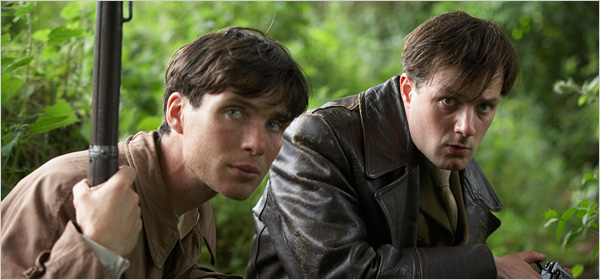
 Winner of the 2006 Palme d’Or at Cannes, The Wind that Shakes the Barley is a brutal masterpiece from director Ken Loach (Riff-Raff, Bread and Roses). It’s 1920, and the English black and tans are running roughshod through Ireland, leaving broken and dead bodies in their wake as they keep the population frightened and in poverty. But poorly armed yet determined local guerrilla armies are forming, prepared to fight for freedom in their homeland. In one small town, Damien (Cillian Murphy) is getting ready to move to London to train as a doctor, but he decides instead to join the burgeoning Irish Republican Army after seeing one too many bloody beatings. Swearing their loyalty to the cause and led by Damien’s brother, Teddy (Padraic Delaney), they set up ambushes of British forces, gathering weapons in a desperate attempt to win back their country. Damien also falls for Sinead (Orla Fitzgerald), one of many women who work as messengers and spies and run safe houses. But when a questionable treaty is signed, loyalty is tested and families torn apart. Written by Paul Laverty and also featuring Liam Cunningham, Mary Riordan, Myles Horgan, and Mary Murphy, The Wind that Shakes the Barley is a fierce, no-holds-barred, if one-sided, look at a violent conflict that has lasted for centuries.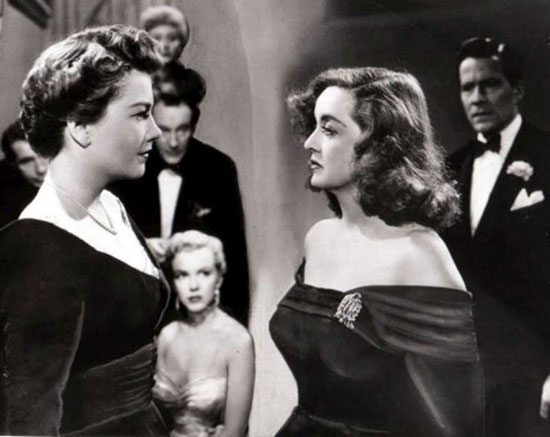
 Nominated for fourteen Academy Awards and winner of six, including Best Picture, Best Director, and Best Screenplay, All About Eve is one of Hollywood’s all-time greatest movies, a searing depiction of naked ambition set on the Great White Way. Based on Mary Orr’s 1946 short story “The Wisdom of Eve,” writer-director Joseph L. Mankiewicz’s flawless drama stars Anne Baxter as Eve Harrington, who is not exactly the mousey wallflower she at first appears to be. She quickly worms her way into an inner circle of Broadway vets populated by superstar Margo Channing (Bette Davis), her younger lover, Bill Sampson (Gary Merrill), playwright and director Lloyd Richards (Hugh Marlowe), and Richards’s wife, Karen (Celeste Holm), who takes Eve under her wing. Joining in on all the fun is powerful theater critic Addison DeWitt (Oscar winner George Sanders), who marvels at all the manipulation and backstage drama, much of which he wickedly orchestrates himself. “There never was, and there never will be, another like you,” DeWitt tells Eve in one of the film’s most poignant moments. All About Eve is filled with classic quotes, including the iconic “Fasten your seatbelts, it’s going to be a bumpy night,” boldly proclaimed by Davis. In a movie about acting and the theater, Mankiewicz never shows anyone onstage; instead, he focuses on the characters and the intrigue with a sly flair that is deliciously entertaining. All About Eve is screening on May 20 at the Rubin Museum as part of the Proverbial Pictureshow series, being held in conjunction with the Tibet carpet exhibit “Patterns of Life,” and will be introduced by writer Anne Christopherson. Admission to the museum is free on Friday nights, so be sure to check out the other current exhibits as well, which include “Masterworks: Jewels of the Collection,” “Body Language,” “Quentin Roosevelt’s China,” and “The Nepalese Legacy in Tibetan Painting.”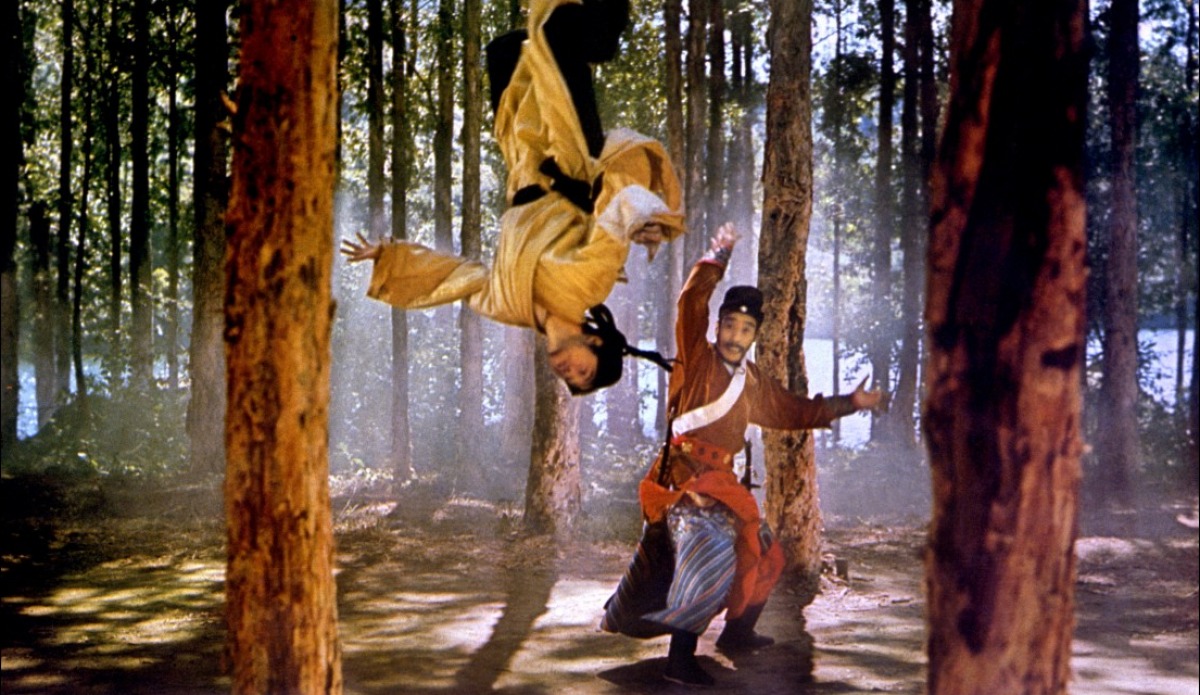
 Watching King Hu’s 1969 wuxia classic, A Touch of Zen, brings us back to the days of couching out with Kung Fu Theater on rainy Saturday afternoons. The highly influential three-hour epic features an impossible-to-figure-out plot, a goofy romance, wicked-cool weaponry, an awesome Buddhist monk, a bloody massacre, and action scenes that clearly involve the overuse of trampolines. Still, it’s great fun, even if it is way too long. (The film, which was initially shown in two parts, earned a special technical prize at the 1975 Cannes Film Festival.) Shih Jun stars as Ku Shen Chai, a local calligrapher and scholar who is extremely curious when the mysterious Ouyang Nin (Tin Peng) suddenly show up in town. It turns out that Ouyang is after Miss Yang (Hsu Feng) to exact “justice” for the corrupt Eunuch Wei, who is out to kill her entire family. Hu (Come Drink with Me, Dragon Gate Inn) fills the film with long, poetic establishing shots of fields and the fort, using herky-jerky camera movements (that might or might not have been done on purpose) and throwing in an ultra-trippy psychedelic mountain scene that is about as 1960s as it gets. A Touch of Zen is ostensibly about Ku’s journey toward enlightenment, but it’s also about so much more, although we’re not completely sure what that is. The film is screening May 15 and May 19 as part of the Film Society of Lincoln Center’s “Taiwan Stories: Classic and Contemporary Film from Taiwan” series, which continues through May 19 with such classic works as Pai Ching-jui’s Home Sweet Home (1970), Li Xing and Li Jia’s Oyster Girl (1964), and Tsai Ming-liang’s Rebels of the Neon God (1992) as well as such more modern films as Doze Niu’s Monga (2008), Chen Wen-tang’s Tears (2009), and Chen Yu-Hsun, Hou Chi-jan, and Shen Ko-Shang’s Juliets (2010).
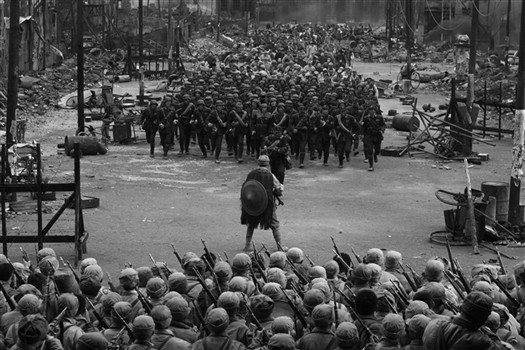
 In December 1937, Japanese military forces invaded Nanking (now called Nanjing), occupying the Chinese capital for six weeks of unspeakable atrocities, resulting in hundreds of thousands of murders and tens of thousands of rapes. Based on survivor accounts on both sides of what became known as the Rape of Nanking (and the Nanking Massacre) in addition to postcards and journals from a group of international workers who furiously attempted to maintain a refugee Safety Zone, Lu Chuan’s City of Life and Death is a brutal, harrowing depiction of this controversial period, the exact details of which are still debated in Japan and China. Writer-director Lu (The Missing Gun, Kekexili: Mountain Patrol) holds nothing back as he tells the story through the eyes of several main characters: Miss Jiang (Gao Yuanyuan), the leader of the refugees who is desperately trying to protect the women and children; Mr. Tang (Fan Wei), a Chinese collaborator who believes he can negotiate with the Japanese army, headed by commander Ida (Ryu Kohata); Xiaodouzi (Bin Liu), a young child who silently watches the horror surrounding him; and Kadokawa (Hideo Nakaizumi), seemingly the only Japanese soldier with a conscience. Evoking such war films as Steven Spielberg’s Saving Private Ryan and Schindler’s List and Stanley Kubrick’s Full Metal Jacket, City of Life and Death is an unsparing look at holocaust and genocide that walks the fine line between propaganda and cinema verité docudrama; Lu and cinematographer Cao Yu increase the feeling of reality by using handheld cameras and shooting the film in a stark black and white. Filmed over the course of 253 days and featuring some thirty thousand extras, City of Life and Death is a massive undertaking that unfolds on-screen in a series of unforgettable images and vignettes that will stay with viewers a long time, capturing a truly horrifying wartime tragedy that is not nearly as well known in the West as it should be.