Apichatpong Weerasethakul installation at New Museum is an enlightening experience
New Museum of Contemporary Art
235 Bowery at Prince St.
Wednesday – Sunday through July 3, $12 (Thursdays free 7:00 – 9:00)
212-219-1222
www.newmuseum.org
www.animateprojects.org
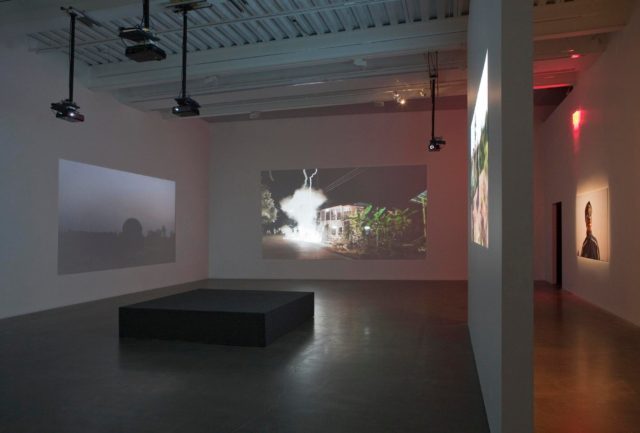
Light and memory are the driving forces behind Thai visual artist and filmmaker Apichatpong Weerasethakul’s exhilarating “Primitive” installation, on view at the New Museum through July 3. Over his nearly decade-long career, Weerasethakul has made beautiful, slow-paced, bittersweet films that combine dreamlike imagery with nature and deep personal introspection. In such works as Blissfully Yours (2002), Tropical Malady (2004), Syndromes and a Century (2006), and his latest, the subtly elegant Palme d’Or winner Uncle Boonmee Who Can Recall His Past Lives (2010), Weerasethakul creates involving, atmospheric tales that often include elements of magical realism while blurring the lines between past, present, and future. “Apichatpong Weerasethakul: Primitive” takes a similar course through a collection of nine interrelated short films set in the rural farming village of Nabua, the site of political and social upheaval and military intervention during the 1960s and ’70s. The hypnotic works, some screened in their own room, others shown en masse in a central area, meld fact and fiction, fantasy and reality. In Making of the Spaceship, members of the community build a time-travel clubhouse; in A Dedicated Machine, the resulting spaceship continuously rises in the distant horizon.
Apichatpong Weerasethakul explores reincarnation and transformation in multimedia installation
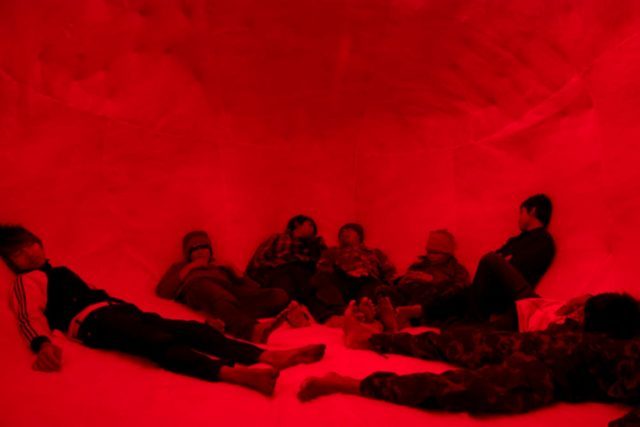
In I’m Still Breathing, teens run down a street and jump on a moving truck as a power-pop song by Modern Dog blasts away; in Phantoms of Nabua, a group of kids play around at night with a fireball, kicking it around until it reveals a projector behind a cloth screen. In An Evening Shoot, teens with a rifle pretend to shoot a friend walking through a grassy rice field, while in Nabua Song, a man pays tribute to Nabua’s military heroes. In the two-channel Primitive, a man relates a La Jetée–like story involving a legendary widow ghost, bathed in deep blacks and blurry reds. The slow, calm pace of the films are all interrupted by the crashing images and sounds of Nabua, as bolts of lightning rattle down from the sky, lighting up the village. According to Weerasethakul, “‘Primitive’ is about reincarnation and transformation. It’s a celebration of destructive force in nature and in us that burns in order to be reborn and mutate.” Take your time as you make your way around “Apichatpong Weerasethakul: Primitive,” an inventive, enlightening installation that offers myriad rewards, sometimes in the minutest of details, from one of the world’s most creative and innovative filmmakers. (Also on view at the New Museum is “Gustav Metzger: Historic Photographs,” David Medalla’s “Cloud Canyon no. 14,” and “Museum as Hub: The Incongruous Image Marcel Broodthaers and Liliana Porter.”)
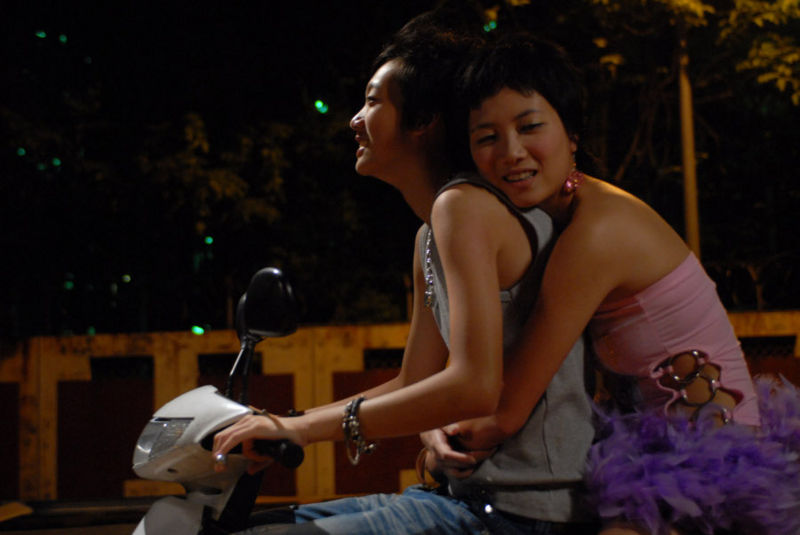
 “Breaking the Waves: The Films of Zero Chou” continues June 23 at 6:30 with a screening of Zero Chou’s 2008 lesbian melodrama, Drifting Flowers. Written at the same time she wrote her previous film, 2004’s Splendid Float, which was set in the world of drag queens, Drifting Flowers consists of three interrelated tales of romance and intimate relationships. The first section is told from the point of view of eight-year-old May (Pai Chih-Ying), who lives with her older sister, Jing (Serena Fang), a blind nightclub singer. Social services thinks May would be better off with a real family instead of doing her homework and falling asleep every night at the club, but things get even more complicated when both May and Jing come to rely on Jing’s new accordion player, the very butch Diego (Chao Yi-Lan), in very different ways. The second segment follows the elderly Lily (Lu Yi-Ching), who is wasting away at a senior citizens’ home until her husband, Yen (Sam Wang), suddenly shows up and instantly fills Lily with fond memories — although she mistakes him for the woman she loved, Ocean; it turns out that the “marriage” was a fraud just to fool their parents so Lily and Yen could actually live with their same-sex lovers. But as Lily feels a new vibrancy in her life, Yen is suffering terribly with HIV. The final part goes back to Diego’s teen years, when she worked in her family’s puppet theater and developed her first real crush on young burlesque singer Lily (Herb Hsu), linking the three stories. Drifting Flowers is bogged down by cliché after cliché, constantly telegraphing exactly where it’s going. Chou, the only openly lesbian Taiwanese filmmaker, regularly takes the easy, obvious route, not being fair to her characters, who deserve better. Although individual vignettes offer the promise of a more challenging narrative, the story inevitably returns to the lowest common denominator in dealing with gender identity, which is a shame, because Chou had so much more to work with. Continuing her goal of making six lesbian films, each one representing another color of the gay rainbow pride flag — Spider Lilies was green, Splendid Float yellow — Drifting Flowers is red. The series concludes June 30 with Chou’s 2001 film, Corners.
 Based on a true story that writer-director Hirokazu Kore-eda (Maborosi, After Life) read about back in 1988, Nobody Knows is a heartwarming, heartbreaking film about four extraordinary half-siblings who must fend for themselves every time their mother takes off for extended periods of time. Japanese TV and pop star YOU makes her feature-film debut as Keiko, a young woman who has four kids by way of four different men. When she’s home, she shows affection for the children, but the problem is, she’s rarely home. Instead, twelve-year-old Akira (Yagira Yuya) must take care of the shy Kyoko (Kitaura Ayu), who handles the laundry; the troublemaker Shigeru (Kimura Hiei), who can’t follow the rules; and sweet baby Yuki (Shimizu Momoko), who likes chocolates and squeaky shoes. At first, it is charming and uplifting watching how Akira handles the complicated situation — the other kids are not allowed outside because the landlord will evict them if he finds out about them, and Akira even helps teach the family, who do not attend school — but as Keiko disappears for longer periods of time, the children’s lives grow more dire by the day as food and money start running out. Kore-eda, who also edited and produced this powerful picture, has created a moving, involving film that nearly plays like a documentary, avoiding melodramatic clichés and instead wrapping the audience up in the closeted life of four terrific kids whose tragic existence will ultimately break your heart. Nobody Knows is screening at MoMA on June 23 and 24 as part of the series “In Focus: IFC Films,” which concludes with a sneak peek of Errol Morris’s Tabloid (2010) on June 24 at 8:00.
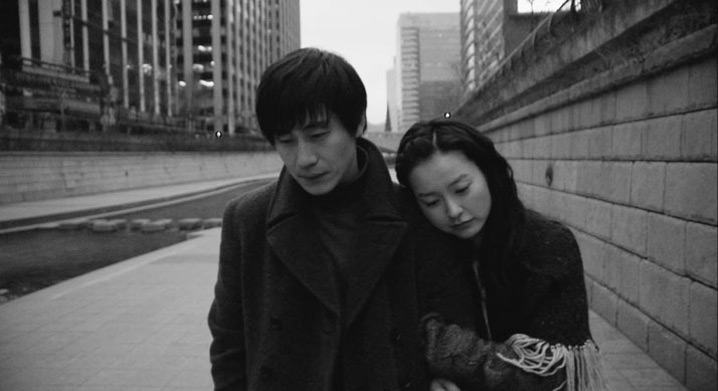
 Longtime Korean film critic Jung Sung-il makes a sparkling debut as writer-director with the masterful Café Noir. Inspired by Goethe’s The Sorrows of Young Werther and Dostoevsky’s White Nights, Jung has created a visually stunning three-hour epic of unrequited and lost love. Shin Ha-gyun stars as Young-soo, a teacher who falls in love with the married Mee-yeon (Moon Jeong-hee), the mother of one of his students. But when Mee-yeon’s husband returns after an extended business leave, she wants to end the affair, but Young-soo has different, far more devious plans. In the second half of the film, Young-soo protects a stranger, Sun-hwa (Jung Yu-mi), from a stalker and becomes obsessed with her story of waiting by the river for a man who had stayed at her grandmother’s hotel where she works. Meanwhile, another woman named Mee-yeon (Kim Hye-na), who delivers relationship-ending packages, enters Young-soo’s life as well, taking him for a liberating ride on her motorcycle. Jung and cinematographer Kim Jun-young go from color to black and white in Café Noir, creating deeply atmospheric scenes interspersed with long, extended shots of numerous locations in Seoul, from Namsan and Sung-Buk-Dong to Cheonggye Stream and Han River. Jung fills the poetic film with direct and indirect nods to such Korean directors as Park Chan-wook, Bong Joon-ho, Hong Sang-soo, and Kim Ki-duk as he tells his offbeat, unusual tale. “I, along with my camera, my crew and cast, wandered around in Seoul,” Jung explains in his director’s note. “The movie’s ‘dead time’ is the real time of Korea, the time in which our despair dwells. Goethe, Frankfurt 1774. Dostoevsky, St. Petersburg 1848. Seoul, 2009. Dead times. No more deaths.” As dark as that sounds, Café Noir is an exhilarating cinematic experience. Café Noir is screening June 21 at 7:00, concluding the latest, and free, Korean Movie Night series at Tribeca Cinemas, “The Hidden Gems of Indie Cinema,” focusing on smaller, independent films from South Korea.