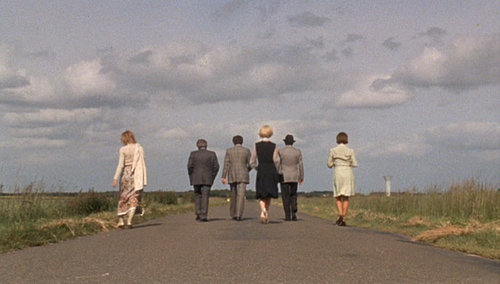
A group of restless bourgeoisie is in search of a dinner party in Bunuel classic
THE DISCREET CHARM OF THE BOURGEOISIE (Luis Buñuel, 1972)
MoMA Film
Museum of Modern Art
11 West 53rd St. between Fifth & Sixth Aves.
Canceled: Sunday, August 28, 5:00
Series concludes August 29-30
Tickets: $10, in person only, may be applied to museum admission within thirty days, same-day screenings free with museum admission, available at Film and Media Desk
212-708-9400
www.moma.org
(MoMA has just announced, late Friday afternoon, that all Saturday and Sunday screenings have been canceled and both MoMA and PS1 will be closed on those days.)
 Winner of the 1972 Oscar for Best Foreign Language Film, Luis Buñuel’s The Discreet Charm of the Bourgeoisie is a sharp, cynical skewering of the European power structure, taking on the high-falutin’ hypocrisy of the government, the military, religion, and, primarily, the wealthy class in hysterical vignettes that center around a group of rich friends trying to sit down and enjoy a meal. But every time they get close, they are ultimately thwarted by miscommunication, a corpse, army maneuvers, terrorists, and, perhaps most bizarrely, fake stage chicken. Buñuel regular Fernando Rey is a hoot as Rafael Acosta, the cocaine-dealing ambassador of Miranda who doesn’t take insults well. Stéphane Audran and Jean-Pierre Cassel play the Sénéchals, a lustful couple desperate to finish a romantic rendezvous even as their guests wait, Julien Bertheau is the local bishop who moonlights as a gardener, Claude Piéplu is an erudite colonel not afraid to share his opinion at a haughty cocktail party, and Maria Gabriella Maione is a sexy stranger who might or might not be a revolutionary after Acosta. Meanwhile, Acosta doesn’t mind making a play for Simone Thévenot (Delphine Seyrig) right under her husband’s (Paul Frankeur) nose. And Ines (Milena Vukotic), one of the Sénéchals’ maids, watches it all with a wonderfully subtle disdain. As if the first half of the film were not surreal enough, the second half includes a series of riotous dream sequences involving ghostly apparitions and a bit of the old ultra-violence, either outwardly related by characters or as cinematic surprises dished out by the masterful Buñuel.
None too discreet about its myriad charms, The Discreet Charm of the Bourgeoisie was supposed to screen August 28 as part of the MoMA series “Carte Blanche: Dieter Kosslick, the Culinary Cineaste,” consisting of movies selected by Slow Foodie and Berlinale director Dieter Kosslick, but MoMA just announced that it will be closed on Saturday and Sunday because of the hurricane; the series concludes August 29 & 30 with such tasty treats as Michelangelo Frammartino’s Le Quattro Volte and D. A. Pennebaker’s Kings of Pastry, among other cinematic culinary delights, some of which are accompanied by special menu selections at the Modern created by Kosslick and executive chef Gabriel Kreuther. No dishes were paired with Buñuel’s film because, well, the characters never really get to eat anything, so it wouldn’t be fair, now, would it?
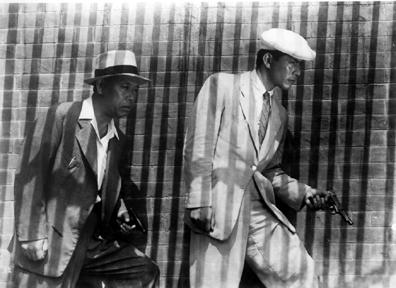
 Akira Kurosawa’s thrilling police procedural, Stray Dog, is one of the all-time-great film noirs. When newbie detective Murakami (Toshirō Mifune) gets his Colt lifted on a bus, he thinks he will be fired if he does not get it back. But as he searches for it, he discovers that it is being used in a series of robberies and murders that he feels responsible for. Teamed with seasoned veteran Sato (Takashi Shimura), Murakami risks his career — and his life — as he tries desperately to track down his gun before it is used again. Kurosawa makes audiences sweat as postwar Japan is in the midst of a heat wave, with Murakami, Sato, prostitute Harumi Namiki (Keiko Awaji), and others constantly mopping their brows, dripping wet. Inspired by the novels of Georges Simenon, Stray Dog is a dark, intense drama shot in creepy black and white by Asakazu Nakai and featuring a jazzy soundtrack by Fumio Hayasaka that unfortunately grows melodramatic in a few key moments — and oh, if only that final scene had been left on the cutting-room floor. Stray Dog will be screening on August 27 at Symphony Space as part of the “Kurosawa” series, consisting of special presentations of the master’s films shown on the big screen in HD for the first time ever; the series concludes August 28 with Rashomon.