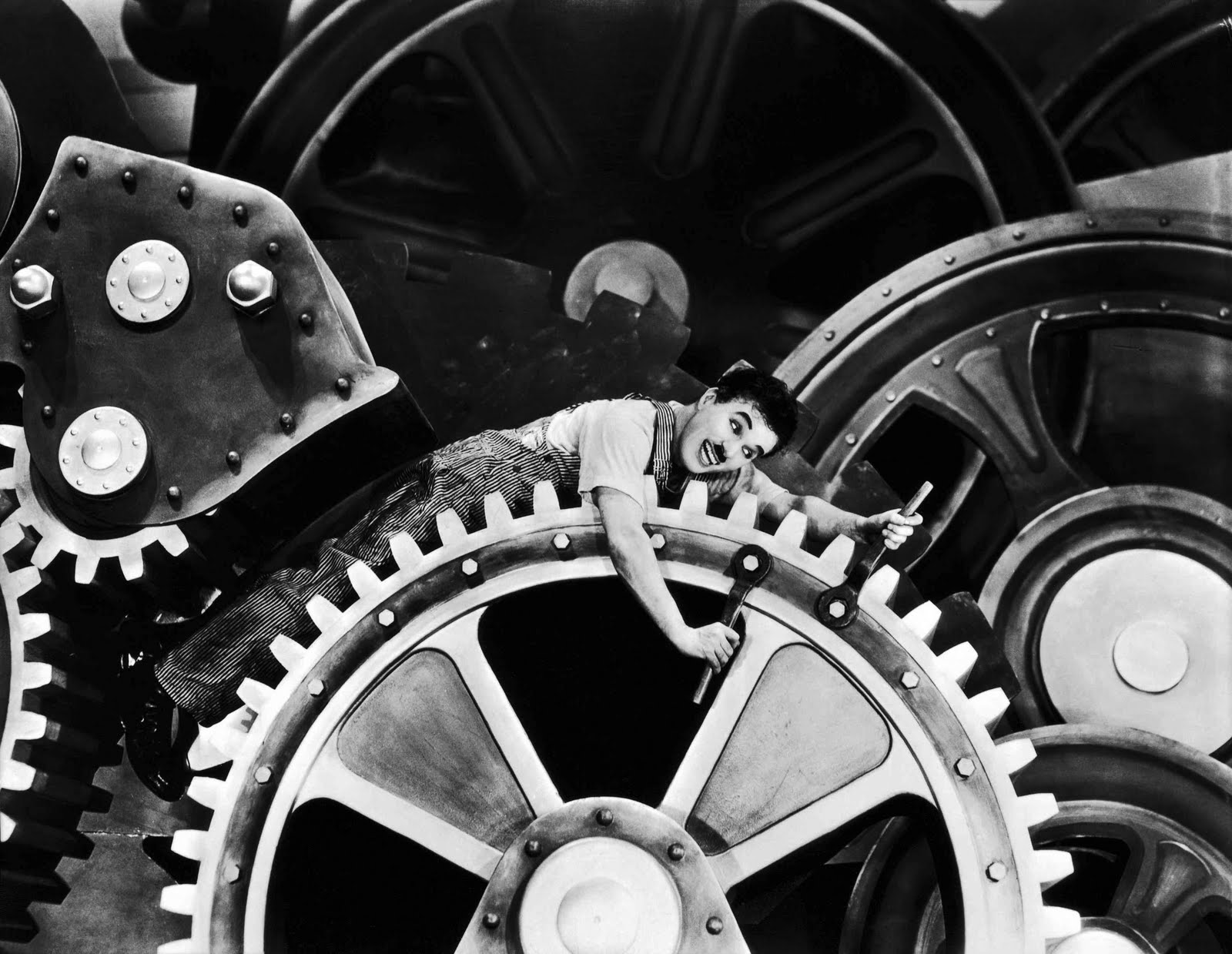
Charlie Chaplin gets caught up in the cogs of machinery in MODERN TIMES
MODERN TIMES (Charlie Chaplin, 1936)
Symphony Space Leonard Nimoy Thalia
2537 Broadway at 95th St.
Saturday, August 13, 2:15; Sunday, August 21, 8:45
Series continues through August 28
212-864-5400
www.symphonyspace.org
 As America slowly recovered from the Great Depression and headed toward the Second World War, Charlie Chaplin also found himself trapped between the past and the future. Talkies had started in 1927 with Al Jolson in The Jazz Singer, but the British-born actor, writer, director, producer, and composer had not crossed over yet, still favoring the silent cinema that had made him an international star. But his 1936 masterpiece, Modern Times, tackled the coming of the modern era in myriad ways, both public and personal, in the world at large as well as in cinema itself. Chaplin stars as an assembly line worker who literally gets caught up in the cogs of machinery, suffers a nervous breakdown, gets sent to prison for leading a Communist march he was not a part of, accidentally dabbles in a little nose candy, and falls in love with a homeless gamin who lives by her wits on the docks, played by his real-life lover, Paulette Goddard. He tries to fit in to the ever-changing society, without much luck; he even has trouble getting himself arrested again, thinking that jail is a better option than what’s out there. The unemployed former factory worker and the gamin move into a run-down shack and try to pretend that they are a happy, successful married couple, but the harsh reality of their poor existence continually thwarts them. Modern Times is a brutally funny, honest, and insightful examination of the socioeconomic conditions of America in the 1930s. As corporations began to grow, workers became nameless automatons; in fact, neither of the film’s protagonists is given a name. For the first time, Chaplin uses sound, but always in ingenious ways: the factory owner, who watches his workers like a hawk, using surveillance cameras that are remarkably prescient, talks only via a screen as he yells at his employees; music, which Chaplin previously utilized only on the backing soundtrack, now comes from bands seen on camera, as if they’re playing live; and the Little Tramp himself gets into the act as a singing waiter, although it’s not exactly like Garbo breaking her on-screen silence. Chaplin’s choice to include some sound while still avoiding even a single strand of actual dialogue between characters is a brash commentary on the technological revolution that was taking hold of the country and, of course, impacting the film industry. Chaplin’s previous movie, the 1931 classic City Lights, was a more traditional silent film, but with his next work, 1940’s The Great Dictator, he finally made the transition to a full talkie, albeit still finding himself trapped between two worlds, playing both a poor ghetto barber and the Fascist Hitler-like leader of Tomania. Modern Times is screening August 13 and 21 as part of Symphony Space’s “Chaplin” series, which is presenting many of his works on the big screen in HD for the first time ever, which is rather ironic, especially in the case of Modern Times; the series continues with such films as Monsieur Verdoux on August 14, The Great Dictator and City Lights on August 21, The Circus on August 27, and Limelight offering a fitting conclusion on August 28.