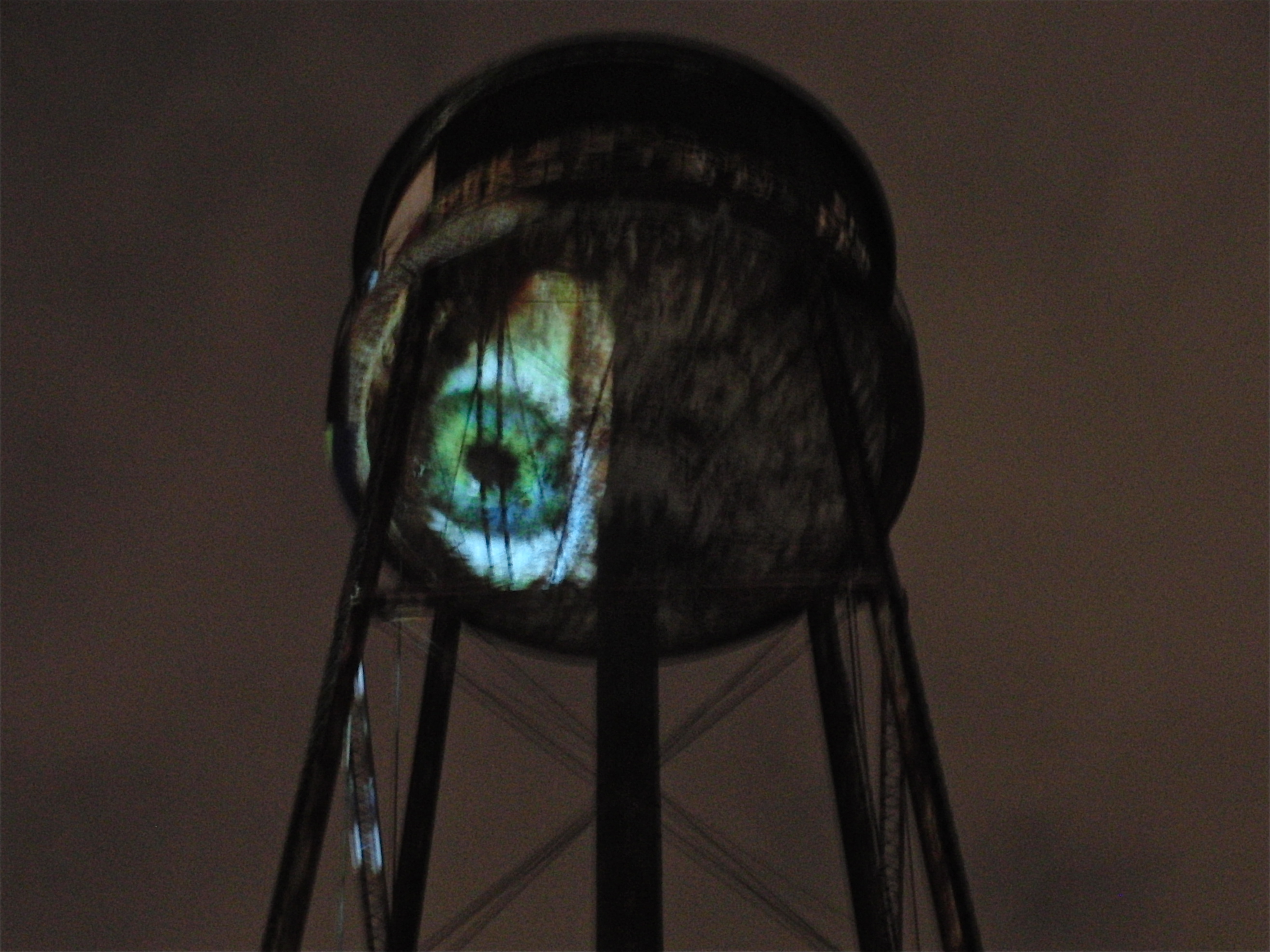
Marcos Zotes’s “CCTV/Creative Control” will look down on “Nuit Blanche” visitors from the Milton St. water tower (photo by twi-ny/mdr)
Multiple locations throughout Greenpoint, Brooklyn
Saturday, October 1, free, 6:00 pm – 12 midnight
www.bringtolightnyc.org
Greenpoint will shine bright tonight for “Bring to Light: Nuit Blanche New York,” the second annual multimedia festival featuring site-specific projections and performance art in the gentrifying neighborhood. Begun ten years ago in Paris and now held in numerous cities around the world, “Nuit Blanche” celebrates the community in which it takes place; in the case of Greenpoint, an industrial zone that has seen an influx of artists (and hip bars, restaurants, and music clubs) over the last few years, “Nuit Blanche” seeks to build interest in expanding and opening up more of the waterfront to public use. In fact, executive director Ethan Vogt and director of operations Tom Peyton got the city to allow access, just for one night, to several areas that are usually closed to the public. “Bring to Light” consists of more than fifty installations scattered throughout Greenpoint, from a trio of Richard Serra videos from the 1960s and ’70s to Krzysztof Wodiczko’s “Veterans Flame Greenpoint” (footage of a flame flickering to Afghan war stories told by Polish and English-language veterans), from Jeremy Blake’s Winchester Trilogy to Raphaele Shirley’s light-and-water-based “Light Cloud on a Bender,” from Sean Boggs’s slide sequence “Passerby” to Jeff Desom’s panoramic restaging of Alfred Hitchcock’s Rear Window. Among the interactive performances are Rita Ackermann’s “A Backwards Walking Flash Mob,” in which one hundred participants will be filmed walking backward; Daniel Canogar’s “Asalto,” in which people are filmed crawling across a green screen, the results of which will be projected onto a tall building across the street, as if dozens of men, women, and children are climbing up the facade toward the heavens; and Ellis & Cuius’s “The Company,” in which visitors can walk under and around an arch of dangling Tungsten lightbulbs that react to sound and movement (and will host live performances in the space). If you take the East River Ferry from Thirty-fourth St., you’ll be greeted by Diller Scofidio + Renfro’s “Soft Sell,” a video of a large lipsticked mouth welcoming visitors to Greenpoint (and which was originally created for Times Square in 1993, just as it was about to undergo massive changes itself), and can later find Alex Villar’s “Splitting Image” in the park, about a commute on the ferry. And keep an eye out for Marcos Zotes’s “CCTV/Creative Control,” a projection of an enormous watching eye under the Milton St. water tower. There’s art just about everywhere you look, so grab a program, follow the map (or just walk around aimlessly), and enjoy what should be a fascinating and fun — and free — evening of unique and unusual art and architecture.

 “It’s the best job in the world, no comparison,” Jonathan Dearman says in American Teacher, Vanessa Roth’s eye-opening documentary about the sorry treatment of teachers in the United States today. Based on the book Teachers Have It Easy: The Big Sacrifices and Small Salaries of America’s Teachers (New Press, 2005) by Dave Eggers, Daniel Moulthrop, and Nínive Clements Calegari, the eighty-one-minute film looks at the surprising lack of status, salary, respect, and training afforded what is considered in other countries the most important profession by examining the cases of four current or former American teachers, dedicated men and women who are born educators but who have been deeply affected by a seriously flawed system. Texas history professor and sports coach Erik Benner sees his marriage fall apart as he works two jobs to help support his wife and two daughters. Brooklynite Jamie Fidler is following in her father’s footsteps as a teacher, but her pregnancy complicates her future in part by revealing the relatively poor health benefits. Maplewood’s Rhena Jasey is a Harvard grad with two masters degrees from Columbia who is considering leaving the kids she loves so much for a Washington Heights charter school that pays a far more substantial salary. And Dearman, a beloved San Francisco educator, turns to the family real estate business when teaching just can’t pay the bills. Part of the nonprofit Teacher Salary Project, American Teacher is at its best when it shows the teachers in the classroom and talking about what they love about their job, but when it focuses on the many negatives, it feels too much like a telethon, as if a crawl should be running across the bottom of the screen soliciting donations. The film includes numerous statistics involving turnover rates, the declining number of men in the industry, and, of course, various financial figures, dryly narrated by Matt Damon. In addition to following around the four protagonists, Roth speaks with students and their parents, superintendents, principals, professors, and other industry professionals who want to see the system changed. Interestingly, one word that never comes up is “union,” which is often at the center of any discussion about the state of education in America. Although it can pull too much at the heartstrings while stating the obvious, American Teacher is an important documentary that makes a strong case for the United States to fix this growing problem, and fast.
 Danish writer-director Lars von Trier has nothing less than the end of the world on his mind in his latest controversial drama, Melancholia. Von Trier’s latest love-it-or-hate-it cinematic foray opens with epic Kubrickian grandeur, introducing characters in marvelously composed slow-motion and still shots (courtesy of cinematographer Manuel Alberto Claro) as an apocalyptic collision threatens the earth and a Wagner overture dominates the soundtrack. Kirsten Dunst won the Best Actress award at Cannes for her portrayal of Justine, a seemingly carefree young woman celebrating her wedding day who soon turns out to be battling a debilitating mental illness. Her husband, Michael (Alexander Skarsgård), is madly in love with her and does not know quite what he has gotten himself into, especially as the partying continues and Justine’s motley crew of family and friends get caught up in various forms of intrigue, including Gaby, her marriage-hating mother (Charlotte Rampling), Dexter, her never serious father (John Hurt), Jack, her pompous boss (Stellan Skarsgård), Claire, her married sister (Charlotte Gainsbourg), and Claire’s filthy rich husband, John (Kiefer Sutherland), who is hosting the event at his massive waterfront estate. While most of the film focuses on the wildly unpredictable Justine, the latter section turns its attention on Claire, who is terrified that a newly discovered planet named Melancholia is on its way to destroy the world. But Melancholia is not just about sadness, depression, family dysfunction, and the end of the world. It’s about the search for real love and truth, things that are disappearing from the earth by the minute. Justine works as an advertising copywriter, attaching tag lines to photographs to help sell product; at the wedding, Jack is determined to get one more great line of copy from her, even siccing his young, inexperienced nephew, Tim (Brady Corbet), on her to make sure she delivers. But what she ends up delivering is not what either man expected. Perhaps the only character who really sees what is going on is a wedding planner played by the great Udo Kier, who continually, and comically, shields his eyes from Justine, unable to watch the impending disaster. Just as in the film, as some characters get out their telescopes to watch the approaching planet and others refuse to look, there are sure to be many in the moviegoing public who will shield their eyes from Melancholia, choosing not to view yet another controversial film from a director who likes to antagonize his audience. They don’t know what they’re missing.
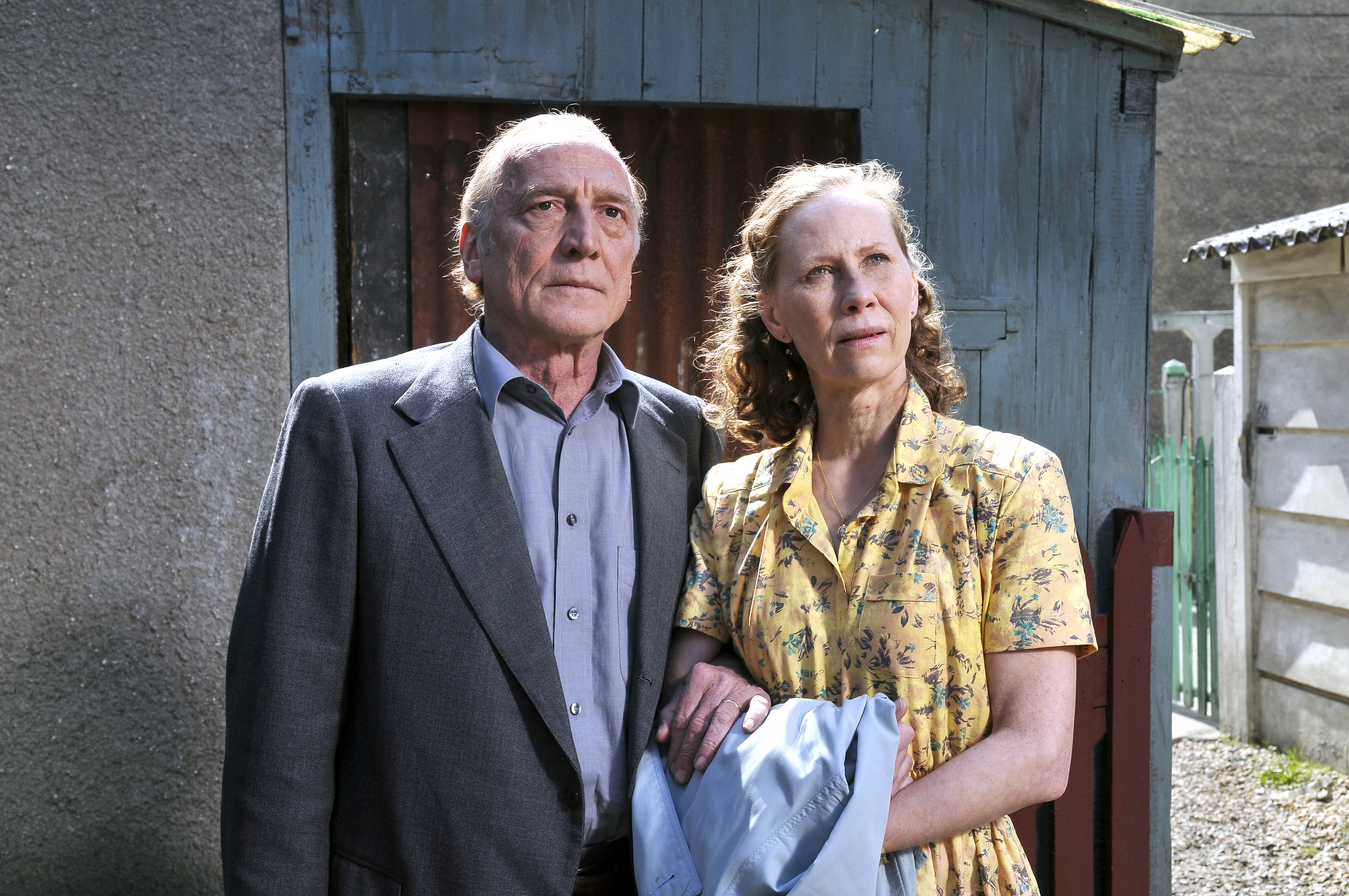
 For nearly thirty years, Finnish auteur Aki Kaurismäki (Leningrad Cowboys Go America, The Man Without a Past) has been making existential deadpan black comedies that are often as funny as they are dark and depressing. Has there ever been a film as bleak as 1990’s The Match Factory Girl, in which a young woman (Kati Outinen) suffers malady after malady, tragedy after tragedy, embarrassment after embarrassment, her expression never changing? In his latest film, the thoroughly engaging Le Havre, Kaurismäki moves the setting to a small port town in France, where shoeshine man Marcel Marx (André Wilms), a self-described former Bohemian, worries about his seriously ill wife (Outinen) while trying to help a young African boy (Blondin Miguel), who was smuggled into the country illegally on board a container ship, steer clear of the police, especially intrepid detective Monet (Jean-Pierre Darroussin), who never says no to a snifter of Calvados. Adding elements of French gangster and WWII Resistance films with Godardian undercurrents — he even casts Jean-Pierre Léaud in a small but pivotal role — Kaurismäki wryly examines how individuals as well as governments deal with illegal immigrants, something that has taken on more importance than ever amid the growing international economic crisis and fears of terrorism. Through it all, Marcel remains steadfast and stalwart, quietly and humbly going about his business, deadpan every step of the way. Wouter Zoon’s set design runs the gamut from stark grays to bursts of color, while longtime Kaurismäki cinematographer Timo Salminen shoots scene after scene with a beautiful simplicity. Winner of a Fipresci critics award at Cannes this year and Finland’s official entry for the Best Foreign Language Film Oscar, Le Havre is another marvelously unusual, charmingly offbeat tale from a master of the form. After screening at the New York Film Festival on October 2, 3, and 5, Le Havre will open theatrically October 21 at the IFC Center, which will also be hosting a Kaurismäki festival on weekends from October 7 through December 18, showing nine of the director’s works, beginning with the Proletariat Trilogy of Shadows in Paradise (October 7-10), Ariel (October 14-16), and The Match Factory Girl (October 28-30). Keep watching twi-ny for more information and select reviews in the coming weeks.