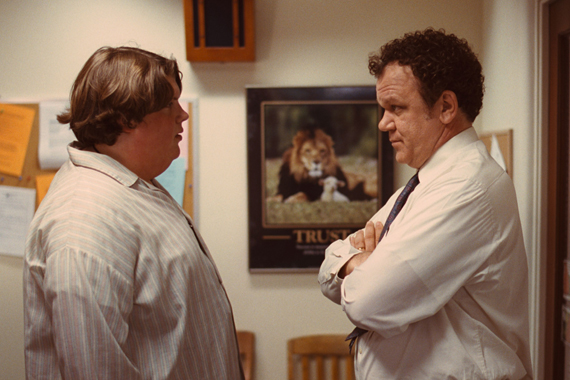
Jacob Wysocki and John C. Reilly star in Azazel Jacobs’s poignant, offbeat look at the tumultuous teen years
TERRI (Azazel Jacobs, 2011)
Museum of the Moving Image
35th Ave. at 36th St., Astoria
Thursday, October 13, $10, 7:00
718-777-6800
www.movingimage.us
www.terri-movie.com
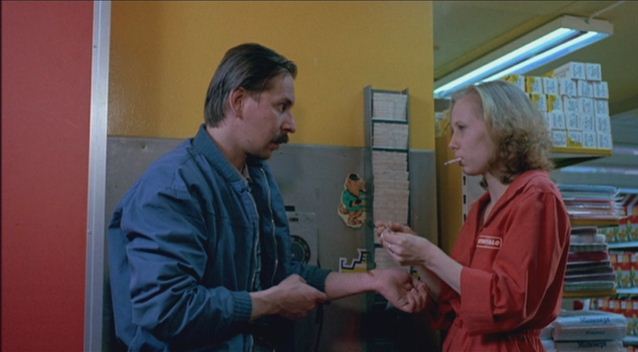
 Azazel Jacobs follows up the widely praised Momma’s Man, in which he cast his real-life parents (experimental filmmaker Ken Jacobs and painter Flo Jacobs) in a story about a married adult and new father (Matt Boren) who keeps extending a visi t to his ancestral home, with another idiosyncratic tale about growing up. Terri, adapted by Patrick deWitt from a series of his interrelated short stories, follows the trials and tribulations of the title teen, played with great subtlety by newcomer Jacob Wysocki. Terri is a grossly overweight kid who shows up late to school every morning wearing pajamas; lives with and takes care of his uncle (The Office’s Creed Bratton), who is in the early stages of Alzheimer’s; becomes obsessed with catching mice; and has a secret crush on high school cutie Heather (Olivia Crocicchia). When the vice principal, Mr. Fitzgerald (a wonderfully offbeat John C. Reilly), takes a personal interest in him, Terri is at first confused, but then seems okay with it, until he finds out that he is part of a group of deeply troubled teens that Mr. Fitzgerald meets with regularly, including such loser outcasts as Chad Markson (Bridger Zadina), who likes to pull out his own hair and say very inappropriate things at inopportune moments. They are soon joined by Heather, who was nearly expelled for allowing a boy to touch her during class and is now shunned by the cool clique. The unlikely threesome, along with Mr. Fitzgerald, who appears to mean well but can’t stop putting his foot in his mouth, exemplify the difficult teenage years as they come together, and break apart, over the course of this charming, eclectic film. As with Momma’s Man, Jacobs has faith in his narrative, eschewing grand statements and teen clichés in favor of a poignant and intelligent examination of adolescence that anyone can relate to, whether they were the teased or the teaser back in those tumultuous and torturous high school days. Terri is screening on October 13 at 7:00 as part of the Museum of the Moving Image’s “After Hours (Fall/Winter 2011)” series, which continues October 27 with Joe Maggio’s The Last Rites of Joe May, followed by a Pinewood Dialogue with star Dennis Farina, and November 3 with Larry Cohen’s 1977 film The Private Files of J. Edgar Hoover, with Cohen in person.
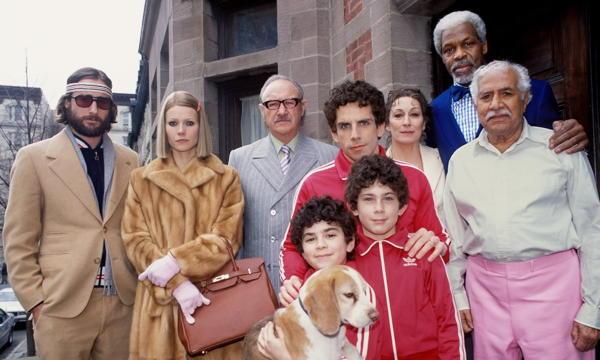
 In his hysterical 2001 black comedy The Royal Tenenbaums, eclectic indie auteur Wes Anderson (The Darjeeling Limited, Fantastic Mr. Fox) created one of the kings of dysfunctional film families. Directly inspired by J. D. Salinger’s Glass clan (Franny and Zooey, Raise High the Roof Beam), the Tenenbaums of New York City have more than their fair share of distress. After being kicked out of the house for being a lousy father and husband, Royal (Gene Hackman) returns, claiming he is dying of stomach cancer. His wife, noted archaeologist Etheline (Anjelica Huston), is now seeing her accountant, the straitlaced Henry Sherman (Danny Glover). Finance wiz Chas (Ben Stiller) is having difficulty getting over his wife’s death in a plane crash, becoming absurdly overprotective of his two young sons’ (Grant Rosenmeyer and Jonah Meyerson) safety. Tennis prodigy Richie (Luke Wilson) is recovering from a very public breakdown and soon has to admit to himself that he is madly in love with his adopted playwright sister, Margot (Gwyneth Paltrow), who is married to strange neurologist Raleigh St. Clair (Bill Murray) and having an affair with longtime family friend and Western novelist Eli Cash (cowriter Owen Wilson). Narrated by Alec Baldwin, The Royal Tenenbaums completed an impressive opening hat trick from Anderson, who had previously made Bottle Rocket (1996) and Rushmore (1998). The marvelously funny flick — which had its premiere at the 2001 New York Film Festival — is having a special tenth-anniversary screening October 13 at the forty-ninth annual New York Film Festival, followed by a discussion with the cast and crew, including Anderson and many of the stars. Additional tickets have just been released, but you better act fast if you want to see this unique event.
 Returning to her small hometown of Hancock in Northern Michigan, documentarian Heather Courtney (Letters from the Other Side) wanted to make a film about the Upper Peninsula area and its residents, and she came up with quite a story. For several years, Courtney followed a group of young men who had enlisted in the National Guard because they either didn’t have enough money for college or didn’t know what else to do with their lives; she then traveled with them as they got called up and sent to fight the war in Afghanistan. Dominic Fredianelli, Cole Smith, and Matt “Bodi” Beaudoin never fully considered what they were getting into when they signed up; they clearly did not join up merely for patriotic reasons, so it doesn’t take long before they start questioning what America is doing over there. The three men, along with their families back home, allowed Courtney remarkable access, holding nothing back as they share their bittersweet emotions, their politics, their fears, and their overwhelming confusion. The men’s National Guard unit is assigned to an IED sweeper team that goes out in heavily protected vehicles, searching for and detonating hidden improvised explosive devices, but even carefully monitored explosions take their toll on the soldiers, not to mention the surprise bombs that nearly blow them to pieces. Courtney, who served as producer, director, cinematographer, and coeditor, does not add any voice-over narration or accumulate facts and statistics; instead, she lets the story tell itself, avoiding propaganda and grand statements. At first it is hard to have much sympathy for Dom, Cole, and Bodi, who should have thought a lot more about their decision to join the National Guard, but as they and their families get more deeply involved in the war, Where Soldiers Come From grows ever-more poignant and frightening.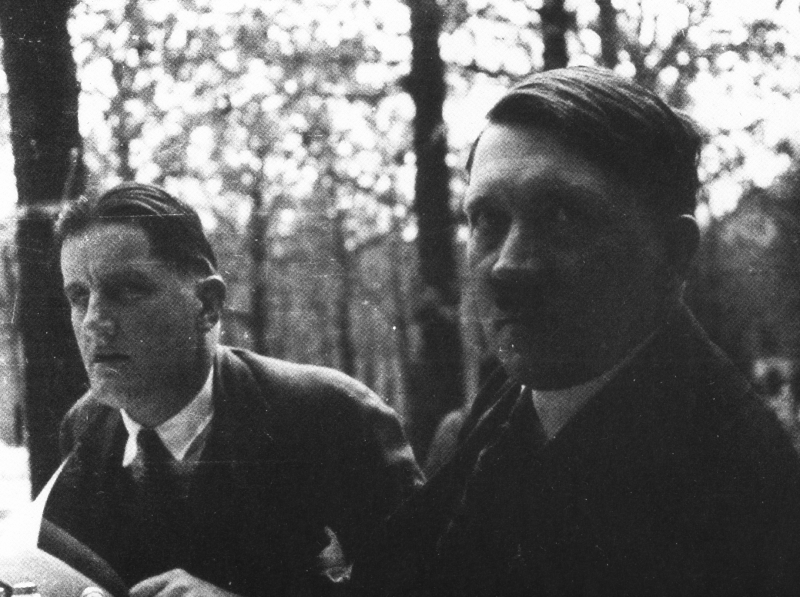
 Earlier this year, MoMA presented “Richard Kaplan: Wayfarer and Truth-Teller,” a one-week look at the films of longtime documentarian Richard Kaplan, featuring such works as 1965’s Oscar-winning The Eleanor Roosevelt Story, 1970’s King: A Filmed Record . . . Montgomery to Memphis, 1989’s The Exiles, and 2003’s Varian and Putzi: A 20th-Century Tale. That last film is back at MoMA for its inaugural one-week theatrical premiere, screening October 8-14. The eighty-minute tale follows the parallel stories of two Harvard graduates who had a little-known but significant impact on WWII but met only once. Born in 1887 to an American mother and a German father, Ernst “Putzi” Hanfstängel returned to Germany after college and soon befriended Adolf Hitler, becoming the foreign press chief of the Nazi party before turning his back on the Third Reich and seeking to redeem himself. Meanwhile, journalist Varian Fry, born in New York City in 1907, was one of the first reporters to uncover plans of the Nazis’ Final Solution and formed the Emergency Rescue Committee, which helped hundreds of people, including many famous artists (Marc Chagall, Hannah Arendt, André Masson, Max Ernst, Jacques Lipchitz), out of occupied France and safely into Spain once America wanted nothing to do with him. Kaplan has fascinating footage of Putzi and talks extensively with Putzi’s son, who speaks with remarkable honesty about his conflicted father. Kaplan also speaks with Fry’s widow as well as historians, biographers, and others who knew the two protagonists. One of the stand-outs is Dina Vierney, a model for artist Aristide Maillol who secretly led men and women through the mountains to freedom for Fry and the ERC; telling her story, she bursts with enthusiasm, remembering intricate and intimate details. However, Varian and Putzi suffers from Kaplan’s insistence on using awkwardly colorful backgrounds, silly interstitials of a man lying on a couch in a psychiatrist’s office (as if Fry is confessing to Sigmund Freud), weak narration, and other elements that make it appear as if someone was having fun with one computer design program or another. Still, it’s an engaging tale, and far more satisfying than Lionel Chetwynd’s melodramatic 2001 cable movie, Varian’s War, in which William Hurt starred as Fry. Varian and Putzi shares a pair of essential Holocaust stories that deserve to be more widely known.