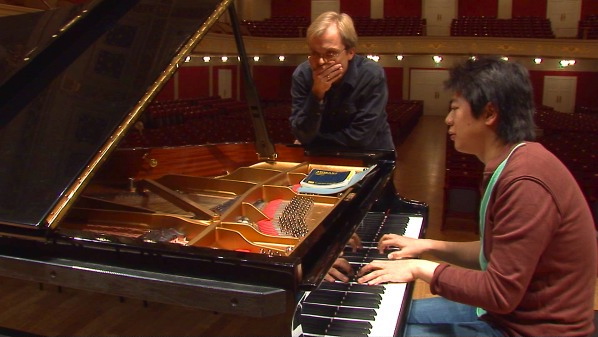
Stefan Knüpfer and Lang Lang carefully consider the intricate sounds of a grand piano in PIANOMANIA
PIANOMANIA (Lilian Franck & Robert Cibis, 2010)
Film Society of Lincoln Center
Elinor Bunin Munroe Film Center
144 West 65th St. between Broadway & Amsterdam Ave.
Opens Friday, November 4
www.firstrunfeatures.com
www.filmlinc.com
 A surprisingly exciting race against time, Lilian Franck and Robert Cibis’s Pianomania offers an inside look at a fascinating aspect of the world of classical keyboardists. The award-winning documentary follows the triumphs and travails of Stefan Knüpfer, the chief technician for Steinway & Sons in Vienna whose primary responsibility is to make sure that the company’s grand pianos are in pristine condition for the great pianists who come to play at the Vienna Concert House. Early in the film, he is running around the dark underbelly of the venue, searching for just the right bench for Lang Lang, displaying his passion and his demand for perfection. The narrative focuses on Knüpfer’s desperate attempts to ensure that piano number 109 (and then 245) is exactly how Pierre-Laurent Aimard wants it as the piano master prepares for a series of Bach recordings. “The tone isn’t breathing,” explains Aimard, who continues to point out minute problems that only he and one of the technicians seem to be able to hear, but Knüpfer is determined to do everything in his power to satisfy Aimard, using whatever means necessary to get the job done. Knüpfer, who goes deep inside 245, the camera intricately following him as he examines nearly every one of the 88 hammers and 230 strings, rarely gets mad at the sometimes diva-like dictates of such pianists as Aimard, Alfred Brendel, and Rudolf Buchbinder, instead seeing each subtle nuance as a challenge, even if it means playfully chastising someone for removing a ball of dust from a piano, since every little detail influences the unique sound of the instrument. He does lighten up significantly when working with Igudesman and Joo, who use grand pianos (and not-so-grand violins) for their comedy act, including playing a very funny joke on them. Although Knüpfer says that he considers his clients “special” instead of “neurotic,” he does admit that he himself is neurotic as he lovingly explores the many secrets and hidden magic that exist within the distinct personalities of each piano he comes into contact with. You don’t have to love classical piano to love Pianomania. The film opens November 4 at Lincoln Center’s Elinor Bunin Munroe Film Center, with codirector Cibis on hand for a Q&A following the 7:15 screening.
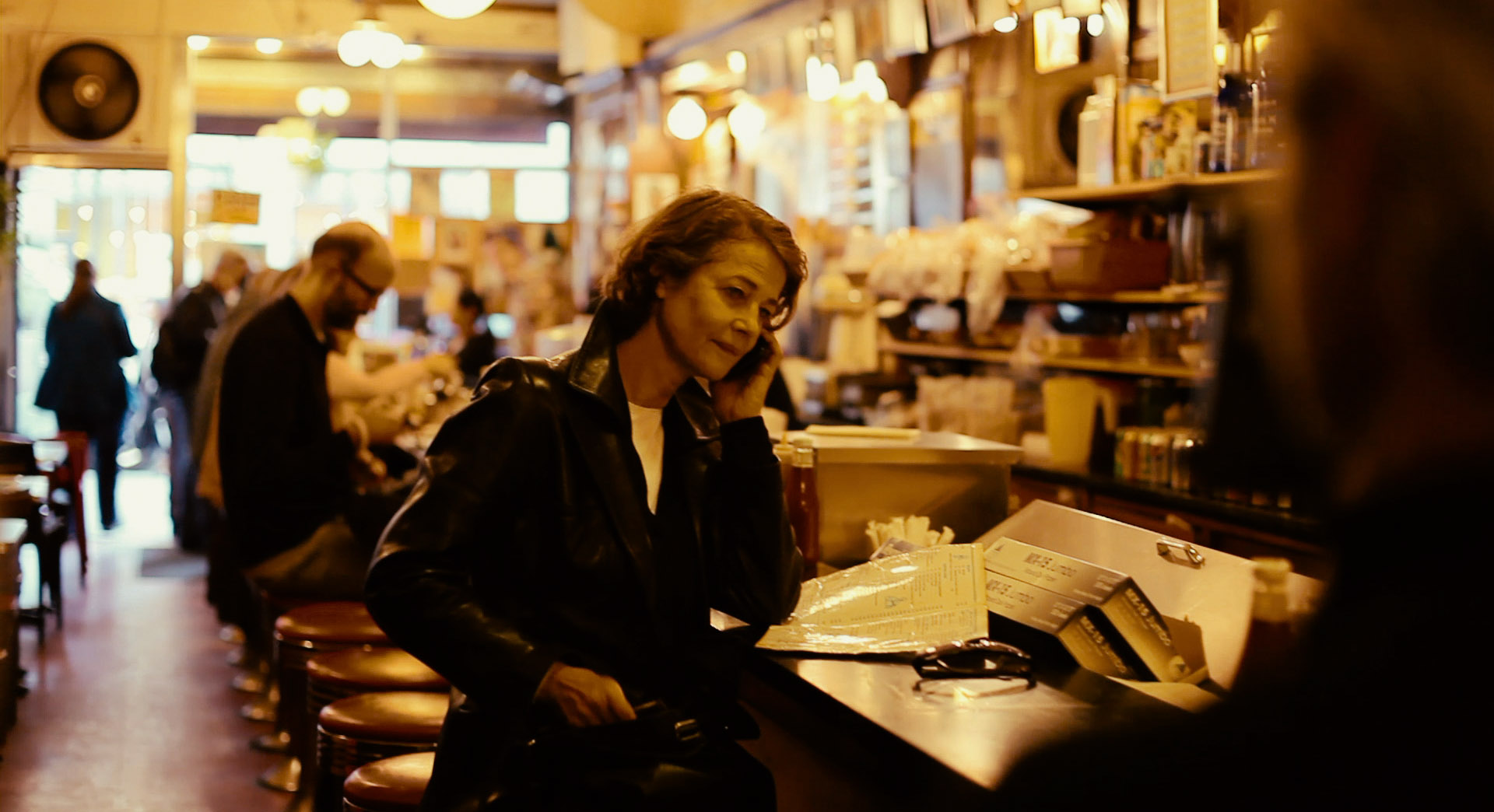
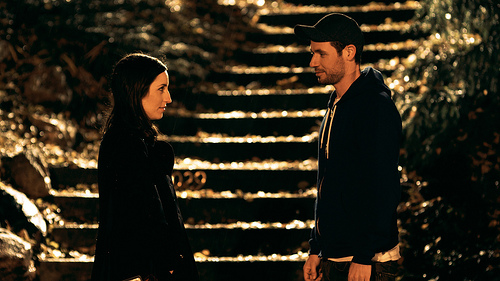
 In many ways, Stuck Between Stations, which screened earlier this year at the Tribeca Film Festival, is the quintessential American festival movie. The low-budget indie feels like a deeply personal work, teetering on the edge of collapsing into overwrought melodrama but always able to get back on track. Cowriter and coproducer Sam Rosen stars as Casper, a young man who returns to his Minneapolis home for his father’s funeral. At a bar he bumps into his childhood crush, Rebecca (Zoe Lister-Jones), a grad student whose life is being turned upside down, as the head of her department just discovered that Zoe has been having an affair with her husband. Casper gets into a fight with Rebecca’s friends, then ends up spending the rest of the very long night with her as they wander through Minneapolis visiting a bizarre circus, breaking into a house, and talking openly and honestly about their lives, revealing only little bits at a time. It takes a while to warm up to the two main characters, but once director and coproducer Brady Kiernan gets things rolling, Stuck Between Stations becomes a compelling, moving ride. To keep the protagonists on-screen the whole way, Kiernan, in his feature-length debut, employs split screens whenever the two are physically separated, a conceit that ends up working. The film also stars Michael Imperioli as Rebecca’s mentor/lover and Josh Hartnett as the leader of a late-night partying bike crew. The title comes from a 2006 song by the then-Minneapolis-based band the Hold Steady in which Craig Finn sings, “Boys and girls in America, they have such a sad time together.” Audiences will end up not having a sad time together watching Stuck Between Stations. The film is having a limited one-week engagement at reRun Gastropub Theater, with the filmmakers and other special guests present for screenings Friday at 7:00 and Saturday at 7:00 and 10:00.

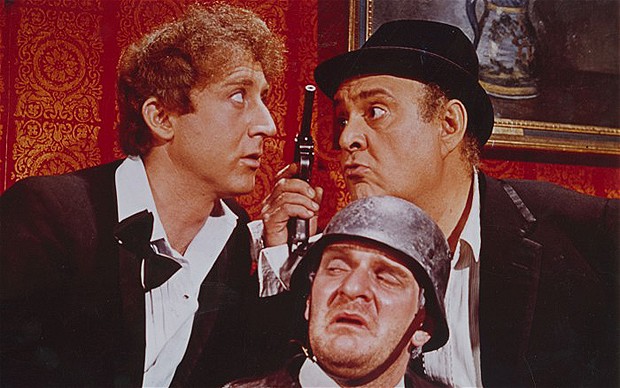
 No way around it; this is one funny movie. Written and directed by Mel Brooks (who won an Oscar for Best Original Screenplay), The Producers stars Zero Mostel as Max Bialystock, a once great Broadway producer now relegated to wooing old ladies for their checkbooks. Gene Wilder earned an Oscar nomination for Best Supporting Actor as Leo Bloom, a by-the-book accountant who figures out that it could be possible to make more money from a bomb than a hit. And the bomb they turn to is the extraordinary Springtime for Hitler, featuring a great turn by Kenneth Mars as a neo-Nazi. Brooks, Mostel, Wilder, Mars, and the rest of the crazy cast — which also includes Dick Shawn, Lee Meredith, Estelle Winwood, Christopher Hewett, Renee Taylor, Barney Martin, Bill Macy, and William Hickey — don’t just play it for laughs but for giant guffaws and jaw-dropping disbelief in this riotous romp that was turned into a very good but overrated Broadway musical and a terrible film version of the show, both starring Nathan Lane and Matthew Broderick, neither of whom can fill Mostel and Wilder’s shoes. The Producers is screening November 3 at 8:30 and on November 7 at 1:45 as part of the Film Society of Lincoln Center’s “Hollywood’s ‘Jew Wave’” festival, being held not far from the very fountain where one pivotal Producers scene takes place. Mostel can also be seen November 12 in Ján Kadár’s oddball rarity The Angel Levine, in which he plays Morris Mishkin, a lonely old Jew suddenly visited by a cool black man (Harry Belafonte) who claims to be an angel sent down from heaven to help him. The series continues through November 13 with screenings of such films as Robert Altman’s California Split, William Wyler’s Funny Girl, Larry Peerce’s Goodbye, Columbus, Hy Averback’s I Love You, Alice B. Toklas, and Bob Fosse’s Lenny, with many special guests on hand to participate in introductions and Q&As.
 When Leslie Braverman suddenly dies at the ripe old age of forty-one, four of his childhood friends reunite to attend the funeral in this very different kind of road movie. Morroe Rieff (George Segal), Barnet Weinstein (Jack Warden), Felix Ottensteen (Joseph Wiseman), and Holly Levine (Sorrell Booke) have one helluva time trying to get to temple on time as they battle traffic, a crazy cabbie (Godfrey Cambridge), and other urban impediments on their way from Sheridan Square to Brooklyn — even though they don’t know exactly which funeral house to go to. Jessica Walter as Inez Braverman, Phyllis Newman as Miss Mandelbaum, and Alan King as a wacky rabbi add to the fun. Based on Wallace Markfield’s 1964 novel, To an Early Grave, this charming little cult fave was written by longtime television variety show scribe Herb Sargent (Saturday Night Live, The Tonight Show Starring Johnny Carson), directed by Sidney Lumet (Serpico, Dog Day Afternoon), and shot by Boris Kaufman (one of Dziga Vertov’s brothers). This very funny absurdist comedy will sneak up on you when you least expect it. Bye Bye Braverman is screening November 3 at 6:30 (introduced by series coprogrammer J. Hoberman) and on November 12 at 3:45 as part of the Film Society of Lincoln Center’s “Hollywood’s ‘Jew Wave’” festival, eighteen (chai!) films made between 1968 and 1977 by and/or about Jewish characters, including such rarities as Ján Kadár’s The Angel Levine (with Zero Mostel as Morris Mishkin and Harry Belafonte as Alexander Levine) and Stuart Rosenbert’s Move (with Elliott Gould and Paula Prentiss), such lesser-known favorites as Karel Reisz’s The Gambler and Michael Roemer’s The Plot Against Harry, and such timeless gems as Woody Allen’s Annie Hall and Ted Kotcheff’s The Apprenticeship of Duddy Kravitz. Among those showing up to talk about the films are Gould (Robert Altman’s California Split), Walter Bernstein (Martin Ritt’s The Front), James Toback (The Gambler), Charles Grodin (Elaine May’s The Heartbreak Kid), Buck Henry (Herbert Ross’s The Owl and the Pussycat), and Gould again with the Safdie brothers (Ingmar Bergman’s The Touch.)