Former gang members try to stop the violence on the streets of Chicago in THE INTERRUPTERS
THE INTERRUPTERS (Steve James, 2011)
IFC Center
323 Sixth Ave. at West Third St.
Wednesday, November 9, $16, 9:00
212-924-7771
www.ifccenter.com
www.interrupters.kartemquin.com
www.docnyc.net
 For The Interrupters, director, producer, and editor Steve James (Hoop Dreams, At the Death House Door) teamed up with journalist Alex Kotlowitz (There Are No Children Here) to hit the dangerous inner-city streets of Chicago with the men and women of CeaseFire, a grass-roots organization of former gang members who are now trying to stop the violence. Inspired by Kotlowitz’s New York Times Magazine article, the two men concentrate on three primary stories. Ameena Matthews, the Muslim daughter of notorious gang leader Jeff Fort, is working with a deeply troubled young woman who’d rather fight than flee, even if it means being sent back to prison. Cobe Williams has his hands full with the angry, recently released Flamo, who thinks the whole world is against him. And Eddie Bocanegra is attempting to come to grips with a cold-blooded revenge murder he committed when he was a teenager by visiting schools and talking about turning his life around. One of the most poignant moments of the film occurs when Williams brings Lil Mikey back to the barbershop he and several of his cohorts robbed at gunpoint as he again faces some of his victims. Matthews, Williams, and Bocanegra are paid employees of CeaseFire, which was founded by Dr. Gary Slutkin, an epidemiologist who believes that violence is a disease that can be treated in similar ways, and is run by Tio Hardman, who handles his extremely tough task with intelligence and dignity as he deals with what he calls “the madness.” But in a society in which “words’ll get you killed,” as Matthews says early on, these tireless violence interrupters put their own lives on the line every day, battling a sickness that seems to have no end in sight. The award-winning film, a hit at numerous film festivals, felt a bit long at its original 144 minutes, but James edited it down to a more streamlined 124 minutes for its recent theatrical release. The Interrupters is screening November 9 at 9:00 as part of the Short List section of the Doc NYC festival, running at the IFC Center through November 10.
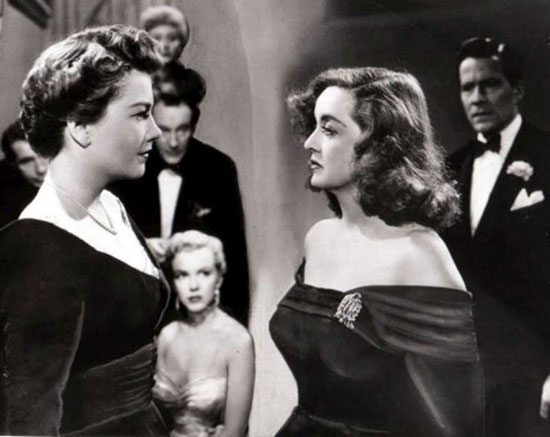
 Nominated for fourteen Academy Awards and winner of six, including Best Picture, Best Director, and Best Screenplay, All About Eve is one of Hollywood’s all-time greatest movies, a searing depiction of naked ambition set on the Great White Way. Based on Mary Orr’s 1946 short story “The Wisdom of Eve,” writer-director Joseph L. Mankiewicz’s flawless drama stars Anne Baxter as Eve Harrington, who is not exactly the mousey wallflower she at first appears to be. She quickly worms her way into an inner circle of Broadway vets populated by superstar Margo Channing (Bette Davis), her younger lover, Bill Sampson (Gary Merrill), playwright and director Lloyd Richards (Hugh Marlowe), and Richards’s wife, Karen (Celeste Holm), who takes Eve under her wing. Joining in on all the fun is powerful theater critic Addison DeWitt (Oscar winner George Sanders), who marvels at all the manipulation and backstage drama, much of which he wickedly orchestrates himself. “There never was, and there never will be, another like you,” DeWitt tells Eve in one of the film’s most poignant moments. All About Eve is filled with classic quotes, including the iconic “Fasten your seatbelts, it’s going to be a bumpy night,” boldly proclaimed by Davis. In a movie about acting and the theater, Mankiewicz never shows anyone onstage; instead, he focuses on the characters and the intrigue with a sly flair that is deliciously entertaining. All About Eve is screening November 6-8 at 4:00 as part of the JCC in Manhattan’s “Black and White” series, which will show classic b&w films on a monthly basis, with Stanley Kubrick’s Paths of Glory on tap for December,
 In a Republican debate in September, presidential hopeful Michele Bachmann called Gardasil, Merck’s HPV vaccine to prevent cervical cancer, “dangerous,” setting off a firestorm across the country and in the scientific community over the safety of childhood vaccinations in general, with groups taking to the streets and the airwaves fighting against government-mandated vaccines. Thus, Kendall Nelson and Chris Pilaro’s The Greater Good comes along at just the right time. In the ninety-minute documentary, the directors speak with individuals on all sides of the now controversial issue. They speak with the Swank, King, and Christner families, who claim that vaccinations specifically led to their children either becoming autistic, suffering strokes, or, dying. While Dr. Paul Offit declares vaccinations safe and bemoans so many people deciding not to have their children vaccinated against anything, which led to a recent outbreak of measles at Children’s Hospital of Philadelphia, Drs. John Green and Lawrence B. Palevsky come out strongly against vaccinations. And experts such as Robert W. “Dr. Bob” Sears, author of The Vaccine Book: Making the Right Decision for Your Child, and Barbara Loe Fisher, cofounder and president of the National Vaccine Information Center, are firmly in the middle, demanding that more testing be done on vaccines before they hit the market and that parents should have the choice of what vaccinations their children receive. Nelson and Pilaro supplement the film with a not-overwhelming amount of relevant data and some playful yet serious animation as they examine corporate influence on public health, the science behind the controversy, government regulation, the growing anti-vaccination movement, and the sad stories of three families dealing with harrowing personal circumstances. The Greater Good is screening November 5 at 6:45 at NYU’s Kimmel Center and November 7 at 1:30 at the IFC Center as part of the “Viewfinders” section of the Doc NYC festival, which continues through November 10, with the codirectors expected to be in attendance to discuss the film.