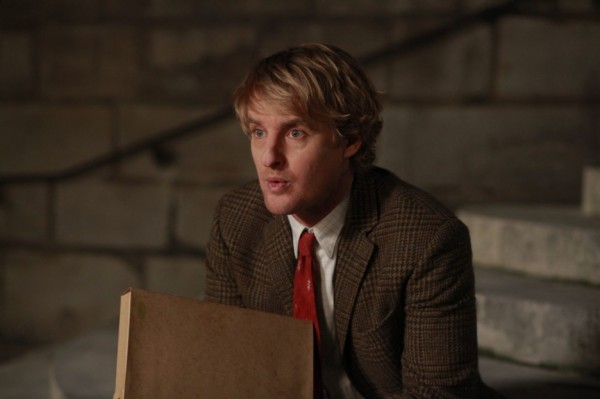
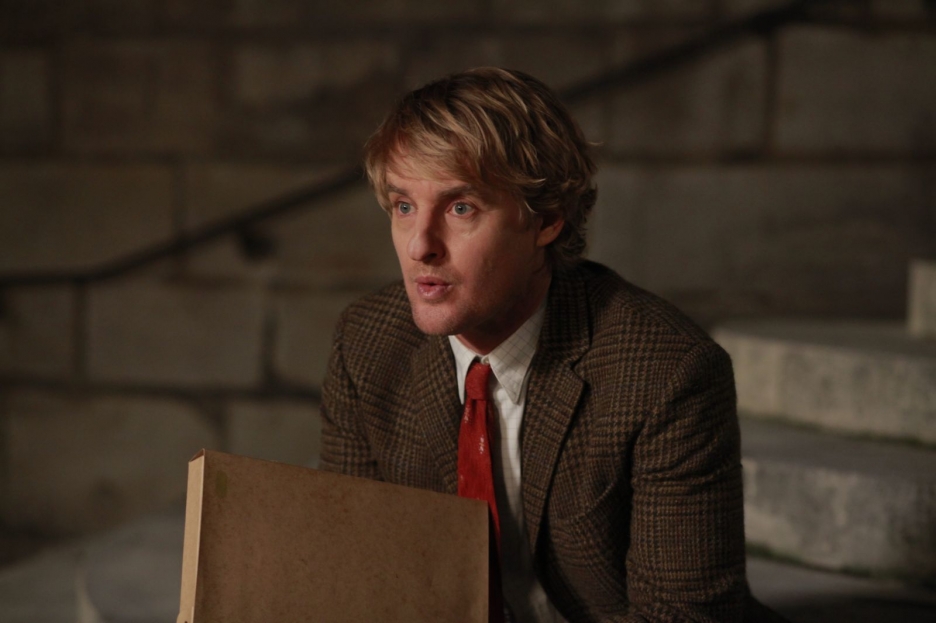
Writer Gil Pender (Owen Wilson) waits to mingle with the Lost Generation in Woody Allen’s MIDNIGHT IN PARIS
MIDNIGHT IN PARIS (Woody Allen, 2011)
MoMA Film
Museum of Modern Art
11 West 53rd St. between Fifth & Sixth Aves.
Sunday, November 27, 2:00
Series runs through January 26
Tickets: $10, in person only, may be applied to museum admission within thirty days, same-day screenings free with museum admission, available at Film and Media Desk beginning at 9:30 am
212-708-9400
www.moma.org
www.sonyclassics.com/midnightinparis
 In 1979, Woody Allen and master cinematographer Gordon Willis made love to New York City architecture in gorgeous black and white in the stunning opening section of Manhattan set to George Gershwin’s “Rhapsody in Blue.” Allen’s latest, Midnight in Paris, begins with Allen and cinematographer Darius Khondji getting intimate with the City of Light in lush color, scanning familiar Parisian landmarks to Cole Porter’s “Let’s Do It, Let’s Fall in Love.” In this beautifully shot love letter to Paris, Owen Wilson stars as Gil Pender, a Hollywood hack screenwriter working on his first novel, about a nostalgia dealer. He and his fiancée, Inez (Rachel McAdams), are vacationing in Paris with her parents, the wealthy, ultraconservative John (Kurt Fuller) and Helen (Mimi Kennedy), who think their daughter can do much better. Gil and Inez bump into their friends Carol (Nina Arianda) and Paul (Michael Sheen), the latter a pedantic know-it-all who begins many an observation with “If I’m not mistaken” and whom Gil can’t stand. Gil is hoping Paris will get his creative juices flowing, and that’s exactly what happens late one evening when he is walking the streets alone at midnight and is invited into an old-fashioned car and taken to what appears to be a throwback party — until he meets F. Scott and Zelda Fitzgerald (Tom Hiddleston and Alison Pill), Cole Porter (Yves Heck), Ernest Hemingway (Corey Stoll), and fashion designer and Picasso muse Adriana (Marion Cotillard). Suddenly he feels more at ease in the swinging ’20s than the 2010s, heading out each night to the same spot, hoping to hang out more with the Fitzgeralds, Hemingway, Gertrude Stein (Kathy Bates), Picasso (Marcial Di Fonzo), and, most importantly, Adriana. Nostalgia for the past and the promise of the future collide as Gil searches deep inside himself, trying to discover just what it is that he wants and needs out of life. Combining elements of such previous films as The Purple Rose of Cairo, Alice, Everything You Ever Wanted to Know About Sex*, and Everyone Says I Love You with a rather standard Twilight Zone-esque setup and a nod to his mid-’60s Lost Generation joke — in which he hangs out with Hemingway, the Fitzgeralds, Picasso, and Stein talking about art and literature, with a series of punch lines involving Allen getting punched in the mouth — Midnight in Paris is a charming, if at times overwrought and just plain silly, romantic fantasy that evokes Allen’s own fondness for nostalgia and the past. As more and more famous artists keep showing up, it gets more than a tad ridiculous, although it is also kinda fun. Midnight in Paris, which opened the 2011 Cannes Film Festival, follows four Allen films set in London (Match Point, Scoop, Cassandra’s Dream, and You Will Meet a Tall Dark Stranger), one in Barcelona (Vicky Christina Barcelona), and only one in New York (Whatever Works) as Allen continues to travel the world after experiencing a dwindling audience and scandal back home. Wilson is excellent as the nostalgic writer, playing him with an edgy uncomfortablilty that makes him endearing, and Cotillard is sexy and alluring as the quintessential artistic muse. And in an inspired bit of casting, French first lady Carla Bruni plays a tour guide who butts heads with the smarmy Paul when discussing Rodin’s “The Thinker.”
Midnight in Paris is screening November 27 at the Museum of Modern Art as part of MoMA’s “The Contenders 2011” series, which focuses on either underlooked films and/or those that MoMA believes will stand the test of time. The series continues through January 26 with such works as Alexander Payne’s The Descendants (followed by a discussion with the director), David Cronenberg’s A Dangerous Method, and Rupert Wyatt’s Rise of the Planet of the Apes.
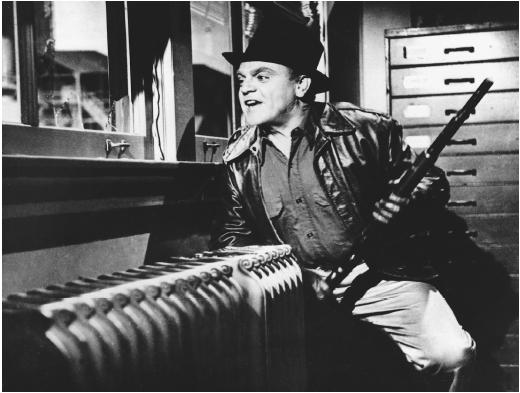
 Raoul Walsh’s film noir classic White Heat might have been nominated for a mere single Oscar, losing for Best Motion Picture Story (losing to The Stratton Story), but it quickly came to be considered one of the greatest gangster pictures ever made. The 1949 film stars James Cagney as Cody Jarrett, a devout criminal married to the beautiful moll Verna (Viriginia Mayo) but still deeply (and unhealthily) attached to his mother (Margaret Wycherly). While doing time for a train robbery gone wrong, Jarrett finds out that his gang has been taken over by his former flunkie Big Ed Somers (Steve Cochran), who also seems to have taken over Verna as well. Jarrett decides he must break out of jail, setting the stage for an unforgettable climax. Walsh (High Sierra, They Died with Their Boots On) doesn’t concentrate just on the action, of which there is plenty, instead focusing on Jarrett’s troubled psyche as he blindly seeks revenge. White Heat will be screening November 30 – December 2 at 1:30 as part of MoMA’s continuing “An Auteurist History of Film” series, which also features such upcoming gems as Yasujiro Ozu’s Banshun (Late Spring), Carol Reed’s The Third Man, Akira Kurosawa’s Rashomon, and John Ford’s Wagon Master.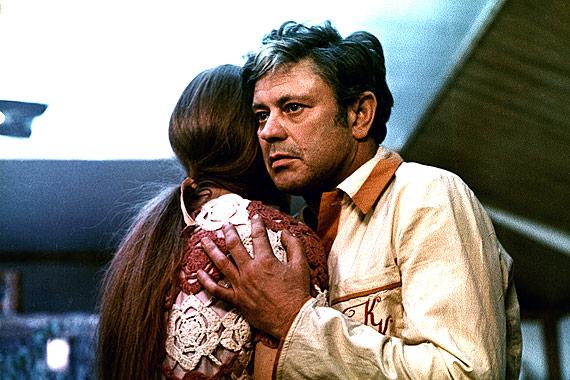
 Natalya Bondarchuk and Donatus Banionis star in Solaris, the Russian 2001: A Space Odyssey, in which something strange is going on in outer space that is unexplainable to both the characters in the film and the people in the audience. Banionis plays Chris Kelvin, who is sent to the Solaris space station to decide whether to put an end to the solaristics project that Burton (Vladislav Dvorzhetsky) complicated twenty years before. What he discovers is one death, two possibly insane men, and his supposedly dead wife (Bondarchuk). Ambiguity reigns supreme in this gorgeously shot (in color and black and white by cinematographer Vadim Yusov) and scored (by Eduard Artemyev) film that, while technically science fiction, is really about the human conscience, another gem from master Russian director Andrei Tarkovsky (Ivan’s Childhood, Andrei Rublev, Nostalghia). See it whether or not you checked out Steven Soderbergh’s underrated remake with George Clooney and Natascha McElhone. Solaris is screening on November 27 as part of BAMcinématek’s “Sci-Fi Thanksgiving” series, which previously showed, appropriately enough, Stanley Kubrick’s classic 2001: A Space Odyssey.
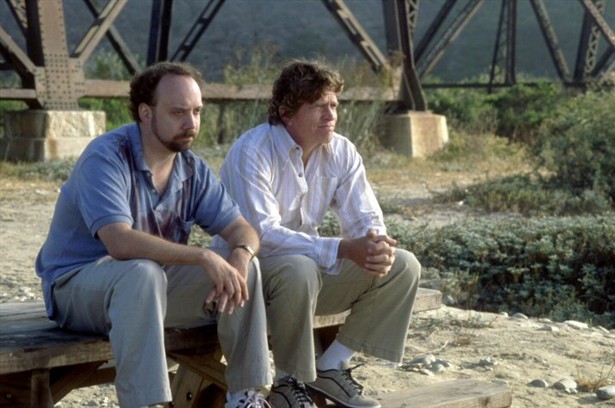
 Celebrating the release of Alexander Payne’s The Descendants, the Museum of the Moving Image’s “The Films of Alexander Payne” series concludes November 25 with Sideways, the eclectic director’s fourth film, following the underseen Citizen Ruth, the excellent Election, and the overrated About Schmidt. Sideways is fabulously entertaining from start to finish, a smart, inventive, very funny dark comedy about friendship and love set in California wine country. Paul Giamatti stars as Miles, a schlumpy wine connoisseur who is having trouble getting over his divorce and the failure of his massive novel to get published. His best friend, Jack (Thomas Haden Church), is getting married, so the two head off on a road trip, with Miles looking forward to sampling fine wine, and Jack anticipating sampling fine women. While Jack finds what he is looking for in Stephanie (Sandra Oh, who was married to Payne at the time), Miles seems hell-bent on not allowing himself to enjoy life, even as a beautiful woman with a deep appreciation of the grape (the excellent Virginia Madsen in what should have been a career-redefining performance) shows an interest in him. You definitely do not have to be a wine drinker to fall in love with this marvelous movie, one of the best of 2004; it was nominated for Best Director, Best Picture, Best Supporting Actress (Madsen), and Best Supporting Actor (Haden Church), and screenwriters Jim Taylor and Payne won for Best Adapted Screenplay.