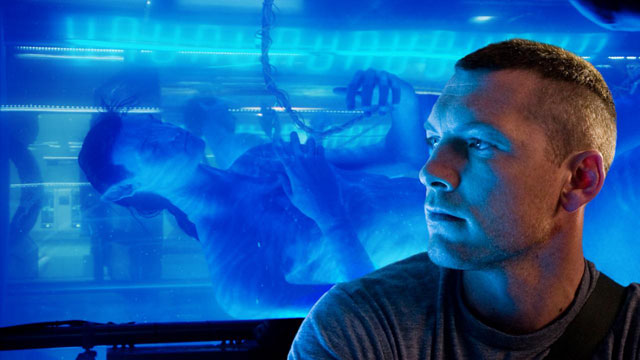
Jake Sully (Sam Worthington) has a new world awaiting him in AVATAR
AVATAR (James Cameron, 2009)
Museum of the Moving Image
35th Ave. at 36th St., Astoria
Thursday, December 29, $15, 7:00
Series concludes January 1
718-777-6800
www.movingimage.us
www.avatarmovie.com
 Canadian-born director James Cameron (The Terminator, Aliens, The Abyss, and some movie about a big sinking ship) crafts an expensive, high-tech apology to native people the world over in the futuristic adventure thriller Avatar. Borrowing elements from such films as The Matrix, Alien, the Lord of the Rings trilogy, the Star Wars saga, Disney’s animated Pocohantas, Reign of Fire, and many a cowboy-and-Indian tale, Cameron propels audiences into 2154, where a team of scientists join up with military troops on Pandora, home to the invaluable mineral unobtainium as well as a native race known alternately as the na’vi, or the People. In the middle of it all is Jake Sully (Sam Worthington), a wheelchair-bound former Marine who takes the place of his brilliant brother, who was recently murdered. While head researcher Dr. Grace Augustine (Sigourney Weaver) thinks bringing Jake on board is a mistake, Col. Miles Quaritch (Stephen Lang) sees it as an opportunity to make use of Jake’s expert reconnaissance skills, so Jake takes over what would have been his brother’s avatar — a giant creation modeled after the na’vi that humans can operate from a pod while asleep and that gives Jake the opportunity to walk again through this tall blue being. Quaritch secretly promises Jake that he will get him the costly procedure that will give him back the use of his real legs if he infiltrates the na’vi and sends intel back to the colonel as the military prepares an all-out assault on the People, but when Jake falls for the beautiful Neytiri (Zoë Saldaña), he undergoes a change of heart. As with most Cameron films, the visual splendor is thwarted by a tired, clichéd script that devolves into complete silliness in the last half hour, spurred on by James Horner’s treacly score and plenty of poorly delivered lines. But Avatar is still lots of stupid fun, especially if you see it in 3D, as it is being shown December 29 at the Museum of the Moving Image as part of the “See It Big!” series, which concludes December 30 and January 1 with Stanley Kubrick’s lush and elegant Barry Lyndon.
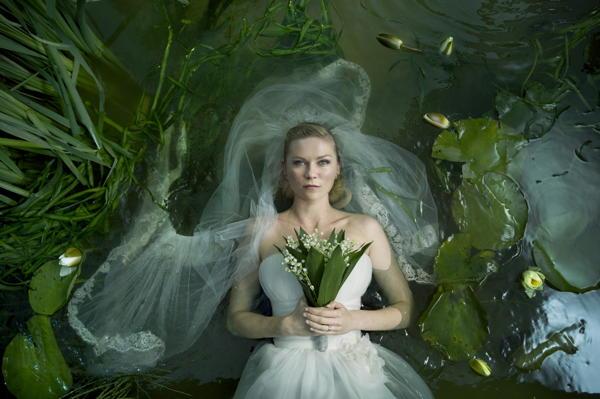
 Danish writer-director Lars von Trier has nothing less than the end of the world on his mind in his latest controversial drama, Melancholia. Von Trier’s latest love-it-or-hate-it cinematic foray opens with epic Kubrickian grandeur, introducing characters in marvelously composed slow-motion and still shots (courtesy of cinematographer Manuel Alberto Claro) as an apocalyptic collision threatens the earth and a Wagner overture dominates the soundtrack. Kirsten Dunst won the Best Actress award at Cannes for her portrayal of Justine, a seemingly carefree young woman celebrating her wedding day who soon turns out to be battling a debilitating mental illness. Her husband, Michael (Alexander Skarsgård), is madly in love with her and does not know quite what he has gotten himself into, especially as the partying continues and Justine’s motley crew of family and friends get caught up in various forms of intrigue, including Gaby, her marriage-hating mother (Charlotte Rampling), Dexter, her never serious father (John Hurt), Jack, her pompous boss (Stellan Skarsgård), Claire, her married sister (Charlotte Gainsbourg), and Claire’s filthy rich husband, John (Kiefer Sutherland), who is hosting the event at his massive waterfront estate. While most of the film focuses on the wildly unpredictable Justine, the latter section turns its attention on Claire, who is terrified that a newly discovered planet named Melancholia is on its way to destroy the world. But Melancholia is not just about sadness, depression, family dysfunction, and the end of the world. It’s about the search for real love and truth, things that are disappearing from the earth by the minute. Justine works as an advertising copywriter, attaching tag lines to photographs to help sell product; at the wedding, Jack is determined to get one more great line of copy from her, even siccing his young, inexperienced nephew, Tim (Brady Corbet), on her to make sure she delivers. But what she ends up delivering is not what either man expected. Perhaps the only character who really sees what is going on is a wedding planner played by the great Udo Kier, who continually, and comically, shields his eyes from Justine, unable to watch the impending disaster. Just as in the film, as some characters get out their telescopes to watch the approaching planet and others refuse to look, there are sure to be many in the moviegoing public who will shield their eyes from Melancholia, choosing not to view yet another controversial film from a director who likes to antagonize his audience. They don’t know what they’re missing.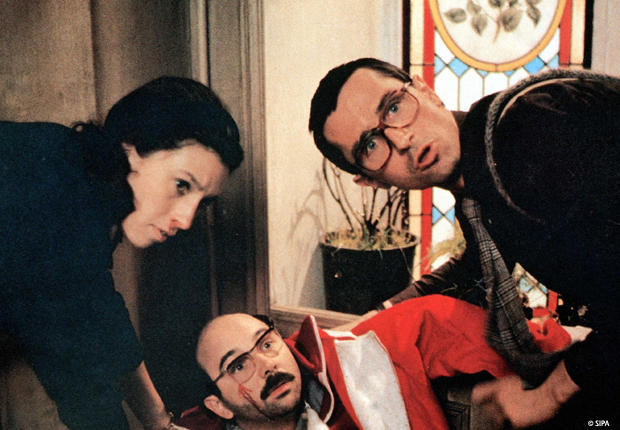
 While here in America, Christmas movie traditions tend to be on the more sappy side, like the treacly It’s a Wonderful Life, Miracle on 34th St., or any one of a number of updated versions of A Christmas Carol, France has a very different idea of what qualifies as a holiday favorite. Le père Noël est une ordure, also known as Santa Stinks (or the closer translation Father Christmas Is a Bastard), has been a cult classic going on thirty years now. The no-holds-barred seasonal slapstick satire is the creation of Jean-Marie Poiré and the members of the popular Le Splendid café-théâtre company, who spend a New Year’s Eve together like you’ve never seen before. Thérèse (Anémone) and Pierre (Thierry Lhermitte) work at a suicide-prevention hotline, but they are not very good at helping lonely, depressed people, as shown early on when a man calls from a phone booth and quickly puts a bullet in his head when no one at the SOS Detresse Amitié really listens to him. Meanwhile, their cranky coworker, Madame Musquin (Josiane Balasko), gets trapped in an elevator, desperate to get to her Christmas Eve dinner; young transvestite Katia (Christian Clavier) stops by looking for a little love; neighbor Preskovic (Bruno Moynot) keeps bringing over the most disgusting homemade treats imaginable; and low-level crook Félix (Gérard Jugnot) wanders around in a Santa suit, chasing rabbits and wielding a gun while his pregnant wife, the obnoxiously chatty Josette (Marie-Anne Chazel), does everything she can to get away from him while also commenting on all the fun. Le père Noël est une ordure has no sympathy for the holiday season, instead reveling in low-grade humor, over-the-top violence, and surprising plot twists that are not at all what you’d expect from a Christmas movie. With that in mind, MoMA has chosen to present the U.S. theatrical premiere of this French farce with a one-week run beginning December 28 so as not to ruin your Christmas celebration. (And to further save you from potential ruination, be sure to pay no attention whatsoever to Nora Ephron’s all-star 1994 dud, Mixed Nuts, which was loosely based on Le père Noël est une ordure.)
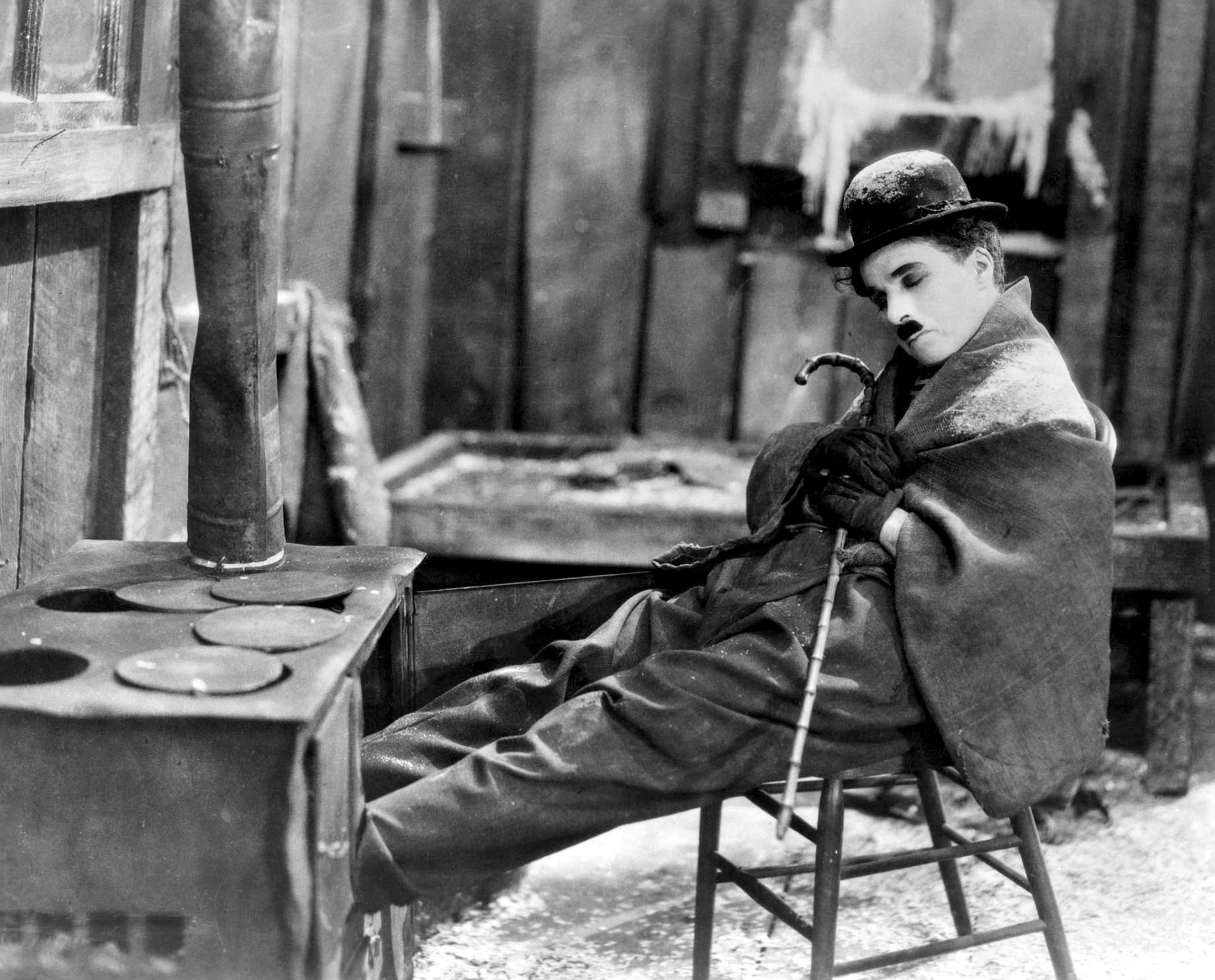
 Charlie Chaplin died thirty-four years ago on Christmas Day, at the ripe old age of eighty-eight, so Film Forum is paying tribute to the anniversary by screening a restored 35mm print of the complete version, with a newly recorded orchestral score, of what Chaplin called “the picture I want to be remembered by.” Made four years prior to the Great Depression, the slapstick comedy is still remarkably socially relevant, tackling unemployment, crime, hunger, and poverty. Chaplin, who wrote, produced, and directed the silent masterpiece, stars as the Lone Prospector, a little tramp who has set out to strike it rich during the Alaskan Gold Rush of 1848 but isn’t really having much luck. He takes shelter during a snowstorm in a small shack, does battle with a pair of much bigger men, turns into a chicken, and, yes, eats his shoe, doing whatever it takes to survive. The prescient film was originally to star Lita Grey as the love interest, but Chaplin impregnated (and later married) the sixteen-year-old, so she was replaced by Georgia Hale. Film Forum is screening The Gold Rush, which also features Mack Swain as Big Jim McKay, Malcolm Waite as ladies’ man Jack Cameron, and Tom Murray as Black Larsen, through December 29, including five times on Christmas Day. (And by the way, if you’ve only seen Charles Chaplin’s reedited 1942 version with his own treacly narration and score, well, you’ve never really experienced this American treasure.)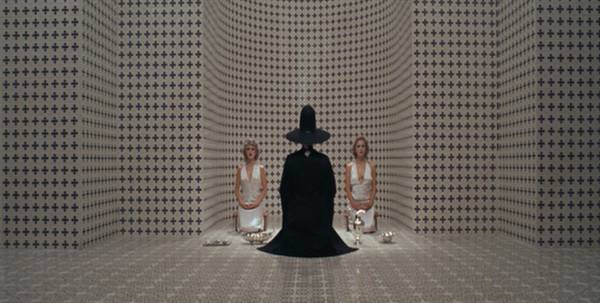
 While churches around the city are filling up for midnight mass on Christmas Eve, you can have a completely different kind of religious experience at the IFC Center, one of New York’s cinematic temples. Inspired by Rene Daumal’s Mount Analogue: A Novel of Symbolically Authentic Non-Euclidean Adventures in Mountain Climbing, Alejandro Jodorowsky’s The Holy Mountain also involves symbolically non-Euclidean adventures in mountain climbing, funneled through Carlos Castaneda, Stanley Kubrick’s 2001: A Space Odyssey, and magic mushrooms and LSD galore. What passes for narrative follows a Jesus look-alike thief (Horacio Salinas) and an alchemist with a thing for female nudity (Jodorowsky) on the path to enlightenment; along the way they encounter the mysterious Tarot, stigmata, stoning, eyeballs, frogs, flies, cold-blooded murder, naked young boys, chakra points, life-size plaster casts, Nazi dancers, sex, violence, blood, gambling, turning human waste into gold, death and rebirth, and the search for the secret of immortality via representatives of the planets, each with their own extremely bizarre story to tell. Jodorowsky, who is credited with having invented the midnight movie with the acid Western El Topo (1970), literally shatters religious iconography in a kaleidoscopic whirlwind of jaw-droppingly gorgeous and often inexplicable imagery composed from a surreal color palette, set to a score by free jazz trumpeter Don Cherry and Archies keyboardist Ron Frangipane. (Frangipane also worked with John Lennon and Yoko Ono, who produced this film with their business manager, Allen Klein.) The Holy Mountain — which brings a whole new insight to Matthew Barney’s Cremaster Cycle — is filled with psychedelic mysticism centered around the human search for transcendence in a wilderness of the sacred and profane. Jodorowsky’s work can move you deeply, but don’t expect it to make much sense. Sit back and let in pour in and over you — you’ll feel it. You may hate it, but you’ll feel it. Although you’ll definitely hate the very end. The film is also screening on Christmas night and New Year’s weekend at the IFC Center, offering one helluva way to welcome in 2012.
 Will Ferrell is a hoot in this somewhat overrated Christmas movie that starts out with such promise before descending into sappy melodrama and seasonal cliché hell. Ferrell stars as Buddy the elf, a human orphan who crawls inside Santa’s bag one Xmas Eve and grows up to become an unusually big worker in the North Pole. When he finally realizes he’s different from everyone around him, he sets out to New York City to find his birth father, who turns out to be a tough, ruthless publisher (James Caan) who neglects his family. It’s hard not to laugh nearly every time you see the gleam in Ferrell’s eye, the curls in his hair, or the hysterical outfit he’s wearing as he makes his way through Gimbels (Macy’s), the Rockefeller Center ice skating rink, the Empire State Building, Central Park, and other local landmarks. Teaming Ed (Lou Grant) Asner and Bob (Bob Hartley) Newhart, who used to be on CBS back to back on Saturday nights, is a nice touch. And the scene with Peter Dinklage as a mega-successful but rather diminutive children’s book writer is awesome, even if the movie has no idea how kids’ books are really made. It’s too bad this sharp-edged comedy had to turn all warm and fuzzy in the end, but it might not matter quite so much at these midnight holiday screenings.