Every house has a door takes on Bergman, Makavejev, and Cavell in Coil production at P.S. 122
Performance Space 122
150 First Ave. at Ninth St.
Through January 9, $20
Festival runs through January 29
www.ps122.org
www.everyhousehasadoor.org
At the beginning of Every House Has a Door’s Let us think of these things often. Let us speak of them never. the audience is told that it doesn’t need to know anything about Dušan Makavejev, Ingmar Bergman, or Stanley Cavell to enjoy the show, but a brief look at the source material does provide valuable insight to help one better understand and appreciate what they are about to see. In January 1978, philosopher Stanley Cavell attended a presentation by Dušan Makavejev at a Harvard conference entitled “Bergman and Dreams” in which the Yugoslavian director of W.R.: Mysteries of the Organism screened a short experimental work composed of nonverbal scenes from films by Ingmar Bergman. Cavell described the experience in an article that dealt with time, audience involvement, artistic reappropriation, and other elements. “The question Is it possible to construct a Bergman film . . . ? serves to make us think again about the relation of film and theater, about the fact that plays have productions and performances whereas films, by comparison, have their awful integrity or finality: modifying them feels like mutilating them,” Cavell writes. “In contrast, members of an audience of a (live) performance are participants in it in varying degrees; writing can be read at any tempo, at any length, in any order, and a passage reread at will. . . . [Film] does not lend itself — with but minor exceptions — to incorporation by the other arts. It is the perfect consumer, with a stomach for anything.”
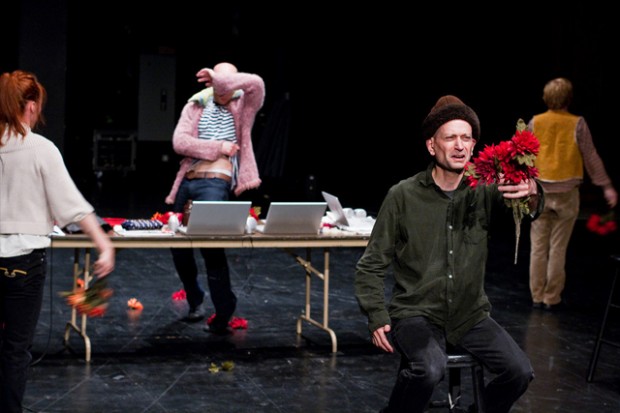
Chicago troupe presents thought-provoking theater that traps the audience (photo by John W. Sisson Jr.)
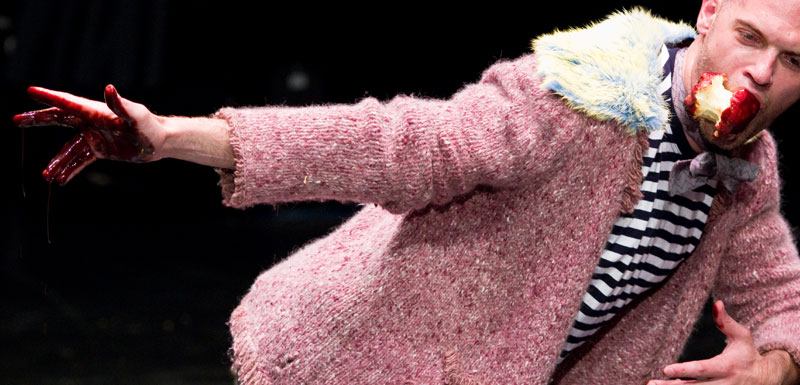
Indeed, the audience for Let us think of these things often. Let us speak of them never., which continues at P.S. 122 as part of the Coil festival through January 9, becomes an unwitting participant right from the start, as the seats are set up on three sides of the stage in such a way that if someone needs to use the bathroom or wants to leave before it’s over, they’d have to walk right through the action. Not that the show necessarily warrants early departure, but it is a conceit that makes the audience feel trapped. Conceived by Lin Hixson and Matthew Goulish, formerly of Goat Island, and performed by Ghoulish, Selma Banich, Mislav Čavajda, and Stephen Fiehn, the eighty-minute production features disembodied narration referencing the show itself, a re-creation of Makavejev’s “Bergman film” (with moments from such works as Persona, The Virgin Spring, The Seventh Seal, The Silence, and Through a Glass Darkly, using a rolling light source, the presentation of various theories about live vs. cinematic entertainment, using loaves of bread as weapons, and a mimicking of a scene from Makavejev’s Sweet Movie that involves fake flowers and Ghoulish teasing the audience by allowing only glimpses of the original film as he follows Čavajda around the stage while the movie plays on his laptop. It all makes for a wildly inconsistent, intriguing, thought-provoking, confusing, engaging, and frustrating evening of avant-garde theater, with some parts working well (the Bergman re-creation), some appearing downright silly and amateurish (the Makavejev re-creation with plastic flowers), but with a wonderfully devised existential ending that will make you glad you stayed, even if you’re not quite sure about what you’ve just experienced.
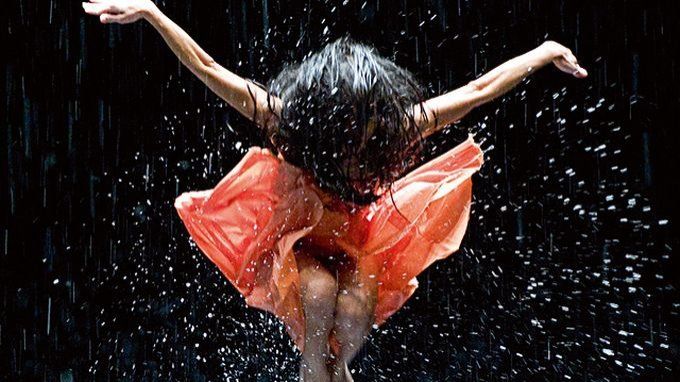
 Back in 2004, in reviewing Pina Bausch’s Fur Die Kinder von Gesern, Heute und Morgen (For the Children of Yesterday, Today, and Tomorrow) at BAM, we wrote, “You don’t have to be a dance fan to love the always engaging Pina Bausch.” The same holds true for Wim Wenders’s loving 3-D documentary, Pina. The longtime director of Tanztheater Wuppertal, German choreographer Bausch created uniquely entertaining pieces for more than thirty years, combining a playful visual language with a ribald sense of humor, cutting-edge staging, diverse music, and a stellar cast of men and women of varying ages and body sizes, resulting in a new kind of dance theater. A friend of hers for more than twenty years, Wenders (Wings of Desire, Paris, Texas) was collaborating with Bausch on a film when she suddenly died of cancer in 2009 at the age of sixty-eight, two days before rehearsal shooting was to begin. Wenders decided to proceed, making a film for Pina instead of with her. Using the latest 3-D technology, including a specially developed camera rig mounted on a crane, Wenders invites audiences onstage as he captures thrilling, intimate performances of several of Bausch’s seminal works, 1975’s Le Sacre du printemps, 1978’s Café Müller, 1978 and 2000’s Kontakthof (Contact Zone), 2002’s Fur Die Kinder, and 2006’s
 For nearly thirty years, Finnish auteur Aki Kaurismäki (Leningrad Cowboys Go America, The Man Without a Past) has been making existential deadpan black comedies that are often as funny as they are dark and depressing. Has there ever been a film as bleak as 1990’s The Match Factory Girl, in which a young woman (Kati Outinen) suffers malady after malady, tragedy after tragedy, embarrassment after embarrassment, her expression never changing? In his latest film, the thoroughly engaging Le Havre, Kaurismäki moves the setting to a small port town in France, where shoeshine man Marcel Marx (André Wilms), a self-described former Bohemian, worries about his seriously ill wife (Outinen) while trying to help a young African boy (Blondin Miguel), who was smuggled into the country illegally on board a container ship, steer clear of the police, especially intrepid detective Monet (Jean-Pierre Darroussin), who never says no to a snifter of Calvados. Adding elements of French gangster and WWII Resistance films with Godardian undercurrents — he even casts Jean-Pierre Léaud in a small but pivotal role — Kaurismäki wryly examines how individuals as well as governments deal with illegal immigrants, something that has taken on more importance than ever amid the growing international economic crisis and fears of terrorism. Through it all, Marcel remains steadfast and stalwart, quietly and humbly going about his business, deadpan every step of the way. Wouter Zoon’s set design runs the gamut from stark grays to bursts of color, while longtime Kaurismäki cinematographer Timo Salminen shoots scene after scene with a beautiful simplicity. Winner of a Fipresci critics award at Cannes this year and Finland’s official entry for the Best Foreign Language Film Oscar, Le Havre, the first of a proposed trilogy, is another marvelously unusual, charmingly offbeat tale from a master of the form. A selection of the 2011 New York Film Festival, Le Havre is screening January 6 at 6:30 as part of the “Nordic Oscar Contenders” series at Scandinavia House, which begins January 4 with Pernilla August’s Swedish entry, Svinalängorna (Beyond), and concludes January 9 with Anne Sewitsky’s Norwegian drama Sykt lykkelig (Happy, happy).