Lt. Kang Eun-pyo (Shin Ha-Kyun) sees the futility of war in Korean military epic THE FRONT LINE
THE FRONT LINE (Jang Hun, 2011)
AMC Empire 25
234 West 42nd St. between Broadway & Eighth Ave.
Opens Friday, January 20
888-262-4386
www.thefrontlinemovie.com
www.amctheatres.com
 During the Korean War, the north and south did battle over a series of hills, with the key locations changing hands of over and over, sometimes multiple times the same day. Director Jang Hun tells the fictionalized story of one such hill, Aero.K, in the tense military thriller The Front Line. Shin Ha-Kyun (Thirst, Sympathy for Mr. Vengeance) stars as Lt. Kang Eun-pyo, an investigator who has been sent to the eastern front to uncover a possible spy. Upon joining Alligator Company, Eun-pyo is surprised to find his old college friend, Kim Su-hyeok (Ko Soo), a former scared grunt who had been captured by the North Koreans and has now blossomed into a strong leader — and quickly becomes the leading candidate to be the potential traitor. The hill has changed hands so often that each side has been secretly communicating with the other by leaving such materials as photos, letters, and alcohol in a hidden spot, developing a relationship that reveals their humanity but also could compromise them on the field. And as a possible armistice approaches, the brass ramps up the fighting in a series of last-ditch efforts to take the hill and expand the potential demarcation line in their favor. Park Sang-yeon’s script is filled with clichéd characters and familiar plot lines, leaning toward the melodramatic, but Jang still makes it work, building the violent film around the strong main characters and several powerful, unexpected twists. South Korea’s official entry for the Academy Awards, The Front Line is a gritty epic that reveals man’s inhumanity to man and the ultimate futility of war.

 Director David Cronenberg just might have made the best film of his career with the brilliant A History of Violence. Set to the marvelously tense music of Howard Shore — which threatens to explode at any moment — the film stars Viggo Mortensen as Tom Stall, a quiet, calm family man who runs a local diner in a small town in Indiana. Stall reluctantly becomes the town hero (and media darling) after a dangerous, bloody incident in his diner, which leads to the arrival of Carl Fogaty (the excellent Ed Harris), an East Coast mob kingpin who insists that Tom is actually Joey Cusack, a former Mafia goon who is in witness protection. As Fogaty and his men harass Tom and his family (wife Maria Bello and kids Ashton Holmes and Heidi Hayes), Stall desperately fights to protect his simple, happy life. William Hurt excels in a small role near the end of the film. A History of Violence is as suspenseful as they come, a simmering masterpiece that blows up the American dream. The film is loosely based on the graphic novel by John Wagner and Vince Locke, but as Cronenberg explained at the 2005 San Diego Comic-Con, he didn’t even know the book existed until the production was well under way, and Josh Olson’s outstanding screenplay ultimately veers far away from its source. Screening on January 21 at 5:00 at the Museum of the Moving Image, A History of Violence kicks off a three-week retrospective of eighteen of Cronenberg’s films, which together form a rather unique view of the world. The films range from Videodrome, Dead Ringers, The Fly, and The Dead Zone to Eastern Promises, eXistenZ, Rabid, and The Brood in addition to such lesser-known fare as Fast Company, They Came from Within, and a double feature of Stereo and Crimes of the Future. Cronenberg will be at the museum on January 21 at 2:00 to talk about his career; while the event is sold out, you can still get a $15 ticket for the live simulcast in the Bartos Screening Room.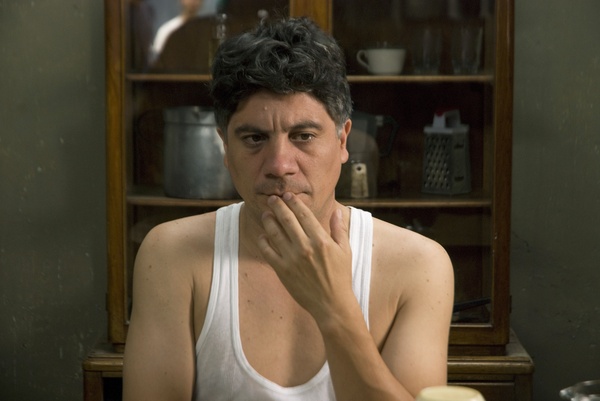
 Winner of the Jury Prize of the Un Certain Regard section at Cannes, Octubre is a deadpan black comedy about loneliness and, ultimately, a different kind of family. In Daniel and Diego Vega’s first feature, Bruno Odar stars as Clemente, a low-key money lender in Lima, Peru, who comes home one day to his stark apartment to find a baby left in a back room. Figuring out it must be his by one of the prostitutes he frequents, he goes in search of the woman, known as la Cajamarquina, who does not want to be found. After the authorities strongly suggest that he keep the baby, Clemente hires the deeply religious Sofia (Gabriela Velásquez) to help take care of the child. The events unfold during the Purple Month, October, when Lima celebrates El Señor de los Milagros (the Lord of the Miracles), worshiping a seventeenth-century image of Christ that many believe is responsible for myriad miracles. Citing Robert Bresson, Jim Jarmusch, and Aki Kaurismäki as direct influences, the brothers Vega have made a slow-paced little gem, a curious tale with strange characters centered around the idea of money — but not greed. Clemente, the son of a respected pawnbroker, lends out cash to locals who tend to dictate the terms to him. When one man pays him back with a questionable bill, Clemente spends the rest of the film trying to get rid of it, but everyone else seems to be a lot smarter than he is when it comes to money. Sofia sells homemade nougat, a Purple Month tradition, and plays the numbers with Don Fico (Carlos Gassols), hoping for a small break in her spinsterish life. The only relationships that Clemente and Sofia have with other people involve money, either lending it, borrowing it, gambling it, or, in Clemente’s case, spending it to have sex. But the surprise baby has the potential to change both of their drab, boring lives. Octubre is a promising debut from the Vegas, who, along with cinematographer Fergan Chávez-Ferrer, display a smart sense of subtle visual and narrative style in telling this offbeat story. Octubre is screening January 21 at 92YTribeca as Best Feature Film at the Cinema Tropical Festival, which also includes Michael Rowe’s Camera d’Or winner Leap Year (Año Bisiesto), Patricio Guzmán’s stunning Nostalgia for the Light, and Tatiana Huezo’s The Tiniest Place (El Lugar Más Pequeño).
 Upon meeting convicted murderer Michael James Perry on Death Row eight days before the twenty-eight-year-old was going to be executed by the state of Texas, master filmmaker Werner Herzog tells him, “I have the feeling that destiny, in a way, has dealt you a very bad deck of cards. It does not exonerate you, and when I talk to you, it doesn’t necessarily mean that I have to like you, but I respect you, and you are a human being, and I think human beings should not be executed.” After explaining his personal view on capital punishment, Herzog then lets the rest of the compelling documentary Into the Abyss: A Tale of Death, a Tale of Life play out like a police procedural as he investigates how and why two teenage boys murdered three people in October 2001. Herzog opens the film by speaking with Death House chaplain Rev. Richard Lopez in a potter’s field graveyard, then follows that with four sections that detail the crime, the community in which it occurred, and the family members on both sides of the law affected by the grisly, senseless murders. Herzog divides the film into four primary chapters — “The Crime,” “The Dark Side of Conroe,” “Time and Emptiness,” and “A Glimmer of Hope” — as he talks with the often smiling Perry and his cohort, Jason Aaron Burkett; Lt. Damon Hall, who shares the specific aspects of the murders of Sandra Stotler, her seventeen-year-old son, Adam, and Adam’s friend Jeremy Richardson, supplemented by original crime-scene video; Charles Richardson, Jeremy’s older brother; Lisa Stotler-Balloun, Adam’s sister, who has seen more than her fair share of loss; Melyssa Thompson-Burkett, who fell in love with Burkett after he was incarcerated; Delbert Burkett, Jason’s stepfather, who is also behind bars; and Captain Fred Allen, who oversaw executions in the Huntsville prison. Herzog asks penetrating but not leading questions that get the subjects to talk openly and honestly about the crime and its aftermath and their lives in general, many of which seem trapped in a vicious cycle of violence, jail, poor education, and other endless hardships. Into the Abyss is a powerful film that, because of Herzog’s extremely sensitive handling of an extremely controversial topic, is not nearly as polemical or political as it could have been. Into the Abyss, which was the opening-night gala selection of the recent Doc NYC festival, is screening January 19 at the Museum of Modern Art as part of MoMA’s “The Contenders 2011” series, which focuses on either underlooked films and/or those that MoMA believes will stand the test of time. The series continues through January 30 with Ben Rivers’s Two Years at Sea, Jason Reitman’s Young Adult, Wim Wenders’s Pina, and Liza Johnson’s Return.