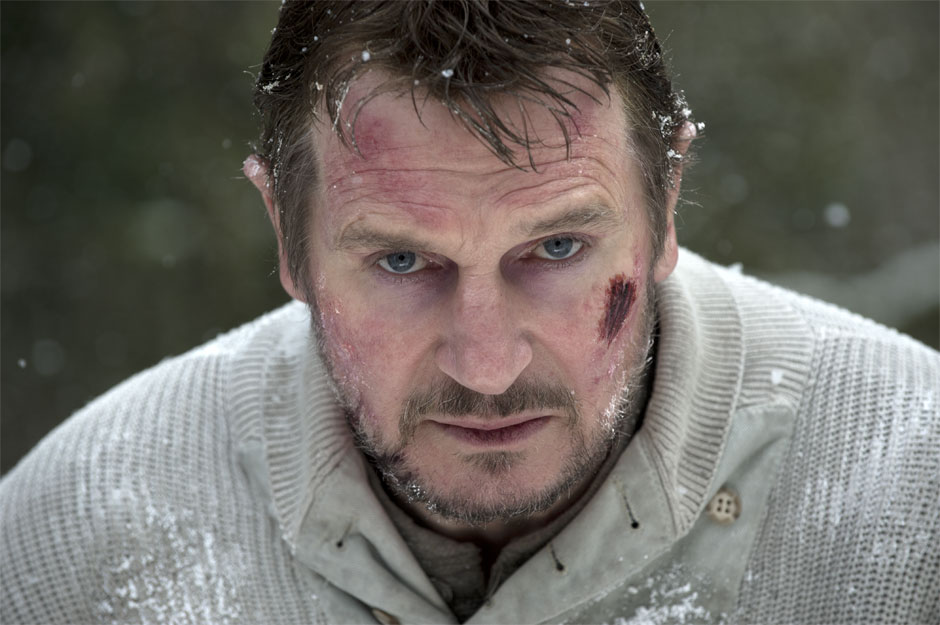
Liam Neeson goes all primal in the gripping adventure thriller THE GREY
THE GREY (Joe Carnahan, 2012)
Opens Friday, January 27
www.thegreythemovie.com
 Shortly after suicidal sharpshooter John Ottway (Liam Neeson) decides to kill a big grey instead of himself, the desperate man is fighting for his life, leading a small group of men who have survived a horrific plane crash only to find themselves right smack in wolf territory — and the wolves are none too happy that their territory has been intruded upon. Based on the short story “Ghost Walker” by Ian Mackenzie Jeffers, who wrote the taut screenplay with director Joe Carnahan (Narc,) The Grey is an intense, gripping thriller set in the vast Alaskan wilderness. In the middle of nowhere, a gang of societal outcasts — Ottway, Diaz (Frank Grillo), Talget (Dermot Mulroney), Henrick (Dallas Roberts), Flannery (Joe Anderson), Burke (Nonso Anozie), Hernandez (Ben Bray), and Lewenden (James Badge Dale), who all work at an oil refinery at the end of the earth, since no one else will have them — must band together if they want to survive, something that is a whole lot easier said than done with this collection of miscreants. As the men battle the increasingly dangerous elements, the wolves hover just on the periphery, seemingly always at the ready to attack, especially at night. Meanwhile, Ottway has tender memories of being in bed with his wife (Anne Openshaw), who has left him, the flashbacks helping him focus on his natural survival instincts. But even the skilled hunter might have finally met his match with these fierce, vengeful wolves. Beautifully photographed by Masanobu Takayanagi, The Grey expertly mixes action-adventure with horror, filled with thrills and chills galore. Evoking Sigourney Weaver in the Alien series, Neeson lends class to the film with his sensitive portrayal of the severely damaged Ottway, a good man who is more than a little down on his luck. Carnahan rarely settles for the lowest common denominator, instead telling the primal story of Ottway’s inner and outer journeys with wit and intelligence — and plenty of scares. The new year is less than a month old, but The Grey is destined to be one of the best films of 2012. (And be sure to stick around for the end of the credits for a brief bonus.)
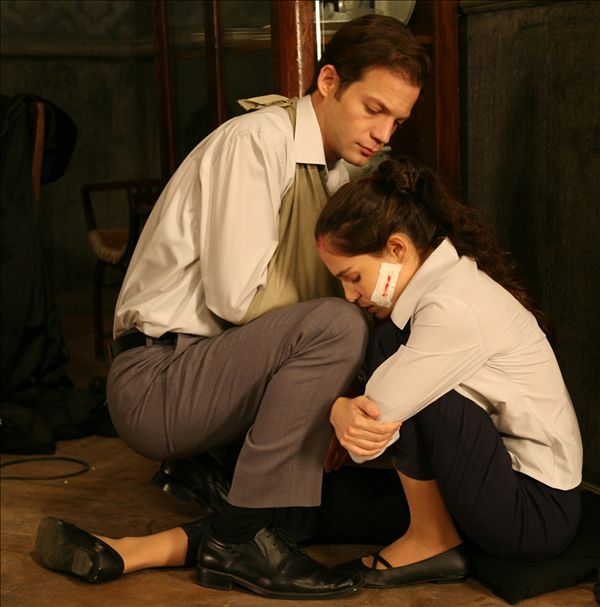
 Following a launch party for her book about how she and two fellow Mossad agents in 1964 captured and killed Max Reiner (Edgar Selge), the notorious “Surgeon of Birkenau,” Rachel Brener (Gila Almagor) immediately learns that there is an old man in a Ukrainian nursing home claiming that he is in fact the doctor who performed horrific experiments on Jewish men, women, and children in the German concentration camp during World War II. Rachel is reunited with Zvi (Alex Peleg) and Ehud (Oded Teomi), who come up with a plan to eliminate the doctor once again to protect a secret that has been haunting them for forty years. But they’re no longer the brash, finely chiseled spies they were when they were young, leading to crises of conscience and other physical and psychological dilemmas. Nominated for four Israeli Academy Awards, The Debt is a tense thriller from director Assaf Bernstein, who cowrote the screenplay with Ido Rosenblum. The story weaves back and forth between the present day, as Rachel meets Ehud in Ukraine and they hash out their plan, neither one having done anything like this in decades, and 1964, when Rachel (Neta Garty), Zvi (Itay Tiran), and Ehud (Yehezkel Lazarov) were younger and more idealistic. The scenes in which the young Rachel visits the doctor, who has become a gynecologist, and pretends she is trying to conceive a child are particularly gripping, setting up a powerful conclusion. The Debt, which was recently remade in English by John Madden with Helen Mirren, Ciarán Hinds, Sam Worthington, Jessica Chastain, and Tom Wilkinson and evokes such films as The Wild Geese, The Boys from Brazil, and QB VII, will open the Brooklyn Israel Film Festival on Thursday night at the Kane Street Synagogue in Cobble Hill, followed on Saturday night by Yossi Madmony’s Restoration, which was named Best Feature at the 2011 Jerusalem Film Festival, and Dolphin Boy on Sunday night, which will be followed by a Q&A with codirector Dani Menkin and producer Judith Manassen-Ramon.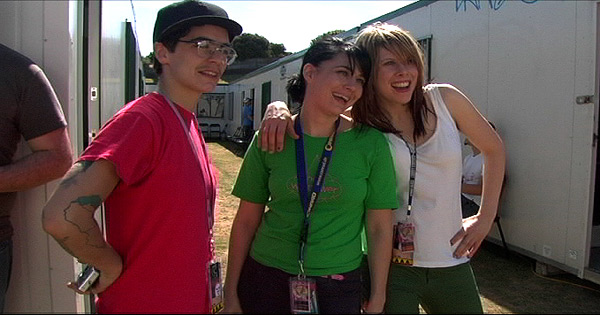
 In 1961, Barry Mann and Gerry Goffin wrote, “I’d like to thank the guy / who wrote the song / that made my baby / fall in love with me.” The title of that be-bop song, “Who Put the Bomp,” inspired one of music’s first fanzines and later the punk record label Bomp! Records. In their 1999 song “Deceptacon,” the riot grrrl group Le Tigre flipped that question around, asking, “Who took the bomp from the bompalompalomp? / Who took the ram from the ramalamadingdong?” In the song they also dare, “Let me hear you depoliticise my rhyme.” Formed in 1998 by former Bikini Kill leader Kathleen Hanna, zine writer Johanna Fateman, and visual artist Sadie Benning, who was replaced in 2000 by DJ and projectionist JD Samson, Le Tigre challenged the male-dominated world of rock and punk, championing individuality and sexual freedom while redefining gender roles. In 2004, Hanna, Fateman, and Samson set out on a world tour in support of their third and final album, This Island, and asked their lighting designer, Carmine Covelli, to capture it all on film. The result is the engaging Who Took the Bomp? Le Tigre on Tour, in which Covelli and director Kerthy Fix go onstage, backstage, and behind the scenes as the influential trio heads across four continents and ten countries, playing exciting live shows, meeting the media, taking pictures with Slipknot, revealing what they pack in their luggage, exercising in the gym, and talking about facial hair. They also discuss more serious issues such as gender identity, lesbianism, and their DIY mentality, which flew in the face of the music industry. The seventy-two-minute film, which features live multimedia performances of such songs as “Hot Topic,” “Keep on Livin’,” “Viz,” and “Deceptacon,” is screening on January 25 at 9:00 at the Nitehawk Cinema in Brooklyn and will be followed by a Q&A with members of the band.
 “Kino-eye has managed to find its way in the struggle with bourgeois cinema,” Russian filmmaker Dziga Vertov wrote in 1925, “and we seriously doubt that the latter (despite its present international dominance) can long withstand our revolutionary onslaught. There is another, greater danger — the distortion of our ideas.” One of the early masters of the new art form, Vertov, along with such contemporaries as Sergei Eisenstein, Lev Kuleshov, and Vsevolod Pudovkin, explored the potential power of the cinema in both fiction and nonfiction storytelling and as a propaganda tool. Vertov, whose most famous film is 1929’s Man with a Movie Camera, a revolutionary work about cinema itself, searched for truth in his films, what he referred to as “kino-pravda,” employing a unique cinema-verité style to capture real life. Not that he also didn’t have a very specific agenda. In the seminal Kino-Eye, what Vertov called a “tapestry of life,” Vertov and one of his brothers, cameraman Mikhail Kaufman, depict Soviet life of the 1920s, exploiting the technology of the medium while following a group of Young Pioneers marching through towns putting up political banners and waving flags. Along the way they stop by a village party filled with drunken revelers, wander through a street market, camp out in the fields, watch a Chinese magician perform, and come upon such health issues as tuberculosis and mental illness. Several scenes are projected in reverse, including the butchering of meat, the baking of bread, and even the sport of diving, as Vertov and Kaufman play with the story while also revealing the methods of production. By focusing on the children, Vertov is forming a blueprint for the future of the nation, just as in the film itself he is laying the groundwork for the future of cinema. Kino-Eye is screening on January 21 at 5:15 as part of Anthology Film Archives’ continuing “Essential Cinema” series, which followed by Vertov’s Forward, Soviet! at 7:00 and A Sixth of the World at 8:45.