WINGED MIGRATION takes viewers on a remarkable airborne adventure, part of Jacques Perrin tribute at FIAF
French Institute Alliance Française
Florence Gould Hall
55 East 59th St. between Madison & Park Aves.
Tuesday, January 31, $10
212-355-6160
www.fiaf.org
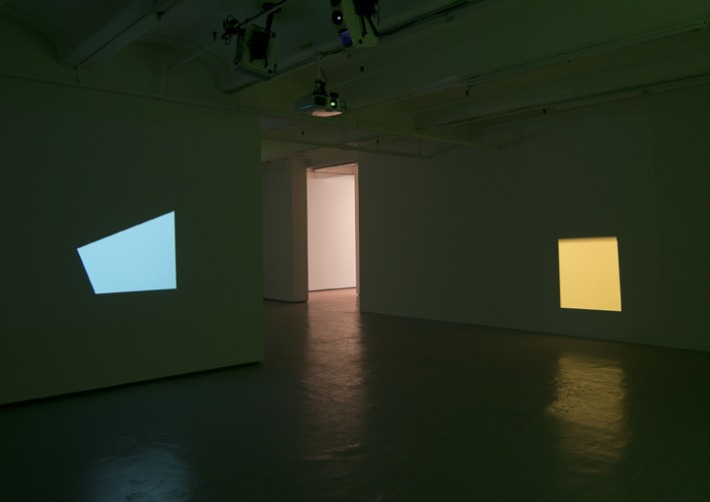
FIAF’s January CinémaTuesdays presentation, “Jacques Perrin: Renaissance Man,” comes to a close today with screenings of a pair of magnificent visual treats narrated by French actor, producer, and director Jacques Perrin. Microcosmos (le peuple de l’herbe) (Claude Nuridsany & Marie Pérennou, 1996) begins above the clouds before swooping down to the ground for spectacular close-ups of insects going about their business, interacting with nature and experiencing a rainstorm. The gorgeous film, being shown at 12:30 and 7:30 in Florence Gould Hall, captured five César Awards, with Perrin being named Best Producer. Even more remarkable is Winged Migration (Le peuple migrateur) (Jacques Perrin, Jacques Cluzaud & Michel Debats, 2001), screening at 4:00, which begins on the ground and in the trees before taking to the sky, following the migration of Canadian geese and other flocks of birds, flying alongside them, taking viewers on a remarkable adventure. You’ll find it impossible to believe that the Oscar-nominated documentary, narrated and codirected by Perrin, was made without any special effects involved in the filming of the birds. Produced by Perrin’s Galatée Films company, Winged Migration and Microcosmos are stunning cinematic experiences that need to be seen on the big screen. And while at FIAF, be sure to stop by the gallery, currently displaying Eric Fonteneau’s site-specific installation “La Bibliothèque.”

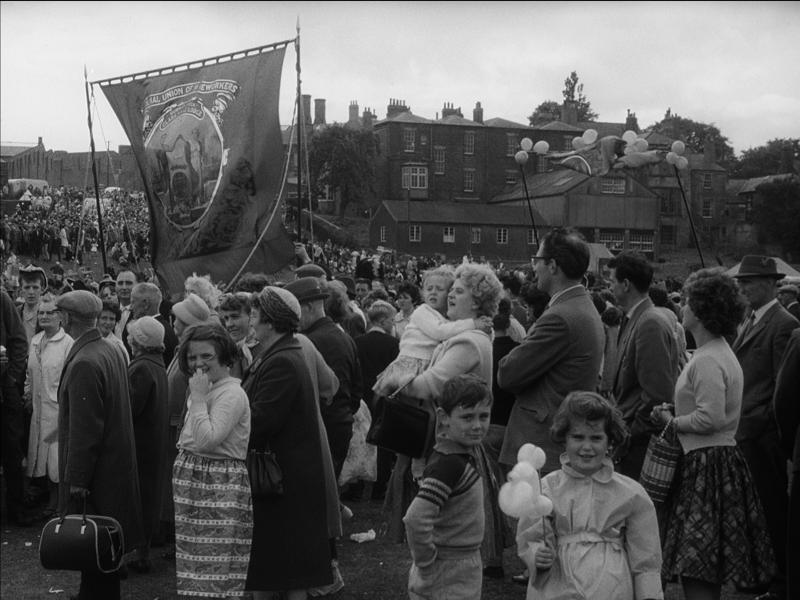
 Avant-garde filmmaker Bill Morrison (Decasia), who uses found footage and often delves into the cinematic process itself in his fascinating work, collaborates with Icelandic musician and composer Jóhann Jóhannsson in the elegiac The Miners’ Hymns, a tribute to the now-gone collieries, or coal mines, of Northeast England. The fifty-two-minute documentary opens with new aerial shots of the locations where the Durham coal mines were, since replaced by luxury housing and megastores. The film shows the birth and death dates of several collieries going back to the nineteenth century, then seamlessly blends into archival black-and-white footage of the miners at work underground, the community coming together for a local fair, and a union rally during a strike that includes a confrontation with the police. There is no text and no narration in The Miners’ Hymn; instead, Morrison’s savvy editing of the found footage, consisting of both moving pictures and still photographs primarily acquired through the British Film Institute and the BBC, brings the old-fashioned town and its old-fashioned ways to vibrant life even though they roll across the screen in slow motion. Jóhannsson’s score punctuates the proceedings with an occasional brassy flare when not sounding more funereal. Despite the lack of text and narration, Morrison’s point of view is clear and all too obvious, paying homage to something that has been lost, and he is never quite able to make an emotional or personal connection with the viewer. However, The Miners’ Hymns contains remarkable footage that still manages to tell an important story, even if it is one-sided and lacking at least a little more historical context. Prior to its theatrical release on February 8 at Film Forum, The Miners’ Hymns is being shown on the big screen in the World Financial Center on January 31 as part of WNYC host John Schaefer’s annual free New Sounds Live Silent Film Series, featuring a live score performed by the Wordless Music Orchestra. The series continues February 1 with Morrison’s latest work, The Great Flood, followed on February 2 with Spark of Being and February 3 with the amazing Decasia, with Michael Gordon’s memorable score performed live by the Oberlin Contemporary Music Ensemble.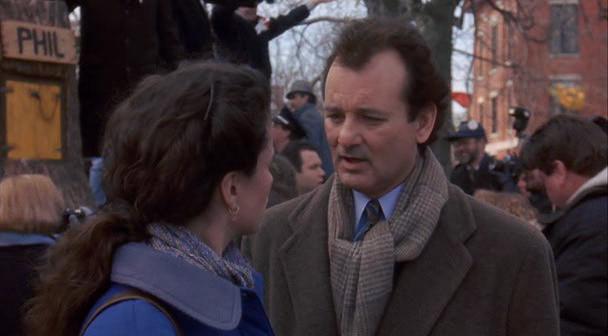
 “Well, what if there is no tomorrow?” asks weatherman Phil Connors in Groundhog Day. “There wasn’t one today.” Bill Murray gives one of his most nuanced performances in the 1993 comedy, ably directed by his Stripes cohort, SCTV alum Harold Ramis. Murray stars as cynical, smarmy, mean-spirited meteorologist Phil Connors, who has been sent by his local TV station to Punxsutawney, Pennsylvania, to cover the annual Groundhog Day festivities and report on whether Punxsutawney Phil sees his shadow. He is joined by segment producer Rita (a radiant Andie MacDowell) and cameraman Larry (the always funny Chris Elliott), who find him to be a pompous ass. But just like Punxsutawney Phil comes out of his hole every February 2, Phil Connors is soon getting out of bed reexperiencing the same exact day, given the chance over and over to change, for better or worse. Besides being downright hysterical, Groundhog Day has a lot of heart, making it the kind of movie you can watch, well, over and over again, still pulling each time for Connors to do the right thing and become a worthwhile human being. It seems that Murray does some of his best work when paired with a small, furry creature, like when he desperately tried to catch and kill a too-smart gopher in Caddyshack. Groundhog Day is screening for free on January 30 at the second annual Citi Pond Winter Film Festival in Bryant Park, which continues February 6 with Edward Scissorhands and February 13 with the animated favorite Lady and the Tramp.
 For The Interrupters, director, producer, and editor Steve James (Hoop Dreams, At the Death House Door) teamed up with journalist Alex Kotlowitz (There Are No Children Here) to hit the dangerous inner-city streets of Chicago with the men and women of CeaseFire, a grass-roots organization of former gang members who are now trying to stop the violence. Inspired by Kotlowitz’s New York Times Magazine article, the two men concentrate on three primary stories. Ameena Matthews, the Muslim daughter of notorious gang leader Jeff Fort, is working with a deeply troubled young woman who’d rather fight than flee, even if it means being sent back to prison. Cobe Williams has his hands full with the angry, recently released Flamo, who thinks the whole world is against him. And Eddie Bocanegra is attempting to come to grips with a cold-blooded revenge murder he committed when he was a teenager by visiting schools and talking about turning his life around. One of the most poignant moments of the film occurs when Williams brings Lil Mikey back to the barbershop he and several of his cohorts robbed at gunpoint as he again faces some of his victims. Matthews, Williams, and Bocanegra are paid employees of CeaseFire, which was founded by Dr. Gary Slutkin, an epidemiologist who believes that violence is a disease that can be treated in similar ways, and is run by Tio Hardman, who handles his extremely tough task with intelligence and dignity as he deals with what he calls “the madness.” But in a society in which “words’ll get you killed,” as Matthews says early on, these tireless violence interrupters put their own lives on the line every day, battling a sickness that seems to have no end in sight. The award-winning film, a hit at numerous film festivals, felt a bit long at its original 144 minutes, but James edited it down to a more streamlined 124 minutes for its recent theatrical release. The Interrupters is screening January 29 at 4:45 as part of Symphony Space’s “Thalia Film Sundays” series, which continues in February with Patrick Takaya Solomon’s Finding Joe and Philipp Stölzl’s Young Goethe in Love.