Even house arrest and potential imprisonment cannot stop Iranian auteur Jafar Panahi from telling cinematic stories
THIS IS NOT A FILM (Jafar Panahi & Mojtaba Mirtahmasb, 2011)
Film Forum
209 West Houston St.
February 29 – March 13
212-727-8110
www.filmforum.org
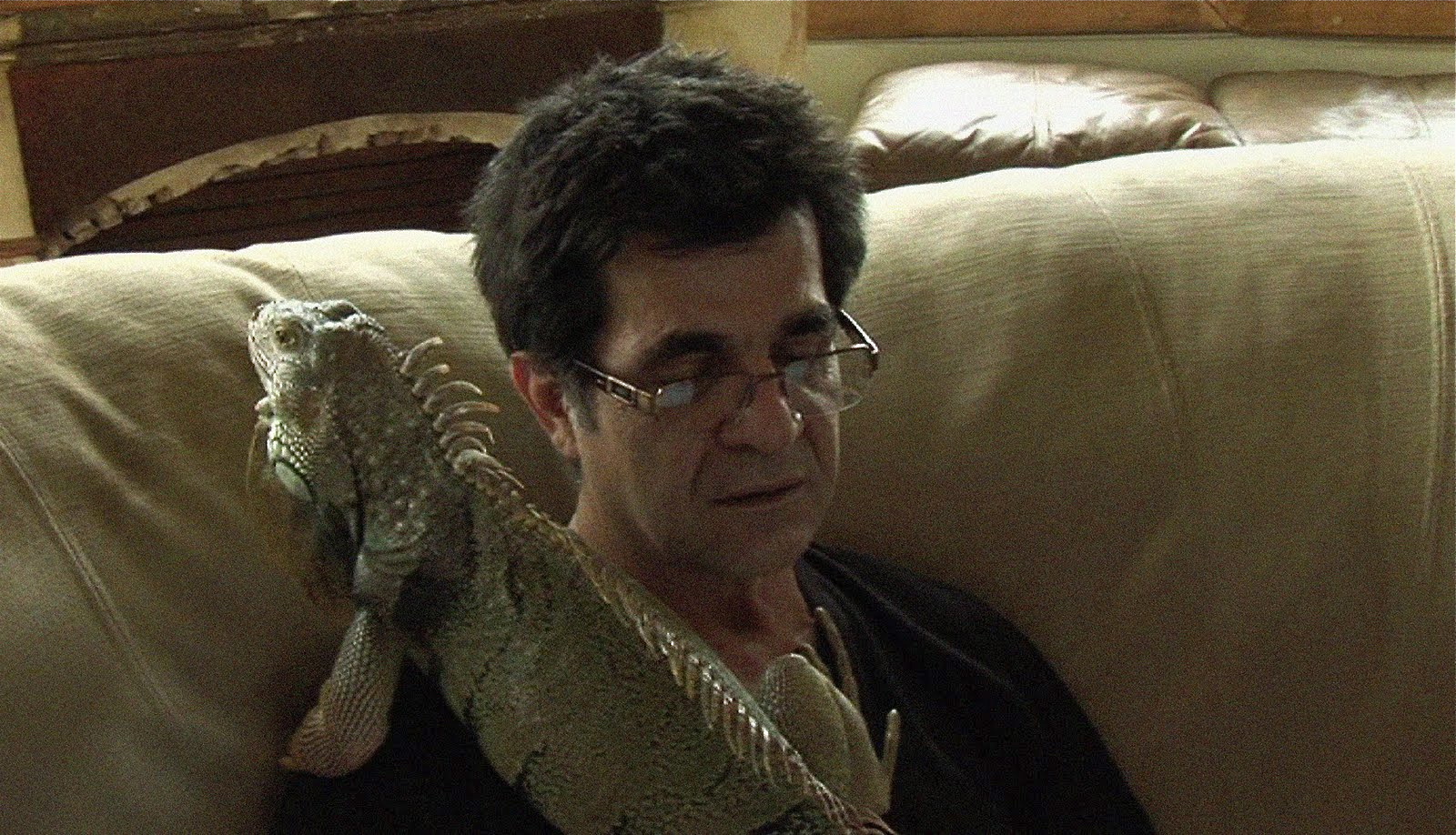
 “You call this a film?” Jafar Panahi asks rhetorically about halfway through the revealing documentary This Is Not a Film. After several arrests beginning in July 2009 for supporting the opposition party, the highly influential and respected Iranian filmmaker (Crimson Gold, Offside) was convicted in December 2010 for “assembly and colluding with the intention to commit crimes against the country’s national security and propaganda against the Islamic Republic.” Although facing a six-year prison sentence and twenty-year ban on making or writing any kind of movie, Panahi is a born storyteller, so he can’t stop himself, no matter the risks. Under house arrest, Panahi has his friend, fellow director Mojtaba Mirtahmasb (Lady of the Roses), film him with a handheld DV camera over ten days as Panahi plans out his next movie, speaks with his lawyer, lets his pet iguana climb over him, and is asked to watch a neighbor’s dog, taking viewers “behind the scenes of Iranian filmmakers not making films.” Panahi even pulls out his iPhone to take additional video, photographing New Year’s fireworks that sound suspiciously like a military attack. Panahi is calm throughout, never panicking (although he clearly does not want to take care of the barking dog) and not complaining about his situation, which becomes especially poignant as he watches news reports on the earthquake and tsunami disaster in Japan. “But you can’t make a film now anyhow, can you?” Mirtahmasb — who will later be arrested and imprisoned as well — asks at one point. “So what I can’t make a film?” Panahi responds. “That means I ask you to take a film of me? Do you think it will turn into some major work of art?” This Is Not a Film, which was smuggled out of Iran in a USB drive hidden in a birthday cake so it could be shown at Cannes, is indeed a major work of art, an important document of government repression of free speech as well as a fascinating examination of one man’s intense dedication to his art and the creative process.
 After the breakout success of Born to Run in 1975, Bruce Springsteen became embroiled in a lawsuit over control of his music that prevented him from going into the studio to make the highly anticipated follow-up. Springsteen found himself at a crossroads; “You didn’t know if this would be the last record you’d ever make,” he says in the revealing behind-the-scenes documentary The Promise: The Making of Darkness on the Edge of Town. Combining archival footage of the Darkness sessions shot by Barry Rebo with new interviews with all the members of the E Street Band in addition to producers Jimmy Iovine, Jon Landau, and others, editor and director Thom Zimny melds Bruce’s past with the present, delving deep into Springsteen’s complex, infuriating, and fiercely dedicated creative process. “I had to disregard my own mutation,” Springsteen says at one point, regarding his battle to avoid getting caught up in the hype that came with Born to Run, so he decided that his next album would be “a meditation on where are you going to stand.” Rebo captures Springsteen and the E Street Band — from a bare-chested Bruce to a bandanna-less Steve Van Zandt — rehearsing and recording alternate takes of familiar songs as well as tunes that would later wind up on such albums as The River and Tracks, opening up Bruce’s famous notebooks and examining his intense creative process, which included throwing away dozens and dozens of songs that he believed just didn’t fit within his vision of what Darkness should be. Two of the most fascinating parts of the The Promise involve Patti Smith discussing “Because the Night,” explaining that the lyrics she added are about her waiting for her boyfriend at the time (and later husband), Fred “Sonic” Smith, to call her, and Toby Scott talking about mixing the Darkness record to get the sound pictures in Bruce’s head onto vinyl. The Promise: The Making of Darkness on the Edge of Town is screening as part of the IFC Center’s Stranger Than Fiction series and will be followed by a Q&A with Zimny, Springsteen’s longtime director who just made the music video for Bruce’s latest single, “We Take Care of Our Own.”
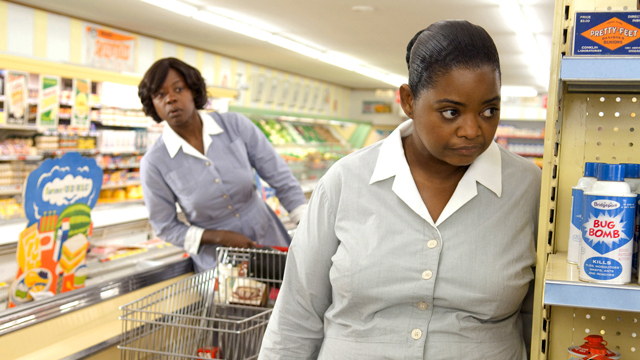
 Based on Kathryn Stockett’s bestselling 2009 debut novel, The Help is an overly melodramatic, emotionally manipulative film about the relationship between the white homeowners of Jackson, Mississippi, and their black maids. Set in the 1960s just as the civil rights movement was beginning to gain ground, the plot centers on a recent white college graduate named Eugenia “Skeeter” Phelan (Emma Stone) who decides that something must be done about the way the whites treat the blacks in her town. An aspiring writer, Skeeter tries to convince black maids Aibileen Clark (Viola Davis) and Minny Jackson (Octavia Spencer) to share their stories for a book that a New York publisher (Mary Steenburgen) might be interested in, but the women are terrified that speaking out could cost them their livelihood as well as jeopardize their physical safety. But as things get worse in Jackson, led by such snooty rich women as Hilly Holbrook (Bryce Dallas Howard), Elizabeth Leefolt (Ahna O’Reilly), and even Skeeter’s mother, Charlotte (Allison Janney), the truth starts becoming more and more difficult to suppress. Adapted and directed by Tate Taylor, The Help undercuts what it is trying to accomplish by making the conflict, well, as black and white as possible, overplaying the sympathy card and laying on the white liberal guilt. While the white men in the film are all powerless cardboard cutouts, there are virtually no black men at all, save for the local preacher (David Oyelowo ) and a counterman (Nelsan Ellis). The only white Jackson housewife who doesn’t treat her maid like a slave, Celia Foote (Jessica Chastain), is a ditzy blonde who can’t take care of herself. Taylor (Pretty Ugly People), who was born and raised in Jackson and is a close friend of Stockett’s, offers the same scenes repeated over and over, going on for nearly two and a half hours. Nominated for four Academy Awards — Best Picture, Best Actress (Davis), and two Best Supporting Actress nods (Spencer and Chastain) — The Help, though well acted, is a major disappointment, a simplistic and condescending movie about an extremely important subject that deserved better treatment.