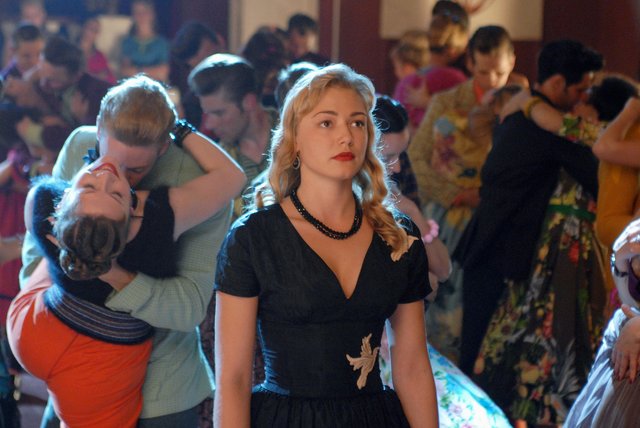
Oksana Akinshina stars as one of a wild group of Russian hipsters not afraid to stare into the face of communism and dance
HIPSTERS (STILYAG) (Valery Todorovsky, 2008)
Cinema Village
22 East 12th St. between University Pl. & Fifth Ave.
Opens Friday, February 24
212-924-3363
www.leisurefeat.com
www.cinemavillage.com
 Shortly after the death of Stalin in 1953, groups of Soviet youth decided to rebel against the boring gray conformity of Russian existence and instead celebrate American hipster culture, dressing in colorful clothing, wearing slick pompadours, and meeting in secret locations along “Broadway” where they would dance wildly to jazz and swing. A sort of Eastern European version of Footloose, Valery Todorovsky’s Hipsters follows the story of Mels (Anton Shagin), a member of the Kmsomol, a uniformed youth organization whose main goal is to destroy the hipsters, known as stilyagi in Russian. But when Mels — whose name is an acronym for Marx/Engels/Lenin/Stalin — confronts the beautiful hipster Polly (Oksana Akinshina), he instantly falls madly in love with her. Shortening his name to the more American Mel, he joins up with the hipsters, even learning to play the saxophone as he woos Polly and battles with Katya (Evgenia Brik), the Kmsomol leader who now considers him to be a traitor. Winner of the Best Picture Nika, the Russian equivalent of the Oscars, Hipsters suffers from a standard, predictable story line, but despite frustrating cliché after frustrating cliché, it starts to grow on you, particularly the musical numbers that take place in regular society, not at the underground parties, which are obvious and overdone. And Akinshina is mesmerizing to watch as Polly, a strong young woman not afraid to spit in the face of life-draining communism. In making the first Russian musical in several generations, Todorovsky (The Lover, Vice) combined 1950s American jazz with 1980s Russian Perestroika rock, giving the film a fresh yet retro feel. Despite a whole lot of silliness and a desperate need to be hip itself, Hipsters is a cold war musical not without a little warmth.
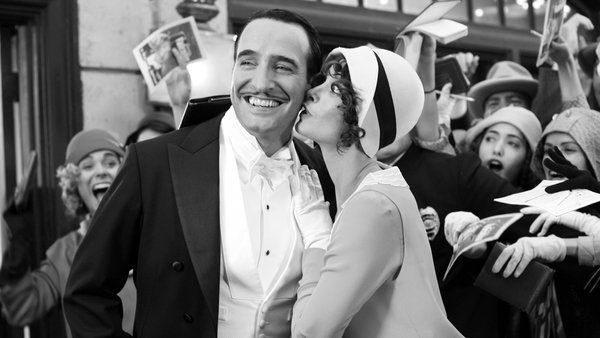
 French director Michel Hazanavicius has followed his two OSS 117 espionage parodies, Cairo, Nest of Spies and Lost in Rio, with another genre exercise, this time taking on silent film in the charming international hit The Artist. Reteaming Jean Dujardin and Bérénice Bejo from Cairo, Nest of Spies, Hazanavicius tells the story of the end of silent cinema through the clever use of the genre’s own familiar conventions. Dujardin stars as George Valentin, a silent-film idol who believes that talking pictures will just be a passing fad. Bejo, who is married to Hazanavicius, plays Peppy Miller, a young, peppy Hollywood hopeful who embraces the arrival of the sound era, rising as fast as Valentin is falling. It’s a different take on the classic A Star Is Born theme, with plenty of inside jokes and cute references about the movies, although purposefully using clichés doesn’t excuse the film from often being too clichéd itself; many of the scenes are far too predictable, offering few genuine surprises as the plot unfolds. However, Hazanavicius and his crew nail the period both aurally and visually, with splendid costumes by Mark Bridges, production design by Laurence Bennett, set decoration by Robert Gould, cinematography by Guillaume Schiffman, and music by Ludovic Bource. Excellent support is supplied by James Cromwell as Valentin’s loyal valet, John Goodman as cigar-chomping producer Al Zimmer, and Uggie as Valentin’s ever-faithful dog, Jack. Nominated for ten Academy Awards, The Artist is a fabulously made though flawed and overrated film that is a charming celebration of the movies — and a great way to get people into theaters to experience the myriad pleasures of black-and-white silent cinema.
 Based on the 2007 novel by Kaui Hart Hemmings, Alexander Payne’s The Descendants is a masterfully made, beautifully told story of love, loss, and family, highlighted by a graceful, wonderfully nuanced performance by George Clooney. Clooney stars as Matt King, a successful Hawaiian lawyer whose wife (Patricia Hastie) has suffered a devastating water-skiing accident that has left her in a coma. King is suddenly forced to be both father and mother to his two daughters, the troubled Alex (Shailene Woodley), who is in college, and ten-year-old Scottie (Amara Miller), something he admits in voice-over narration he is absolutely clueless about. Meanwhile, he is in the midst of deciding what to do with his family inheritance, an enormous plot of pristine beachfront property that his large group of cousins (including Michael Ontkean and Beau Bridges) wants to sell to a major developer. But his life is again turned upside down when he discovers that his marriage was not quite what he thought it had been, learning a secret about his wife that complicates things even further. Nominated for Best Picture, Best Director, Best Actor (Clooney), Best Editing (Kevin Tent), and Best Adapted Screenplay (Payne, Nat Faxon, and Jim Rash), The Descendants never takes the easy way out. In his first film since 2004’s Sideways, Payne (Election, About Schmidt) avoids melodramatic clichés and obvious plot twists, instead creating intelligent scenes filled with complex emotions that continually defy expectations. Clooney gives one of the best performances of his career as King, a carefully measured, subtle portrayal that keeps the film firmly balanced, whether he is being shot from the front, his eyes both intensely thoughtful and painfully confused, or shown from the back, his shoulders barely steady, his head facing out into a whole new world. Payne often allows scenes to take place off-screen and behind closed doors, putting his faith in the audience, who will be well rewarded by putting their trust in him. The Descendants is another great success from Payne, one of Hollywood’s best, and most fascinating, storytellers.
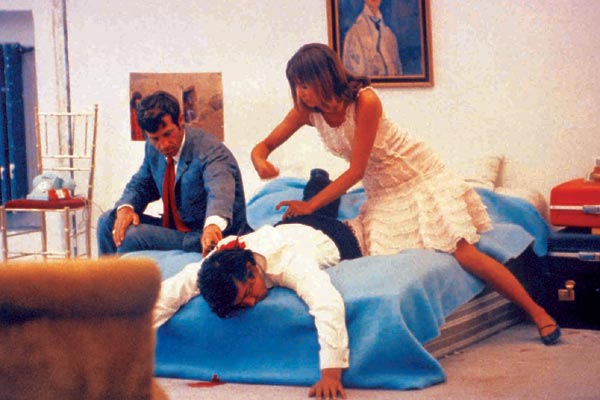
 Art, American consumerism, the Vietnam and Algerian wars, Hollywood, and the cinema itself get skewered in Jean-Luc Godard’s fab feaux gangster flick / road comedy / romance epic / musical Pierrot Le Fou. Based on Lionel White’s novel Obsession, the film follows the chaotic exploits of Ferdinand Griffon (Jean-Paul Belmondo) and Marianne Renoir (Anna Karina, Godard’s then-wife), former lovers who meet up again quite by accident. The bored Ferdinand immediately decides to leave his wife and family for the flirtatious, unpredictable Marianne, who insists on calling him Pierrot despite his protestations. Soon Ferdinand is caught in the middle of a freewheeling journey involving gun running, stolen cars, dead bodies, and half-truths, all the while not quite sure how much he can trust Marianne. Filmed in reverse-scene order without much of a script, the mostly improvised Pierrot Le Fou was shot in stunning color by Raoul Coutard. Many of Godard’s recurring themes and style appear in the movie, including jump cuts, confusing dialogue, written protests on walls, and characters speaking directly at the audience, which is more or less along for the same ride as Ferdinand. And as with many Godard films, the ending is a doozy. Pierrot Le Fou is screening February 21 at 7:30 as part of FIAF’s “Cinema & Fashion: Carte Blanche to agnès b.” series, which also includes Godard’s Vivre sa vie the same day at 12:30 & 4:00 and concludes February 28 with Jacques Becker’s Casque d’or.