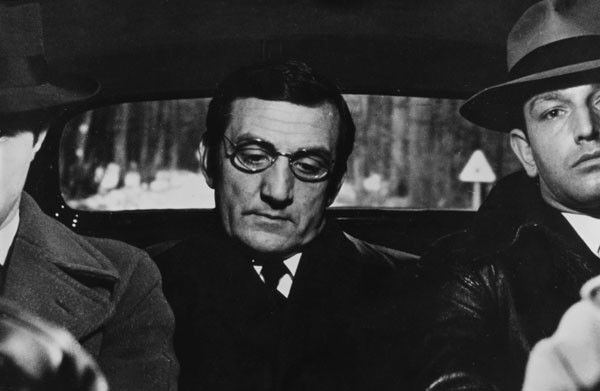
Lina Ventura gives a wonderfully subtle performance as a resistance fighter in Jean-Pierre Melville’s ARMY OF SHADOWS
L’ARMÉE DES OMBRES (ARMY OF SHADOWS) (Jean-Pierre Melville, 1969)
Film Society of Lincoln Center, Walter Reade Theater
165 West 65th St. at Amsterdam Ave.
Monday, March 26, 3:15
Series runs through March 29
212-875-5601
www.filmlinc.com
 Based on the novel by Joseph Kessel (Belle de Jour), Jean-Pierre Melville’s 1969 WWII drama Army of Shadows got its first U.S. theatrical release some thirty-five years later, in a restored 35mm print courtesy of Rialto Pictures and supervised by the film’s cinematographer, Pierre Lhomme, who shot it in a beautiful blue-gray palette. The film centers on a small group of French resistance fighters, including shadowy leader Luc Jardie (Paul Meurisse), the smart and determined Mathilde (Simone Signoret), the nervous Jean-François (Jean-Pierre Cassel), the steady and dependable Felix (Paul Crauchet), the stocky Le Bison (Christian Barbier), the well-named Le Masque (Claude Mann), and the unflappable and practical Gerbier (Lino Ventura). Although Melville, who was a resistance fighter as well, wants the film to be his personal masterpiece, he is too close to the material, leaving large gaps in the narrative and giving too much time to scenes that don’t deserve them. He took offense at the idea that he portrayed the group of fighters as gangsters, yet what shows up on the screen is often more film noir than war movie. However, there are some glorious sections of Army of Shadows, including Gerbier’s escape from a Vichy camp, the execution of a traitor to the cause, and a tense Mission Impossible–like (the TV series, not the Tom Cruise vehicles) attempt to free the imprisoned Felix. But most of all there is Ventura, who gives an amazingly subtle performance that makes the overly long film (nearly two and a half hours) worth seeing all by itself. Army of Shadows is screening March 26 as part of the Film Society of Lincoln Center’s “15 for 15: Celebrating Rialto Pictures” series honoring the fifteenth anniversary of the art-house distributor founded by Film Forum programmer extraordinaire Bruce Goldstein.


 In works such as
 No way around it; this is one funny movie. Written and directed by Mel Brooks (who won an Oscar for Best Original Screenplay), The Producers stars Zero Mostel as Max Bialystock, a once great Broadway producer now relegated to wooing old ladies for their checkbooks. Gene Wilder earned an Oscar nomination for Best Supporting Actor as Leo Bloom, a by-the-book accountant who figures out that it could be possible to make more money from a bomb than a hit. And the bomb they turn to is the extraordinary Springtime for Hitler, featuring a great turn by Kenneth Mars as a neo-Nazi. Brooks, Mostel, Wilder, Mars, and the rest of the crazy cast — which also includes Dick Shawn, Lee Meredith, Estelle Winwood, Christopher Hewett, Renee Taylor, Barney Martin, Bill Macy, and William Hickey — don’t just play it for laughs but for giant guffaws and jaw-dropping disbelief in this riotous romp that was turned into a very good but overrated Broadway musical and a terrible film version of the show, both starring Nathan Lane and Matthew Broderick, neither of whom can fill Mostel and Wilder’s shoes. The Producers is screening March 23 as part of the Film Society of Lincoln Center’s “15 for 15: Celebrating Rialto Pictures” series honoring the fifteenth anniversary of the art-house distributor founded by Film Forum programmer extraordinaire Bruce Goldstein; upcoming films include Jules Dassin’s Riffifi, Claude Berri’s The Two of Us, Federico Fellini’s Nights of Cabiria, and Jacques Becker’s Touchez pas au grisbi.
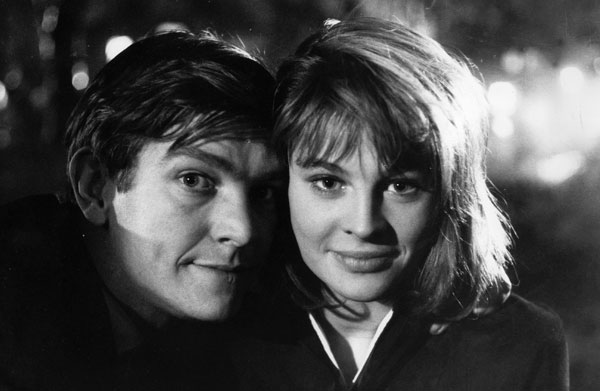
 Based on the novel by Keith Waterhouse (which he also adapted into a play with Willis Hall and which later became a musical), John Schlesinger’s Billy Liar is a prime example of the British New Wave of the 1950s and 1960s, which features work by such directors as Lindsay Anderson, Joseph Losey, Ken Russell, Nicolas Roeg, and Karel Reisz. Tom Courtenay stars as William Fisher, a ne’er-do-well ladies’ man who drudges away in a funeral home and dates (and lies to) multiple women, all the while daydreaming of being the president of the fictional country of Ambrosia. Billy lives in his own fantasy world where he can suddenly fire machine guns at people who bother him and be cheered by adoring crowds as he leads a marching band. Reminiscent of the 1947 American comedy The Secret Life of Walter Mitty, in which Danny Kaye dreams of other lives to lift him out of the doldrums, Billy Liar is also rooted in the reality of post-WWII England, represented by Billy’s father (Wilfred Pickles), who thinks his son is a no-good lazy bum. Shot in black-and-white, the film glows every time Julie Christie appears playing Liz, a modern woman who takes a rather fond liking to Billy. The film made Christie a star; Schlesinger next cast her in Darling, for which she won the Oscar for Best Actress. Billy Liar is screening March 23 as part of the Film Society of Lincoln Center’s “15 for 15: Celebrating Rialto Pictures” series honoring the fifteenth anniversary of the art-house distributor founded by Film Forum programmer extraordinaire Bruce Goldstein. “When I first encountered Billy Liar in the early 1970s, I’d never heard of it,” Goldstein wrote in a 2011 Criterion essay. “I’d somehow acquired a 16mm panned-and-scanned print, and was intrigued by both the title and cast. I certainly knew who Julie Christie was, and I vaguely remembered Tom Courtenay in The Loneliness of the Long Distance Runner, so I ran it. I then ran it a second time. And then again and again, until I fell in love with it.”