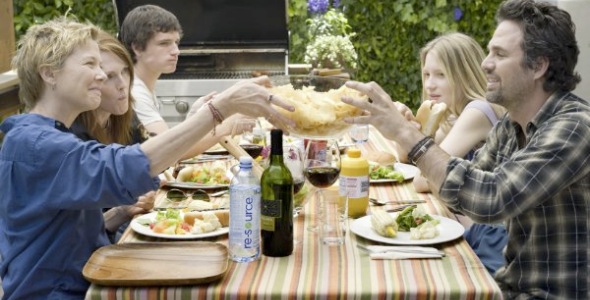
Things are not necessarily quite as happy as they might seem for this very different kind of dysfunctional family
THE KIDS ARE ALL RIGHT (Lisa Cholodenko, 2010)
MoMA Film, Museum of Modern Art
11 West 53rd St. between Fifth & Sixth Aves.
Thursday, May 10, 4:00, and Friday, May 18, 4:30
Series runs through May 20
Tickets: $12, in person only, may be applied to museum admission within thirty days, same-day screenings free with museum admission, available at Film and Media Desk
212-708-9400
www.moma.org
www.filminfocus.com
 When half-siblings Joni (Mia Wasikowska) and Laser (Josh Hutcherson) decide to track down their anonymous sperm-donor father, their two moms, Jules (Julianne Moore) and Nic (Annette Bening), are justifiably concerned with how that might affect their close-knit family. And when the donor ends up being a motorcycle-riding, free-spirited hottie (Mark Ruffalo) who would like to become part of the kids’ lives, it doesn’t take long for some major dysfunction to set in. The third feature-length narrative written or cowritten and directed by Lisa Cholodenko, following 1998’s High Art and 2002’s Laurel Canyon (she directed 2004’s Cavedweller but did not write it), The Kids Are All Right is another intimate drama that explores deeply personal relationships with grace and intelligence — along with a little lesbianism. Bening is strong as the man of the house, overly determined to control and protect her family; Moore is beguiling as the other mother, wanting to develop her own business as a landscape architect; and Wasikowka, who was so outstanding in the HBO series In Treatment, impresses again as the prodigal daughter preparing to go to college. Ruffalo, however, is too flat, and the film takes several missteps, including a final scene that is sadly predictable, detracting from an otherwise fresh and original story. The Kids Are All Right is screening May 10 and 18 at MoMA as part of the series “Focus Features: 10th Anniversary Salute,” which pays tribute to the New York-based distributor responsible for such cutting-edge independent films as Michel Gondry’s Eternal Sunshine of the Spotless Mind, Sofia Coppola’s Lost in Translation, and David Cronenberg’s Eastern Promises, all of which are part of this festival, which runs through May 20.
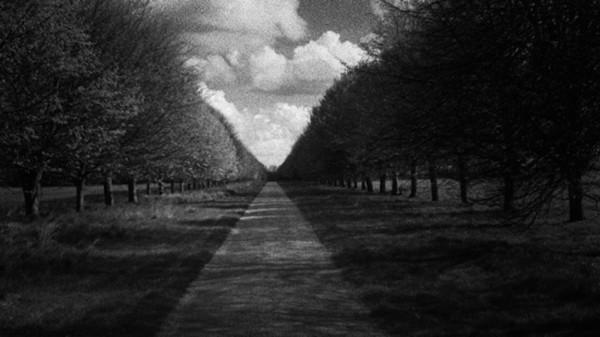
 British director Grant Gee, who has previously made such music documentaries as Meeting People Is Easy (about Radiohead), Demon Days: Live at the Manchester Opera House (with Gorillaz), and Joy Division, takes off on a more literary journey with Patience (After Sebald). Commissioned to examine a written work of fiction or nonfiction, Gee chose to delve into W. G. Maximilian Sebald’s highly influential 1995 book, The Rings of Saturn, about a character named W. G. Sebald who goes on a walk through Suffolk in East Anglia, veering off in his mind in all directions, waxing poetic on history, geography, life, death, literature, and other subjects. “In August 1992,” Sebald begins in the existential travelogue, “when the dog days were drawing to an end, I set off to walk the county of Suffolk, in the hope of dispelling the emptiness that takes hold of me whenever I have completed a long stint of work.” In the film, Gee includes shots of his own feet as he follows Sebald’s path, along with archival footage that relates to the book itself as such writers, artists, and cultural critics as Rick Moody, Tacita Dean, Ian Sinclair, Marina Warner, Adam Phillips, Andrew Motion, and Robert McFarlane talk about Sebald, who died in 2001 at the age of fifty-seven, and the importance of the hard-to-define Rings. To match the older footage, Gee shot much of the new material in a hazy, grainy black and white, with the talking heads occasionally appearing on camera almost in the background. The film includes fascinating snippets of a rare radio interview with Sebald in addition to a narrator reading sections from the book, both of which end up being far more interesting than what many of the other contributors have to say. Reminiscent of Patrick Keiller’s Robinson in Ruins, Robinson in Space, and London, Gee’s Patience fetishizes its subject but lacks the visual and aural poetry of those works, with the walk becoming somewhat tiresome until its offbeat surprise ending. As on most trips, there are beautiful moments, engaging digressions, and gorgeous landscapes to linger over, but they grow fewer and farther between as the story unfolds. Although it’s not necessary to have read the book in order to follow Gee’s wanderings, it would probably help. Patience (After Sebald) opens May 9 at Film Forum, with the 8:20 show on opening night introduced by Sebald friend Moody, and the 8:20 show on May 11 will be introduced by Lynne Sharon Schwartz, editor of The Emergence of Memory: Conversations with W.G. Sebald.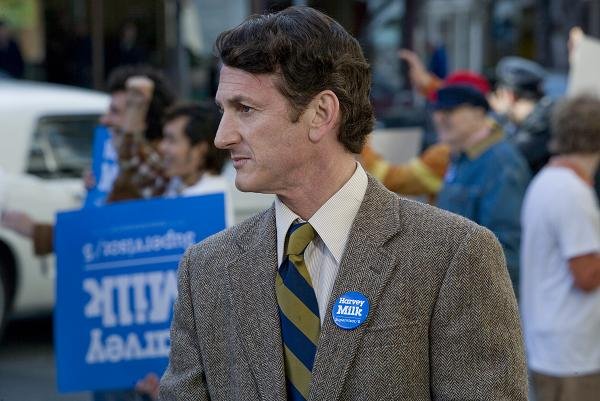
 Gus Van Sant’s Milk is a solid if surprisingly standard biopic focusing on the last eight years in the life of Harvey Milk, the gay activist and politician who was assassinated in 1978. Van Sant (Drugstore Cowboy, To Die For, Good Will Hunting) follows the eventual unofficial Mayor of Castro Street (Sean Penn) as he moves to San Francisco with his much younger partner, Scottie Smith (James Franco), and sets up a camera shop that soon becomes an important meeting ground for the local gay community, fighting for equal rights and supporting Milk as he continually campaigns for public office. The battle hits its high point in 1978 when Milk takes on John Briggs (Denis O’Hare) and the Briggs Initiative, also known as Proposition 6, which sought to take away existing employment rights from gays and lesbians in the California public school system, eerily reminiscent of the recent battle over Proposition 8 there. Although Milk was a rallying figure — his opening mantra was always “My name is Harvey Milk, and I am here to recruit you!” — the film never quite takes off the way it wants to, instead becoming too reverential and melodramatic. Penn, who won an Oscar for his portrayal, is good but subdued in the lead role; the best performance comes from Josh Brolin as Dan White, Milk’s main adversary among the SF supervisors. Milk is screening May 9 and 19 at MoMA as part of the series “Focus Features: 10th Anniversary Salute,” which pays tribute to the New York-based distributor responsible for such cutting-edge independent films as Michel Gondry’s Eternal Sunshine of the Spotless Mind, Lisa Cholodenko’s The Kids Are All Right, Sofia Coppola’s Lost in Translation, and David Cronenberg’s Eastern Promises, all of which are part of this festival, which runs through May 20.
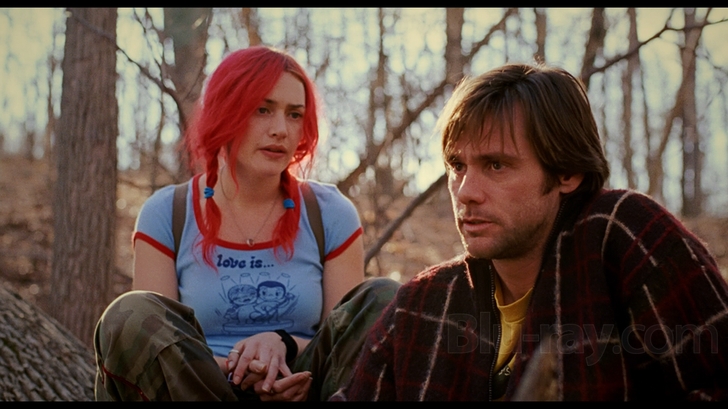
 This brilliant work comes from the warped mind of Charlie Kaufman, the sensational scribe behind Being John Malkovich, Adaptation., and Confessions of a Dangerous Mind. (Chris Elliott fans will get a kick out of knowing that Kaufman was a writer for Get a Life, one of the great warped series of all time.) Eternal Sunshine of the Spotless Mind stars Jim Carrey and Kate Winslet as a couple looking to erase each other from their memories by . . . ah, don’t worry what it’s about. The less you know, the better. Just be prepared for a visual, metaphysical spectacle that will both exhilarate and depress you, filling you with wonder and amazement. The only thing keeping it from perfection is the ordinariness of the subplot involving Elijah Wood. Kaufman and director Michel Gondry (The Science of Sleep) mix in a little Punch-Drunk Love and Groundhog Day, both of which also featured former television comedians in more serious roles, but end up with something wholly original and, quite simply, one of the most romantic movies we have ever seen.Eternal Sunshine is screening May 9 and 19 at MoMA as part of the series “Focus Features: 10th Anniversary Salute,” which pays tribute to the New York-based distributor responsible for such cutting-edge independent films as Gus Van Sant’s Milk, Lisa Cholodenko’s The Kids Are All Right, Sofia Coppola’s Lost in Translation, and David Cronenberg’s Eastern Promises, all of which are part of this festival, which runs through May 20.
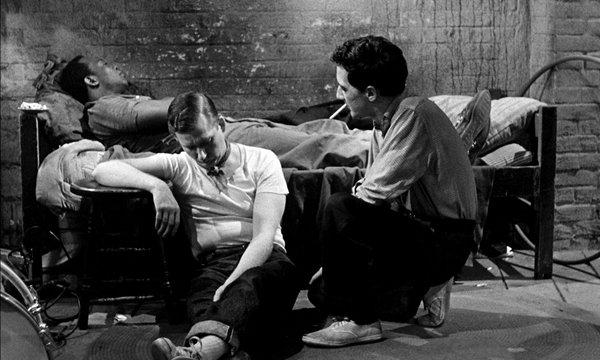
 “Now look, you cats may know more about junk, see,” square film director Jim Dunn (William Redfield) says midway through The Connection, “but let me swing with this movie, huh?” Adapted by Jack Gelber from his play and directed and edited by Shirley Clarke, The Connection is a gritty tale of drug addicts awaiting their fix that was banned for obscenity after only two matinee screenings back in October 1962. It opens in a sharp new fiftieth-anniversary print on May 4 at the IFC Center, beautifully restored by Ross Lipman of the UCLA Film & Television Archive. In a New York City loft, eight men are waiting for their man: Leach (Warren Finnerty), the ringleader who has an oozing scab on his neck; Solly (Jerome Raphael), an intelligent philosopher who speaks poetically about the state of the world; Ernie (Garry Goodrow), a sad-sack complainer who has pawned his horn but still clutches tight to the mouthpiece as if it were a pacifier; Sam (Jim Anderson), a happy dude who tells rambling stories while spinning a hula hoop; and a jazz quartet consisting of real-life musicians Freddie Redd on piano, Jackie McLean on sax, Larry Richie on drums, and Michael Mattos on bass. Dunn and his cameraman, J. J. Burden (Roscoe Lee Browne), are in the apartment filming the men as Dunn tries to up the drama to make it more cinematic as well as more genuine. “Don’t be afraid, man,” Leach tells him. “It’s just your movie. It’s not real.” When Cowboy (Carl Lee) ultimately shows with the stuff, Bible-thumping Sister Salvation (Barbara Winchester) at his side, things take a decidedly more drastic turn. Mixing elements of the French New Wave with a John Cassavetes sensibility and cinema verité style, Clarke has made an underground indie classic that moves to the beat of an addict’s craving and eventual fix. Shot in a luridly arresting black-and-white by Arthur Ornitz, The Connection is like one long be-bop jazz song, giving plenty of time for each player to take his solo, with standout performances by McLean musically and Raphael verbally. The film-within-a-film narrative allows Clarke to experiment with the mechanics of cinema and challenge the audience; when Dunn talks directly into the camera, he is speaking to Burden, yet he is also breaking the fourth wall, addressing the viewer. Cutting between Burden’s steady camera and Dunn’s handheld one, Clarke adds dizzying swirls that rush past like a speeding subway train. A New York City native, Clarke made such other films as The Cool World and Portrait of Jason and won an Academy Award for her 1963 documentary Robert Frost: A Lover’s Quarrel with the World. This new print of The Connection is part of Milestone Films’ Shirley Clarke Project, which will preserve and restore a quartet of her best work, with the 1985 documentary Ornette: Made in America up next.