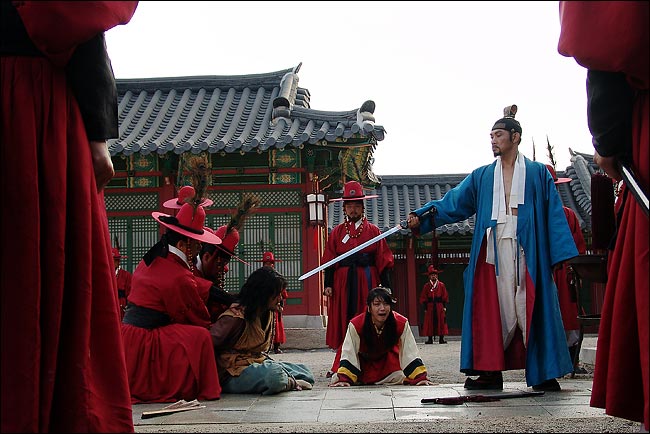
Korean smash KING AND THE CLOWN is based on the Royal Records of the Chosun Dynasty
EPIC ROMANCE: KING AND THE CLOWN (WANG-UI NAMJA) (Lee Jun-ik, 2009)
Tribeca Cinemas
54 Varick St. at Laight St.
Tuesday, May 15, free, 7:00
Series runs every other Tuesday through June 19
212-759-9550
www.koreanculture.org
www.tribecacinemas.com
 Adapted from Kim Tae-woong’s award-winning play Yi (You) and inspired by the Royal Records of the Chosun Dynasty, Lee Jun-ik’s historical epic, King and the Clown, was a critical and popular smash in Korea despite its homosexual subtext. In the early sixteenth century, a troupe of traveling minstrels is making its way across the country when Jang-saeng (Kam Wu-seong) decides that he no longer wants Gong-gil (Lee Jun-ki), an androgynous member of the group who plays all the sexy female characters, to be pimped out to towns’ local leaders. After a deadly fight, the two clowns are on the run, soon taking up with another small troupe and getting arrested for mocking King Yeonsan (Jeong Jin-yeong) and his mistress, Jang Noksu (Kang Seong-yeon). Facing execution, they are saved when the king takes a liking to them, and especially to Gong-gil. But as they continue to stage routines criticizing important ministers and other VIPs, they make high-ranking enemies and once again find their lives in danger. While the first half of King and the Clown tends to be a bit goofy, it sets up the masterfully told second half, an intense, compelling combination of love, fear, politics, and power. Jeong is excellent as Yeonsan, capturing the yin-yang of a leader trying to break free of his late father’s far-reaching grasp, laughing at the clowns one moment, brutally killing someone the next. Lee is alluring as Gong-gil, a beautiful boy uncomfortable with his role but willing to do whatever is asked of him. But the film’s centerpiece is Kam as Jang-saeng, a confident, forward-thinking, risk-taking performer who believes in justice, honor, and creative and personal freedom. King and the Clown is screening for free May 15 at Tribeca Cinemas as part of the Korean Cultural Service film series “Epic Romance,” which continues June 5 with Kim Dae-woo’s Forbidden Quest and June 19 with Kim Yong-gyun’s The Sword with No Name.
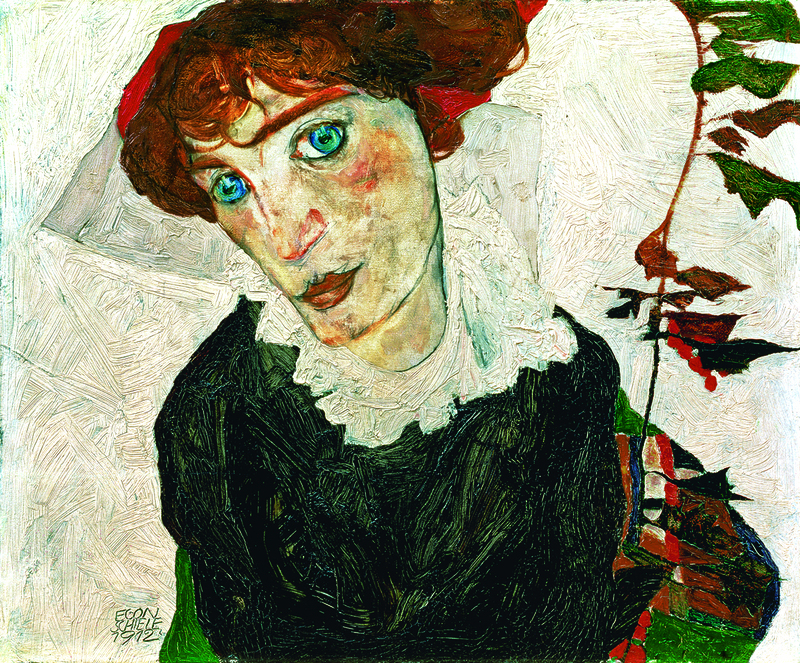
 An exciting, fast-paced documentary set in the high-stakes art world, Andrew Shea’s Portrait of Wally is a gripping real-life legal thriller, complete with international intrigue, love and death, class warfare, lies and deception, and Nazis. In 1912, Austrian artist Egon Schiele painted a small portrait of his mistress, Walburga (“Wally”) Neuzil, in addition to a companion self-portrait. In 1939, the painting of Wally was stolen from art dealer Lea Bondi’s personal collection by Friedrich Welz, a Nazi who had also taken over Bondi’s gallery because she was Jewish. When the painting suddenly showed up in New York City in 1997 as part of the Museum of Modern Art’s “Egon Schiele: The Leopold Collection” exhibition, a furious, angry thirteen-year battle ensued over ownership of the work, involving Manhattan district attorney Robert Morgenthau; MoMA director Glenn D. Lowry; Sharon Cohen Levin, chief of the Asset Forfeiture Unit of the U.S. Attorney’s Office; investigator Willi Korte of the Holocaust Art Restitution Project; Schiele-obsessed art collector Rudolf Leopold; and the Bondi family. Other major museums sided with MoMA in a concerted effort to prevent the government from returning the painting to the Bondis, claiming that it would seriously damage the ability of art institutions to bring works on loan for exhibition in the United States; interestingly, Lowry and MoMA chairman Ronald S. Lauder, who is also the head of the Commission for Art Recovery and displays many of Schiele’s paintings and drawings at his Neue Galerie in New York City, opted not to speak with Shea, but the filmmaker did meet with Morgenthau, Levin, André Bondi, New York Times reporter Judith Dobrzynski, 60 Minutes journalist Morley Safer, Galerie St. Etienne owner and Schiele expert Jane Kallir, and others who share fascinating details about the personal and professional history of Schiele and the painting as well as the inner workings of the art world. Mixing archival footage with new interviews, Shea and his wife, editor Melissa Shea, tell a compelling tale of global importance filled with powerful emotion that, in many ways, evokes the feeling one gets when looking closely at a master work of art. But Portrait of Wally is about a lot more than just art; it is also about memory, about family, about responsibility, and about justice.

 Photographer Edward Burtynsky has been traveling the world with his large-format viewfinder camera, taking remarkable photographs of environmental landscapes undergoing industrial change. For Manufactured Landscapes, cinematographer Peter Mettler and director Jennifer Baichwal joined Burtynsky on his journey as he documented ships being broken down in Chittagong, Bangladesh; the controversial development of the Three Gorges Dam Project in China, which displaced more than a million people; the uniformity at a factory in Cankun that makes irons and the Deda Chicken Processing Plant in Dehui City; as well as various mines and quarries. Burtynsky’s photos, which were on view at the Brooklyn Museum in late 2005 and often can be seen in Chelsea galleries, are filled with gorgeous colors and a horrible sadness at the lack of humanity they portray. As in the exhibit, the audience is not hit over the head with facts and figures and environmental rhetoric; instead, the pictures pretty much speak for themselves, although Burtynsky does give some limited narration. Baichwal lets the camera linger on its subject, as in the remarkable opening shot, a long, slow pan across a seemingly endless factory. She is also able to get inside the photographs, making them appear to be three-dimensional as she slowly pulls away. Manufactured Landscapes is screening May 11 at the Maysles Cinema as part of the Beyond the Image series, which examines how photography is used in documentary film, and will be followed by a Skype Q&A with Baichwal, moderated by photographer Katie Murray. Curated by Clara Bastid, Maira Nolasco, and Zack Taylor, the series continues May 12 with Cheryl Dunn’s Everybody Street and Albert Maysles and Bradley Kaplan’s Close Up: Photographers at Work, followed by a reception and panel discussion with Maysles, Dunn, and photographers Ricky Powell and Clayton Patterson, moderated by Taylor, and May 13 with Christian Frei’s War Photographer, followed by a Q&A with Nolasco and journalist Jimmie Briggs.