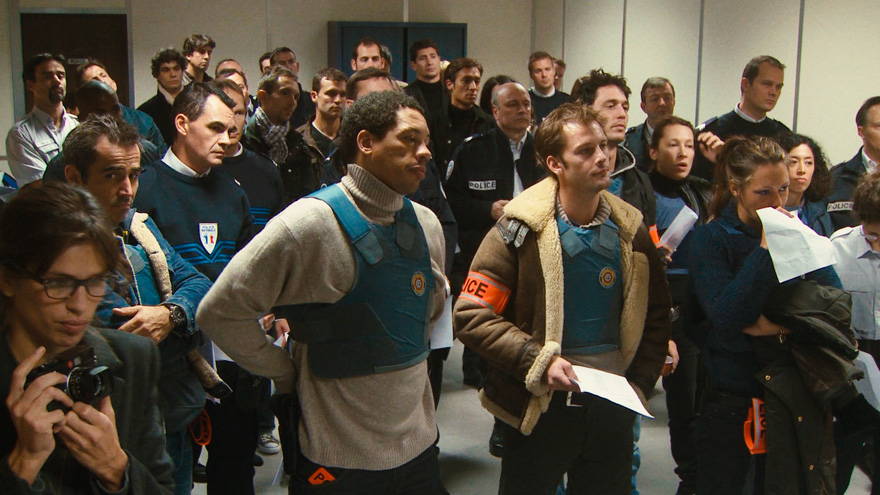
POLISSE follows a Child Protection Unit as it performs its daily duties in Paris
POLISSE (Maïwenn, 2011)
IFC Center, 323 Sixth Ave. at Third St., 212-924-7771
Lincoln Plaza Cinema, 1886 Broadway at 63rd St., 212-757-2280
Opens Friday, May 18
www.sundanceselects.com
 Winner of the Jury Prize at the 2011 Cannes Film Festival and nominated for thirteen Césars, Polisse is an intimate portrait of the men and women who work in the Child Protection Unit of a Paris police precinct. After seeing a television documentary about the CPU, French writer-director-producer-actress Maïwenn (Le bal des actrices, Pardonnez-moi) spent time with the team, basing the screenplay, which she wrote with Emmanuelle Bercot, on her own experiences as well as the stories she heard while embedded with the plainclothes officers. Maïwenn plays a fictionalized version of herself in the film, starring as Mélissa, a young woman who has been embedded with the CPU, taking photographs of the unit in the station house, out on calls, and even in their off time. Polisse does a fabulous job depicting the myriad intricacies of investigating claims of child abuse and pedophilia, showing how careful the team must be when speaking with the children as well as the adults, knowing that the slightest misunderstanding could result in devastating circumstances. Maïwenn includes only bits and pieces of the interrogations, placing the audience in the position of wondering what the truth is and understanding how hard it is to make those decisions. The first half of Polisse is absolutely gripping, but the second half gets bogged down in the soap-opera relationships of the members of the unit as well as a special detail they get assigned to that makes little sense. The large cast, which also features Karin Viard, Joeystarr, Marina Foïs, Nicolas Duvauchelle, Karole Rocher, Frédéric Pierrot, Frédéric Pierrot, and Bercot as Sue Ellen, do a terrific job creating the camaraderie among the officers, from supporting one another to going out drinking to getting into serious arguments, like an extended family that, in this case, spends much of its time investigating dangerous problems in other families.
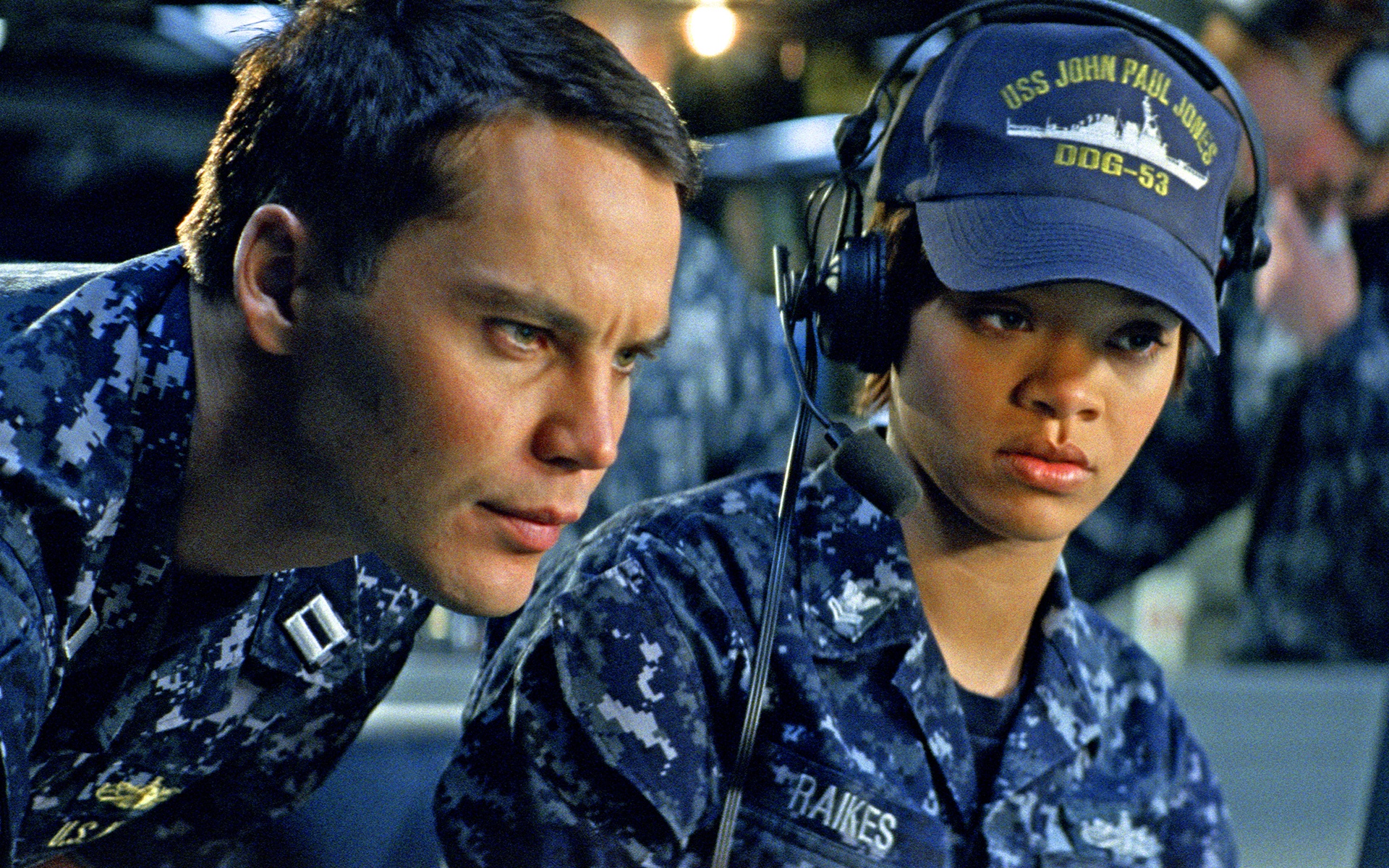
 Whoever first said that you can’t put a square peg in a round hole was clearly not a Hollywood producer. In the big-budget Battleship, writers Jon and Erich Hoeber (Red) and director Peter Berg (Friday Night Lights, The Kingdom) transform the old-fashioned, ultra-low-tech board game Battleship into a massive sci-fi action thriller that is pretty much as dumb as you would expect but not quite as stupid as you would hope. Which is not saying that it is not both dumb and stupid, but it will also unexpectedly grab you upon occasion. Taylor Kitsch stars as Alex Hopper, a young ne’er-do-well who is forced to join the Navy by his older brother, Commander Stone Hopper (Alexander Skarsgård), after everything else in Alex’s life has gone wrong. Just as he’s about to be tossed out of the Navy as well, Alex — who has fallen in love with blonde physical therapist Samantha Shane (Brooklyn Decker), the stunningly beautiful daughter of the tough-as-nails Admiral Shane (Liam Neeson) — must suddenly turn into a leader as the Pacific Fleet comes under attack from what appears to be alien invaders. Taking multiple pages out of such disaster flicks as Armageddon, Pearl Harbor, The Day After Tomorrow, and the 1998 Godzilla, Berg has made an utterly predictable movie with inane dialogue, absurd subplots, cool explosions, and a booty-shaking soundtrack (by composer Steve Jablonsky, with guitar by Tom Morello along with an overdose of classic rock). The casting is often more interesting than the film itself, with Rihanna as Petty Officer Cora Raikes, Army veteran and double amputee Gregory D. Gadson as Lieutenant Colonel Mick Canales, and Japanese star Tadanobu Asano (Ichi the Killer) as Captain Nagata. As far as the film’s relationship to the board game goes, the alien bombs are shaped like Battleship pegs, and there is one scene in which a computerized numbered and lettered grid is used to try to track down the enemy. What’s next? Pong: The Movie? Actually, it looks like there are plans to turn Asteroids and Space Invaders into films. We kid you not. And as far as Battleship is concerned, we can’t even consider it sunk, as it has already grossed more than $200 million overseas. And if you sit through all of the credits, you’ll be rewarded by a bonus scene that just might make you think that a sequel is possible.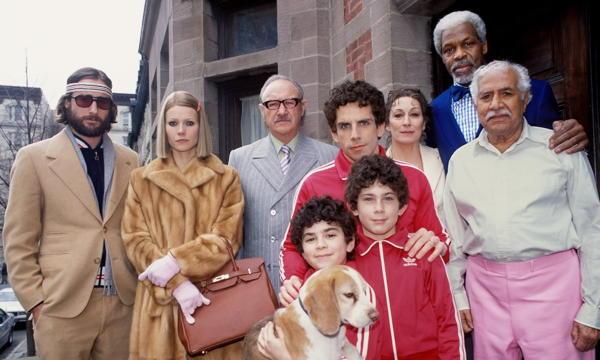
 In his hysterical 2001 black comedy The Royal Tenenbaums, eclectic indie auteur Wes Anderson (The Darjeeling Limited, Fantastic Mr. Fox) created one of the kings of dysfunctional film families. Directly inspired by J. D. Salinger’s Glass clan (Franny and Zooey, Raise High the Roof Beam), the Tenenbaums of New York City have more than their fair share of distress. After being kicked out of the house for being a lousy father and husband, Royal (Gene Hackman) returns, claiming he is dying of stomach cancer. His wife, noted archaeologist Etheline (Anjelica Huston), is now seeing her accountant, the straitlaced Henry Sherman (Danny Glover). Finance wiz Chas (Ben Stiller) is having difficulty getting over his wife’s death in a plane crash, becoming absurdly overprotective of his two young sons’ (Grant Rosenmeyer and Jonah Meyerson) safety. Tennis prodigy Richie (Luke Wilson) is recovering from a very public breakdown and soon has to admit to himself that he is madly in love with his adopted playwright sister, Margot (Gwyneth Paltrow), who is married to strange neurologist Raleigh St. Clair (Bill Murray) and having an affair with longtime family friend and Western novelist Eli Cash (cowriter Owen Wilson). Narrated by Alec Baldwin, The Royal Tenenbaums completed an impressive opening hat trick from Anderson, who had previously made Bottle Rocket (1996) and Rushmore (1998). The marvelously funny flick is screening May 19 & 20 as part of the Museum of the Moving Image series “Wes Anderson’s Worlds,” which is being held in conjunction with the opening of Anderson’s latest, Moonrise Kingdom. The festival begins May 18 with Rushmore and continues through May 27 with screenings of all of his feature-length films, each of which will include a video introduction from Anderson.

 Winner of a Special Jury Prize in the Un Certain Regard section of the 2011 Cannes Film Festival, Andrey Zvyagintsev’s Elena is a poignant character study and family drama set in Vladimir Putin’s post-Communist Russia. Nadezhda Markina gives a marvelously understated performance as Elena, a former nurse now married to her second husband, the successful and very direct Vladimir (Andrey Smirnov). Elena’s son from her first marriage, the unemployed Sergey (Alexey Rozin), is in need of money to support his wife, Tatyana (Evgenia Konushkina) and send his son, Sasha (Igor Ogurtsov), to university, but Vladimir is reconsidering helping them out, believing that it’s about time that Sergey got a job and took care of things himself. Vladimir’s hesitation extremely disappoints Elena, especially when Vladimir continues to support his daughter, Katerina (Elena Lyadova), a free spirit who barely acknowledges his existence. After Vladimir suffers a heart attack, Elena fears for her future and that of her family, suddenly facing some hard questions. Zvyagintsev has followed up the critical smash successes The Return and The Banishment with another superbly told tale that makes expert use of the tools of his trade, from the strong, assured script, which he cowrote with Oleg Negin, and the gorgeous cinematography by Mikhail Krichman to the solid acting and the haunting music. Elena is this generation’s Jeanne Dielman, a deliberate, methodical woman who finds herself caught up in a complex situation with no easy way out. The slow pace of the film, which is filled with lingering shots and Philip Glass’s modern-noir score (from 1995’s Symphony No. 3), moves intoxicatingly to the beat of Elena’s heart. Zvyagintsev, who was just celebrated at BAM with a three-day “Next Director” retrospective, will be at Film Forum for a discussion following the 8:00 screening on May 16.
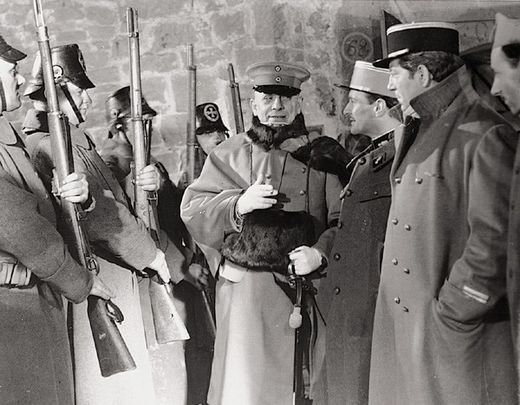
 If you’ve never seen this remarkable cinematic achievement, prepare to be overwhelmed by Jean Renoir’s antiwar masterpiece, screening through May 24 at Film Forum in an all-new 35mm restored print in honor of the film’s seventy-fifth anniversary. The first foreign film to be nominated for a Best Picture Oscar, Grand Illusion is set in a POW camp during WWI, where everyman pilot Lieutenant Maréchal (Jean Gabin), by-the-book Captain de Boieldieu (Pierre Fresnay), lovable Rosenthal (Marcel Dalio), and others are being held by the aristocratic Captain von Rauffenstein (an unforgettable Erich von Stroheim). Proclaimed “cinematic public enemy no. 1” by Joseph Goebbels, Grand Illusion takes on anti-Semitism, class structure, and religion in addition to war, a humanist film that is as relevant as ever seventy-five years after its initial release. Illustrator Paul Davis will be at Film Forum on May 15 following the 7:45 show to sign copies of his specially created poster celebrating the anniversary.