AMERICAN GANGSTER kicks off tribute to Ridley Scott at Lincoln Center
AMERICAN GANGSTER (Ridley Scott, 2007)
Film Society of Lincoln Center, Walter Reade Theater
165 West 65th St. at Amsterdam Ave.
Friday, May 25, 1:00, and Monday, May 28, 6:15
212-875-5601
www.filmlinc.com
www.americangangster.net
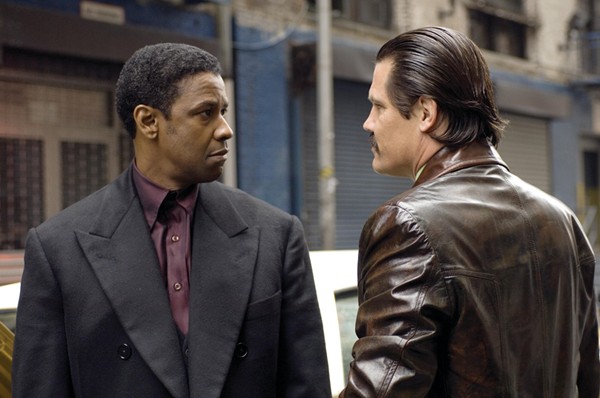
 Based on a true story, Ridley Scott’s American Gangster follows the path of two very different men during the Vietnam War era. Frank Lucas (Denzel Washington) is a proud, dedicated man from poor southern roots who is determined to become the most respected and loved drug lord of Harlem. Richie Roberts (Russell Crowe) is an honest-to-a-fault Jewish cop studying to become a lawyer while failing miserably in his personal life. Cold, calculating, and smooth as silk, Lucas will do whatever is necessary to ensure his absolute success, including shooting another player in the head in plain view on an uptown street. Meanwhile, Roberts becomes a pariah in the corrupt police department when he finds nearly a million dollars in cash and turns it in. As the war escalates in Southeast Asia, Lucas and Roberts are both on a dangerous road that threatens to explode all around them. Filmed in New York City, American Gangster — featuring an excellent script by Steven Zaillian and intense, superb direction from Ridley Scott — is a compelling thinking man’s mob pic, a worthy successor to (and mash-up of) such genre classics as The French Connection, Serpico, and New Jack City. The diverse all-star cast also includes Chiwetel Ejiofor, RZA, T.I., Josh Brolin, Carla Gugino, Cuba Gooding Jr., Common, and the great Ruby Dee and Clarence Williams III. American Gangster is screening May 25 and 28 at the Walter Reade Theater as part of the Lincoln Center series “Past and Prologue: The Films of Ridley Scott,” celebrating the career of the British director who will turn seventy-five later this year and is set to release his latest, the Alien prequel Prometheus, on May 30. The festival continues through June 3 with such diverse films as Legend, The Duellists, Alien, Thelma & Louise, Blade Runner: The Final Cut, Gladiator, and G.I. Jane.




 Writer-director Panos Cosmatos’s debut feature is a creepy homage to those rainy Saturday afternoon low-budget horror movies of the 1970s. Paying tribute to such films as John Carpenter’s Dark Star, Don Coscarelli’s Phantasm, Richard Fleischer’s Soylent Green, Dario Argento’s Suspiria, and even Stanley Kubrick’s 2001: A Space Odyssey, Cosmatos has created a mysterious psychological thriller set in a futuristic past, going from 1983 to 1966, with cinematographer Norm Li alternating between black-and-white scenes to a world bathed in a lurid red, ruled by a cosmic white pyramid. Michael Rogers, sporting the best hairstyle this side of Javier Bardem in No Country for Old Men, stars as Barry Nyle, a psychiatrist whose only patient, kept trapped in a padded cell, is Elena (Eva Allan), a frightened young woman trying to regain control of her life — something that Nyle is not about to allow. Beyond the Black Rainbow is a head trip of a flick, a midnight movie with a thumping electronic score by Sinoia Caves, wonderfully cheesy production design by Bob Bottieri, and some classically inexplicable moments filled with strange close-ups, blurry visions, and appropriately substandard acting. Just listening to Nyle breathe deep and heavy is a hoot. We have no idea what the movie is about, but that didn’t detract from our enjoyment of it; in fact, it might have helped.