
Yeon’s (Yoon Jin-seo) and Jin-ho (Yoo Ji-tae) get caught up in complex family affair in SECRET LOVE
KOREAN MOVIE NIGHT: SECRET LOVE (Kwon Ji-yeon & Ryoo Hoon-I, 2010)
Tribeca Cinemas
54 Varick St. at Laight St.
Tuesday, July 10, free, 7:00
212-759-9550
www.koreanculture.org
www.subwaycinema.com
 A soap-opera melodrama that morphs into an erotic thriller, Secret Love tells the intense story of a complex and dangerous love triangle in modern-day Korea. Shortly after a whirlwind courtship, Yeon’s (Yoon Jin-seo) new husband, Jin-woo (Yoo Ji-tae), lapses into a coma that he might never awake from. Yeon is soon shocked to meet Jin-woo’s twin brother, Jin-ho (also played by Yoo Ji-tae), who recently emerged from a coma himself. As Yeon and Jin-ho grow closer, their relationship threatens to go to the next level — but when Jin-woo suddenly and unexpectedly arises from his coma, the love triangle becomes overwhelmed by betrayal, uncontrollable passion, and mistaken identity. Directed by Kwon Ji-yeon and cowriter Ryoo Hoon-I (who penned the screenplay with Park Hyun-soo), Secret Love, which is also known as The Secret River, uses water as an underlying motif, with many scenes taking place over a river, in the shower or bath, or at an aquarium. Although it begins slowly and sappy, the film picks up speed as hidden passions explode and danger lurks at every twist and turn. Secret Love is screening for free July 10 at Tribeca Cinemas as part of the ongoing Korean Movie Night series as well as the New York Asian Film Festival, which continues through July 12 at Lincoln Center and July 15 at Japan Society in conjunction with Japan Cuts. As an added bonus, Yoon Jin-seo, who has also appeared in such films as Oldboy, Chihwaseon, and A Good Day to Have an Affair, will participate in a Q&A following the screening. She had to cancel an earlier appearance at a screening of Oldboy because she was rushed to the emergency room less than two weeks ago after an overdose of cold medication that was initially — and apparently falsely — reported to be a suicide attempt, so it should make for a lively discussion on July 10.
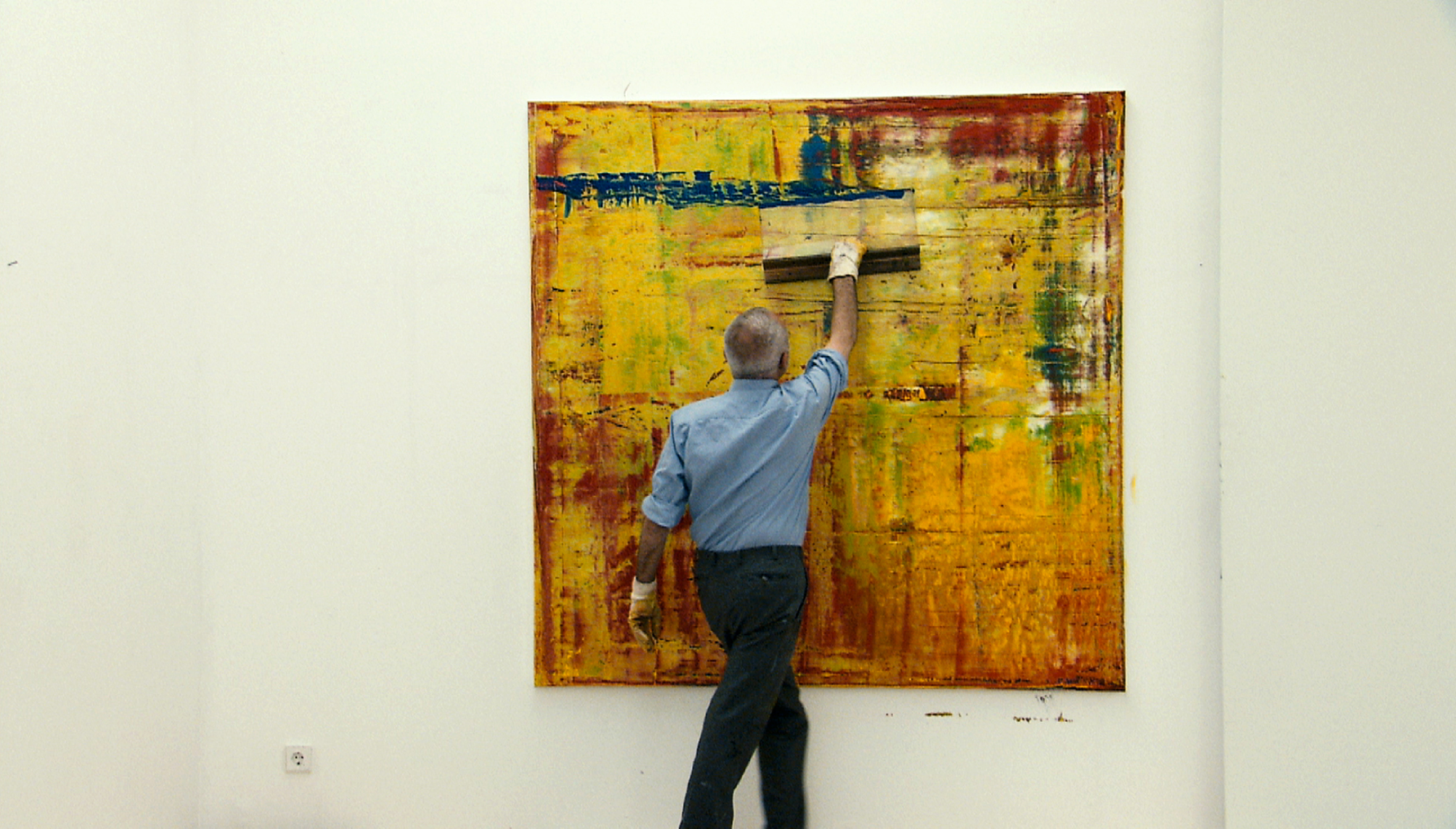
 There’s nothing abstract about the title of Corinna Belz’s documentary on German artist Gerhard Richter, no missing words or punctuation marks. Gerhard Richter Painting is primarily just that: Ninety-seven minutes of Gerhard Richter painting as he prepares for several exhibitions, including a 2009 show at the Marian Goodman Gallery in New York City. In 2007, Belz got a rare chance to capture Richter on camera, making a short film focusing on the stained-glass window he designed for the Cologne Cathedral. Two years later, the shy, reserved German artist, who prefers to have his art speak for itself, invited Belz into his studio, giving her remarkable access inside his creative process, which revealingly relies so much on chance and accident. Belz films Richter as he works on two large-scale canvases on which he first slathers yellow paint, adds other colors, then takes a large squeegee and drags it across the surface, changing everything. It’s fascinating to watch Richter study the pieces, never quite knowing when they are done, unsure of whether they are any good. It’s also painful to see him take what looks like an extraordinary painting and then run the squeegee over it yet again, destroying what he had in order to see if he can make it still better. “They do what they want,” he says of the paintings. “I planned something totally different.” About halfway through the film, a deeply concerned Richter starts regretting his decision to allow the camera into his studio. “It won’t work,” he says. “At the moment it seems hopeless. I don’t think I can do this, painting under observation. That’s the worst thing there is.” But continue he does, for Belz’s and our benefit. Belz (Life After Microsoft) even gets Richter to talk a little about his family while looking at some old photos, offering intriguing tidbits about his early life and his escape to Düsseldorf just before the Berlin Wall went up. Belz also includes clips from 1966 and 1976 interviews with Richter, and she attends a meeting he has with Goodman about his upcoming show, lending yet more insight into the rather eclectic artist. “To talk about painting is not only difficult but perhaps pointless, too,” Richter, who turned eighty last month, says in the 1966 clip. However, watching Gerhard Richter Painting is far from pointless; Belz has made a compelling documentary about one of the great, most elusive artists of our time. “Man, this is fun,” Richter says at one point, and indeed it is; watching the masterful artist at work is, well, a whole lot more fun than watching paint dry. Gerhard Richter Painting is screening at Symphony Space on July 8, 15, and 22 at 8:00 as part of the ongoing series Thalia Film Sundays.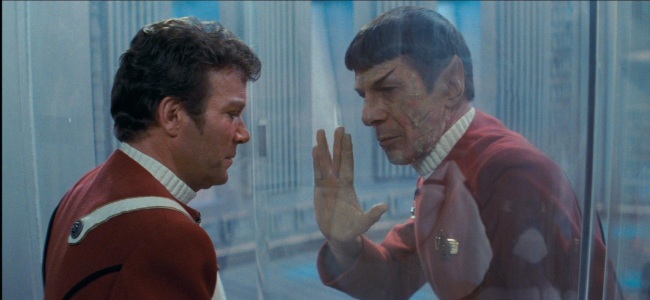
 With all the movies, TV series, and everything else, Star Trek II: The Wrath of Khan just might be the best thing that has ever come out of Star Trek land. We’re talking the Genesis project here, earwigs, Kirk’s offspring, Khan’s superior intellect, Kirstie Alley as a Vulcan, Spock bending the truth, the Kobayashi Maru no-win scenario, and Kirk screaming out his enemy’s name in unforgettable fashion, a classic movie moment. Everybody’s on board the USS Enterprise for this journey, including Dr. Leonard McCoy (DeForest Kelley), Montgomery Scott (James Doohan), Hikaru Sulu (George Takei), Lt. Uhura (Nichelle Nichols), Chekhov (Walter Koenig), Captain Spock (Leonard Nimoy), and Admiral James T. Kirk (William Shatner). The enemy is the conniving but brilliant Khan Noonien Singh, played with delightful relish by Ricardo Montalban, returning from an episode of the original television series. Just the way Montalban pronounces “Kirk” is worth the price of admission; the film serves up a bevy of memorable quotes throughout. The ending is both surprising and surprisingly heartwarming, laying the groundwork for the third film. The Wrath of Khan is about loyalty, friendship, honor, honesty, midlife crisis, fathers and sons, aging — and a bunch of great characters coming together yet again to do a far, far better thing than they have ever done before, or since.
 Based on the 2010 book by Don Winslow, Oliver Stone’s Savages is a sort of Jules and Jim meets Breaking Bad by way of Pulp Fiction, Saw, and Blow but falls far short of all of those far superior works. Taylor Kitsch and Aaron Taylor-Johnson star as childhood friends Chon, a former Navy SEAL with a violent streak just waiting to explode, and Ben, a surfer dude who is making the most potent pot around. They live with and share O (Blake Lively), a carefree woman who loves them both as they run an easygoing marijuana operation in Laguna Beach. When Elena “La Reina” Sanchez (Salma Hayek), head of the vicious Baja Cartel, gets wind of Chon and Ben’s extraordinary weed, she first sends her lawyer, Alex (Demián Bichir), to them to make a deal, but when they reject it, they next have to face the dark, brooding Lado (Benicio del Toro), who enjoys such things as torture and killing. As the film spins out of control, its only saving grace is the occasional appearances of John Travolta as Dennis, a pleasant but corrupt DEA agent who just might know a lot more than he’s telling. The primary problem with Savages is that it is filled with characters who are hard to care about in any way or have sympathy for at all, whether they’re over-the-top evil or treacly sweet. Each side calls the other savages, and because that is indeed true, the film feels lost from the start. Once again Stone shows himself to be an immensely talented but frustrating filmmaker choosing style over substance. But things significantly improve whenever Travolta is on-screen, playing Dennis with a wry sense of humor and un-Travolta-like hair.