Christian Marclay’s twenty-four-hour masterpiece unfolds in real time at Lincoln Center
David Rubenstein Atrium at Lincoln Center
61 West 62nd St. at Broadway
Tuesday – Thursday, 8:00 am – 10:00 pm
Friday at 8:00 am through Sunday at 10:00 pm
July 13 – August 1 (closed Mondays), free
212-255-1105
lincolncenterfestival.org
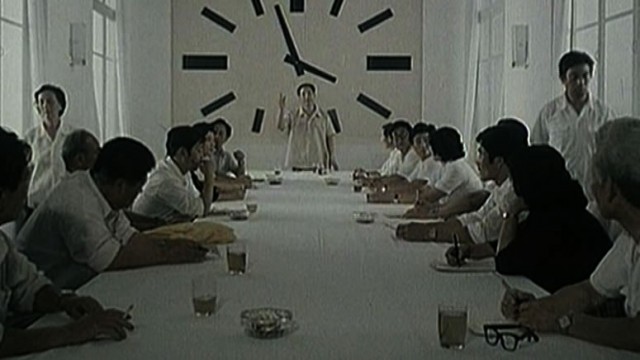
Two years ago, the Whitney presented “Festival,” a thrilling interactive retrospective of the work of Christian Marclay, featuring multiple site-specific installations and live performances. The New York-based multidisciplinary artist followed that up in winter 2011 with a supreme work of utter brilliance, the captivating twenty-four-hour video The Clock, at the Paula Cooper Gallery in Chelsea. Having traveled around the world, The Clock is back in the city for a special engagement at the David Rubenstein Atrium as part of the Lincoln Center Festival. Screened in a large, dark gallery with roomy, comfortable seats, the film unfolds in real time, composed of thousands of clips from movies and television that feature all kinds of clocks and watches showing the minutes ticking away. Masterfully edited so that it creates its own fluid narrative, The Clock seamlessly cuts from romantic comedies with birds emerging from cuckoo clocks to action films in which protagonists synchronize their watches, from thrillers with characters battling it out in clock towers to dramas with convicted murderers facing execution and sci-fi programs with mad masterminds attempting to freeze time. Marclay mixes in iconic images with excerpts from little-known foreign works, so audiences are kept on the edge of their seats, wondering what will come next, laughing knowingly at recognizable scenes and gawking at strange, unfamiliar bits. Part of the beauty of The Clock is that while time is often central to many of the clips, it is merely incidental in others, someone casually checking their watch or a clock visible in the background, emphasizing how pervasive time is — both on-screen and in real life. Americans spend an enormous amount of time watching movies and television, so The Clock is also a wry though loving commentary on what we choose to do with our leisure time as well. The Clock will be shown 8:00 am to 10:00 pm Tuesdays through Thursdays and continuously from 8:00 in the morning on Fridays through 10:00 at night on Sunday. Admission is free and first-come, first-served, with a maximum of ninety-six people, so be prepared for some very long lines, especially during prime time. Since the film corresponds to the actual time, midnight should offer some fascinating moments, although you might be surprised how exciting even three o’clock in the morning can be.
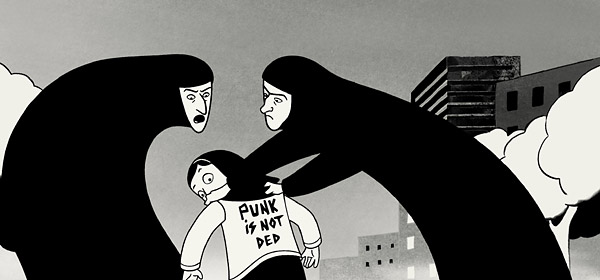
 France’s official selection for the 2007 Academy Awards, Persepolis brings to animated life Marjane Satrapi’s stunning graphic novels. Codirected by Satrapi and comic-book artist Vincent Paronnaud, Persepolis tells Satrapi’s harrowing life story as she comes of age during the Islamic Revolution in Iran in the late 1970s and early 1980s. Raised in a well-off activist family, she fights against many of the country’s crippling mores and laws, particularly those that treat women as second-class citizens, trapping them in their veils, denying them any kind of individual freedom. But the progressive Satrapi (voiced first by Gabrielle Lopes, then Chiara Mastroianni) continually gets into trouble as she speaks her mind, experiments with sex, and refuses to play by her country’s repressive rules. Satrapi and Paronnaud do an outstanding job of adapting the books’ black-and-white panels for the big screen, maintaining her unique style and emotional breadth. The first part of the film is excellent as the precocious teenager who talks to God learns about life in some very harsh ways. Unfortunately, the second half gets bogged down in Satrapi’s failures as an adult, focusing too much on her myriad personal problems and taking away the bigger picture that made the first part so entertaining as well as educational. Still, it’s a story worth telling, and well worth seeing. (Interestingly, since the film, which is in French, is subtitled in English, the audience ends up reading it similarly to the way they read the graphic novel.) The closing-night selection of the 2007 New York Film Festival, Persepolis also features the voices of Catherine Deneuve as Marjane’s mother, Danielle Darrieux as her grandmother, Simon Akbarian as her father, and François Jerosme as her radical uncle Anouche. Persepolis is screening in Riverside Park on July 13 as part of the Films on the Green series, which concludes September 6 with François Truffaut’s Jules et Jim on the Low Library Steps at Columbia University.
 Brazilian filmmaker Eryk Rocha’s feature narrative debut, Transeunte (Passerby), is a beautifully poetic, lyrical examination of loneliness and connection. Fernando Bezerra gives a brilliant performance as Expedito, a sixty-five-year-old man who spends his days in Rio de Janeiro walking the streets and riding buses as he puts flowers on his mother’s grave, picks up his benefits check, takes a nap on his couch, goes to the doctor, listens to his old-fashioned transistor radio, and stops by a bar for a few drinks. A simple man who seems to be content in his small life, Expedito is an innocent bystander in the world; Rocha often cuts to extreme close-ups of Expedito’s eyes as the character watches and listens to other people singing, dancing, preaching, celebrating a birthday, and just having regular conversations as he takes it all in from a distance. He rarely even speaks, saying only what is absolutely necessary as he goes about his daily business. Yet he does all this with a quiet confidence, his deeply chiseled face, rigid brow, and slow gait (in opposition to his name) revealing him to be a simple man with simple pleasures instead of a sad, lonely man leading a nowhere life. Rocha, who has made such documentaries as Rocha que Voa and Pachamama and has also been an editor, actor, composer, and cinematographer (though still only in his thirties), uses that varied background to create a mesmerizing tale that mixes fiction and reality, set to a lively score and shot in a lush black-and-white, recalling such seminal films as Charles Burnett’s