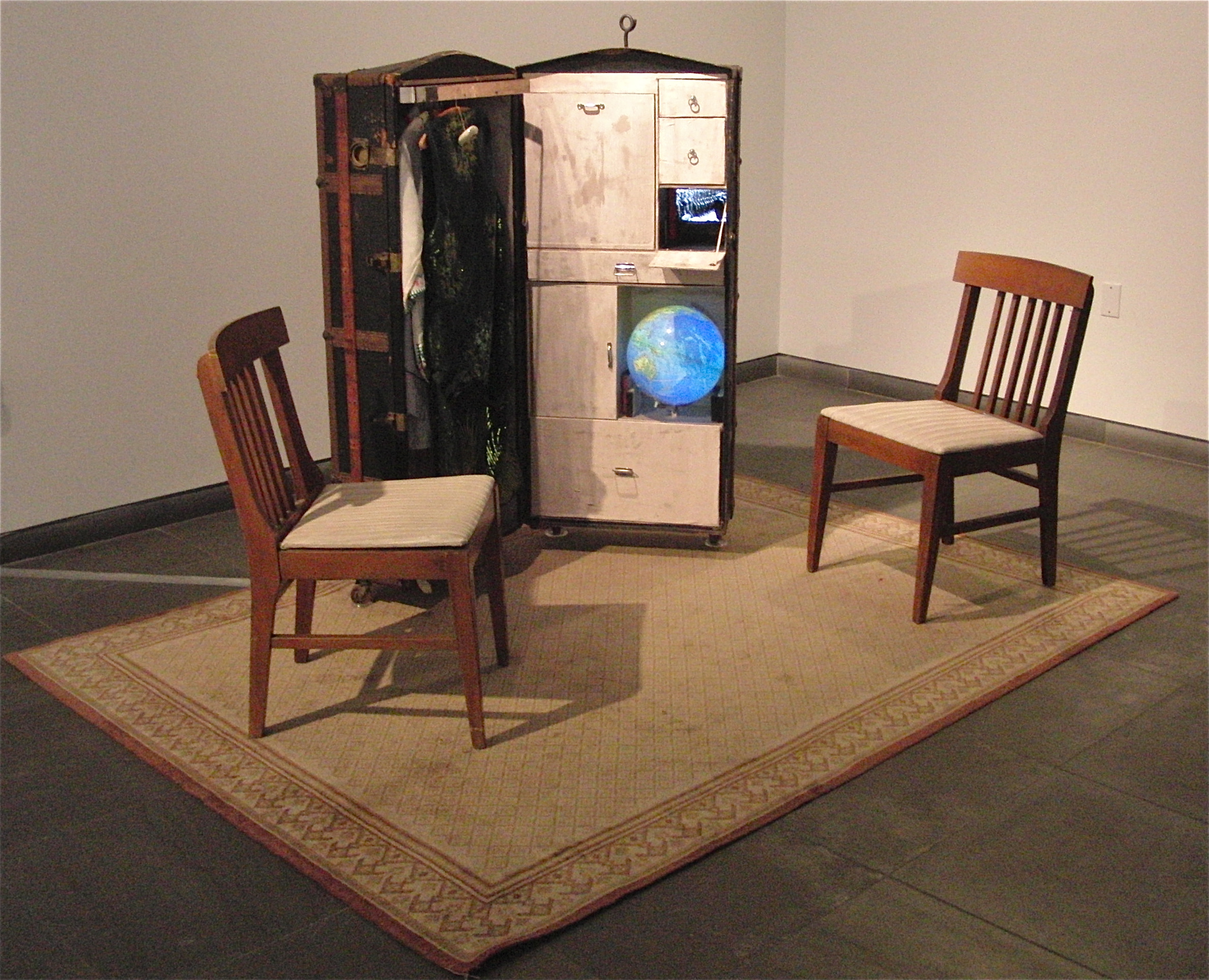
“Unattended Luggage” by Time’s Up gives visitors a chance to explore personal aspects of immigration and home (photo by twi-ny/mdr)
Austrian Cultural Forum
11 East 52nd St. between Madison & Fifth Aves.
Daily through August 26, free, 10:00 am – 5:00 pm
212-319-5300
www.acfny.org
our haus slideshow
In 1970, Crosby, Stills, Nash & Young sang, “Our house is a very, very, very fine house.” The same can be said of architect Raimund Abraham’s stunning Austrian Cultural Forum tower, which turns ten this year. In honor of the anniversary, the ACFNY has put together the multimedia exhibit “Our Haus,” consisting of specially commissioned works that explore the nature of home, the physicality and psychology of place, and the cross-cultural link between New York and Austria. Spread across four floors of the twenty-five-foot-wide, eighty-one-foot-deep, twenty-four-story building that ACFNY director Andreas Stadler calls “an artistic lighthouse in this metropolis of creativity and communication,” the show includes photography, painting, video, sculpture, and site-specific installations that curator Amanda McDonald Crowley says “recognize the ACFNY as a space for conversation, contradiction, intimacy, and conviviality.” In Brünnerstraße 165, Helmut and Johanna Kandl go back to Johanna’s childhood home, combining vintage Super-8 footage of her as a little girl playing in the backyard with contemporary video of her rising out of a pond on the now-abandoned property. Austrian-born artist Rainer Ganahl examines two sides of New York in “Haunted Houses — Vacant Buildings on Third Avenue between 99th and 120th Street,” a two-channel video that he made while riding his bicycle through his adopted home of Spanish Harlem; while the bottom images depict stores and signs of life, the top shows broken windows, empty apartments, and shattered dreams. Judith Fegerl’s “Untitled (cauter)” intrudes on Abraham’s tower itself, as electrical wires burn lines onto the wall. Time’s Up investigates travel and immigration in “Unattended Luggage,” which invites visitors to look through drawers in a large open suitcase filled with items that remind one of home. Matthias Herrmann conjures up Felix Gonzalez-Torres and Bruce Naumann in a series of still-life postcards, free for the taking, that he made during a New York City residency.
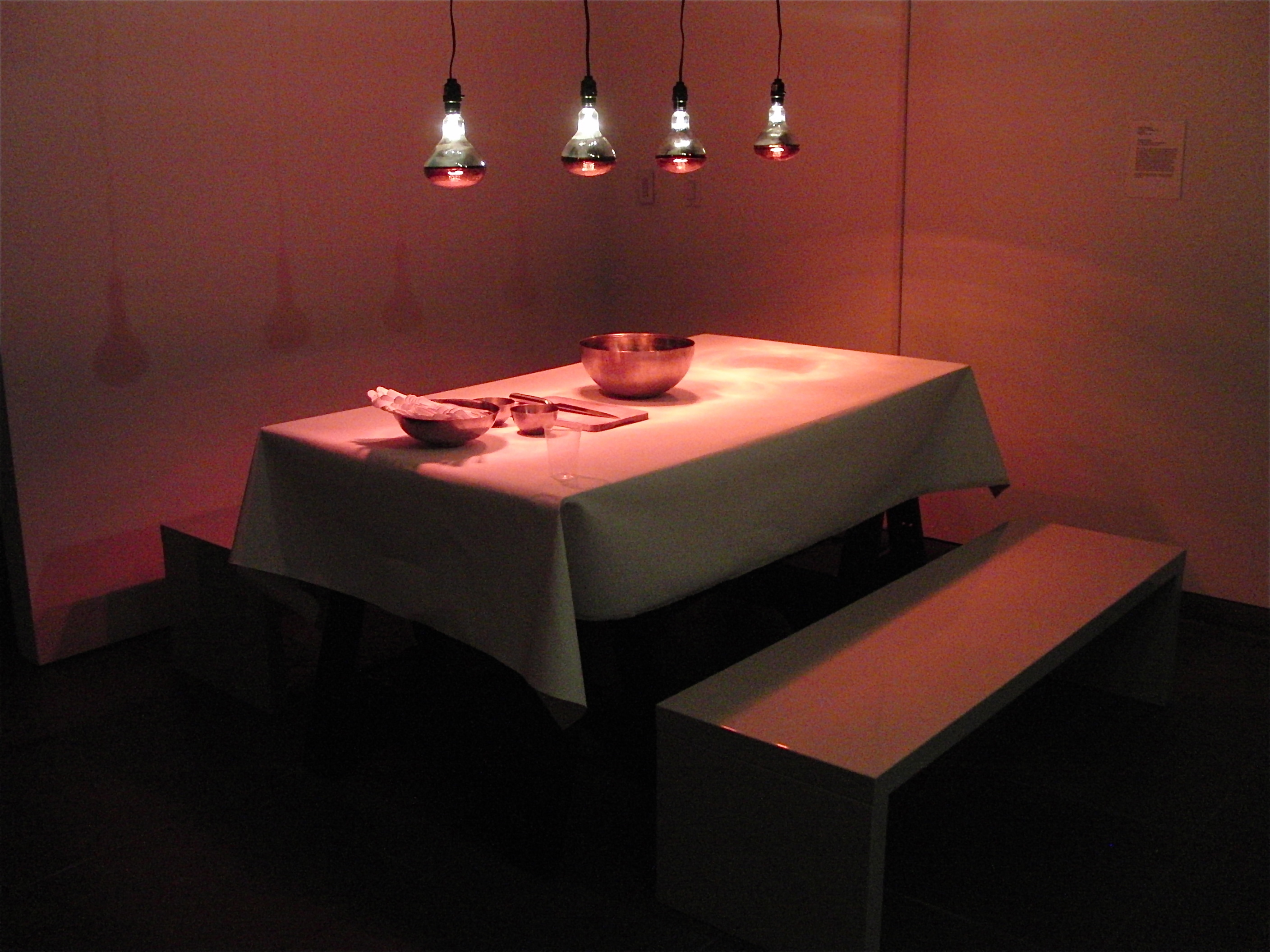
Rainer Prohaska’s “Floor Cuisine, ACF New York” offers a place to gather at the Austrian Cultural Forum (photo by twi-ny/mdr)
In 1982, the British ska band Madness sang, “Our house it has a crowd / There’s always something happening,” and the same can be said for “Our Haus.” Rainer Prohaska’s “Floor Cuisine, ACF New York” features kitchen stations throughout the exhibit, culminating in a table downstairs where people can come together and enjoy a drink from Mathias Kessler’s “Das Eismeer, Die gescheiterte Hoffnung (The Arctic Sea, the Failed Hope),” a refrigerator stocked with beer and containing a sculptural tribute to Caspar David Friedrich in the freezer. Meanwhile, the collective WochenKlausur has set up a meeting room that will host various gatherings over the course of the exhibition; through July 22, “It Came from chashama” will highlight works from the nonprofit organization that displays art in public spaces. (The Center for Urban Pedagogy takes over July 23-29, with a panel discussion that first night at 7:00, followed by Green Guerillas, CAAAV, and Not an Alternative.) And in conjunction with the anniversary, Anthology Film Archives is hosting “The Austrian Cultural Forum New York: The First Decade,” a series of screenings through July 22 of Austrian films made over the last ten years, including Nikolaus Geyrhalter’s Our Daily Bread, Götz Spielmann’s Revanche, Michael Haneke’s The White Ribbon, and Ruth Beckermann’s Zorro’s Bar Mitzva.
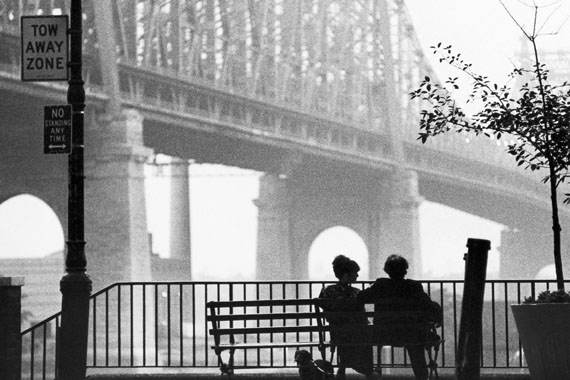
 Woody Allen’s Manhattan opens with one of the most beautiful tributes ever made to the Big Apple, a lovingly filmed black-and-white architectural tour set to the beautiful sounds of George Gershwin’s “Rhapsody in Blue.” As Allen’s character says at the beginning, “He adored New York City, he idolized it all out of proportion — no, make that, he romanticized it all out of proportion.” Once again collaborating with screenwriter Marshall Brickman, master cinematographer Gordon Willis, and Oscar-winning actress Diane Keaton, Allen’s tale of a nebbishy forty-two-year-old two-time divorcee who takes up with a seventeen-year-old ingénue (Mariel Hemingway) is both hysterically funny and romantically poignant, filled with classic dialogue (Yale: “You think you’re God.” Isaac: “I gotta model myself after someone.”) and iconic shots of city landmarks. Manhattan is being screened in an iconic landmark itself, Coney Island, on July 16, a free presentation of Rooftop Films, with music and dancing at 7:00, followed by the film at 8:30. Future free Rooftop Films screenings include a “Coming Home” shorts program with Shenandoah and the Night at MetroTech on July 20, The Muppets in Coney Island on July 23, Peter Nicks’s The Waiting Room in Dag Hammarskjöld Plaza on July 24, Nina Conti’s Her Master’s Voice and a pair of shorts in Socrates Sculpture Park on July 25, and The Natural in Richmond County Bank Ballpark on July 26.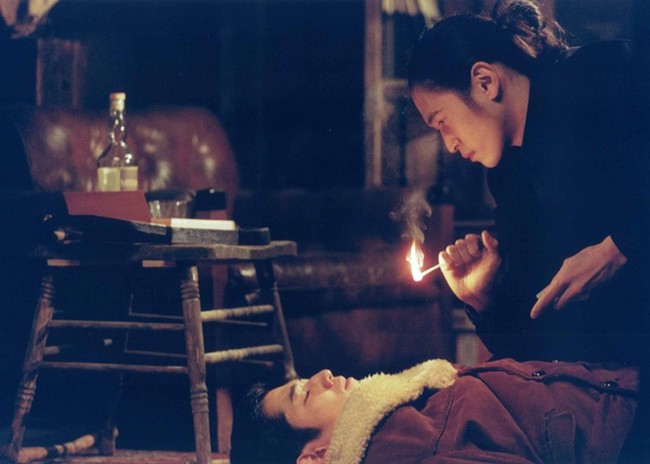
 Two years ago, Japanese auteur Toshiaki Toyoda presented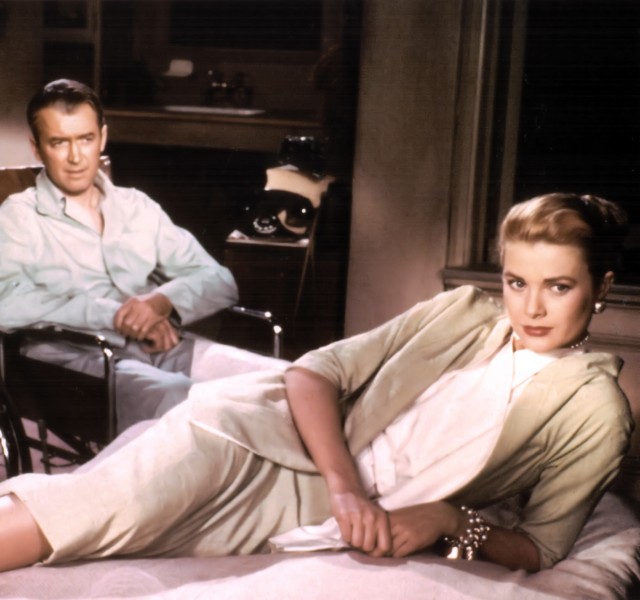

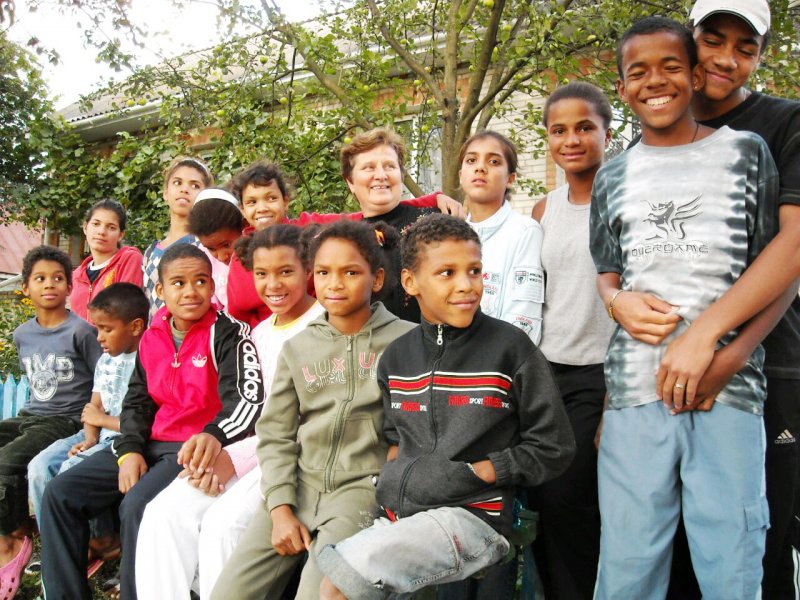
 “What difference does it make — black, white, yellow? They are just kids,” says Olga Nenya in the intriguing documentary Family Portrait in Black and White. Evoking the classic nursery rhyme about an old woman who lives in a shoe, Nenya runs a foster home in the Ukraine suburb of Sumy, where she takes care of as many as twenty-seven children (including four of her own), most of whom are mixed-race boys and girls abandoned by their parents, primarily local women and African men who were studying in Eastern Europe. Because of their heritage, the children are despised by neighbors, the growing, violent neo-Nazi movement, and the government, which gives Nenya very little money but then sends inspectors who decry the living conditions in her house. Canadian filmmaker Julia Ivanova, who wrote, directed, and edited the eighty-five-minute documentary in addition to serving as cinematographer, follows the kids as they do their daily chores, go to school, spend the summer with families in Italy, and look forward to the day when they are old enough to go out on their own, either to be legally adopted or to attend university. For as much as most of them love and respect Nenya, she can be a tough, dominating taskmaster with old-fashioned values who selfishly holds on to her flock even when better opportunities are out there for some of her children. A product of Stalinism, Nenya can be dictatorial, yet she clearly loves and cares deeply about her children; as Ivanova focuses in on Kiril, Roman, Anya, and Andrey, each of whom has serious issues about the way they are being raised, the individual relationships become more and more tense. A multiple-award-winning international festival favorite, Family Portrait in Black and White is a compelling look at racism, value systems, and just what family means in today’s ever-changing society.