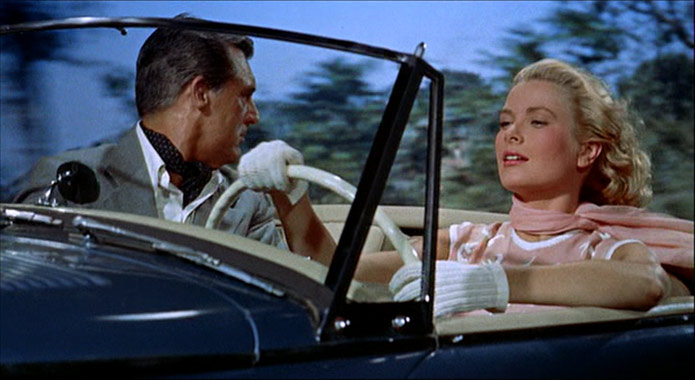
Cary Grant and Grace Kelly turn up the glamor quotient in Hitchcock thriller set on the French Riviera
TO CATCH A THIEF (Alfred Hitchcock, 1955)
Museum of the Moving Image
35th Ave. at 36th St., Astoria
Saturday, July 28, and Sunday, July 29, free with museum admission, 3:00
718-777-6800
www.movingimage.us
 Is he or isn’t he? In Alfred Hitchcock’s glamorous thriller set on the French Riviera, Cary Grant stars as John Robie, a famous burglar known as the Cat who has supposedly retired but is suddenly believed to be responsible for a rash of new jewelry thefts. Determined to prove his innocence and catch the real thief, he enlists the help of Lloyd’s of London insurance agent H. H. Hughson (John Williams), who supplies him with a list of women on the Riviera who have expensive baubles ripe for the taking. At the top of the list are the Americans Jessie Stevens (Jessie Royce Landis) and her gorgeous daughter, Francie (a radiant Grace Kelly), who teases Robie, hinting that she might in fact be the Cat — if he isn’t. As Robie avoids the cops and looks to his old friends in the French Resistance for further help, the tension heats up, leading to a climax that takes place on the rooftops of the French Riviera. Grant’s third of four outings with Hitchcock and Kelly’s third and final turn with the suspense master is an exciting “who’s doing it” featuring the dream pairing of two of Hollywood’s most beautiful and talented superstars, filled with just the right amount of comedy and romance in a glorious setting. Look for Alfie to make his appearance early on, causing Grant to do a double take in the back of a bus. To Catch a Thief is screening July 28 & 29 in a new DCP restoration at the Museum of the Moving Image as part of the institution’s continuing See It Big! series.



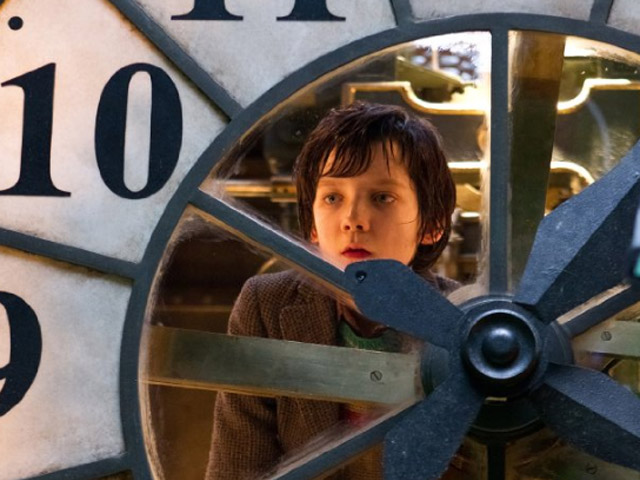
 Martin Scorsese wears his cinematic heart on his sleeve in his first family-friendly film, Hugo. Based on Brian Selznick’s Caldecott-winning 2007 illustrated historical-fiction novel The Invention of Hugo Cabret, the movie follows the adventures of the title character, a homeless orphan boy (Asa Butterfield) who survives by his wits in a Paris train station in the early 1900s. He spends his days stealing small bits of food, winding the big clock, avoiding Inspector Gustav (Sacha Baron Cohen), and trying to find parts for an automaton he is rebuilding, hoping it will have a message for him from his father (Jude Law). He soon makes his only friend, a girl named Isabelle (Chloë Grace Moretz) who is being raised by her godparents, the bitter Papa Georges (Ben Kingsley) and his wife, Mama Jeanne (Helen McCrory). When it turns out that Papa Georges is the one and only Georges Méliès, who made the world’s first science-fiction film, A Trip to the Moon, among hundreds of others, then was thought to have died in obscurity, all of his work destroyed, Hugo and Isabelle, along with the help of film historian René Tabard (Michael Stuhlbarg), are determined to resurrect Papa Georges and his reputation. Gorgeously shot by Robert Richardson and featuring marvelous period sets by Dante Ferretti, Hugo is beautiful to look at, the camera roaming through the immense train station and up the tall clock tower like in a Jules Verne story. Such side plots as the budding romances between a café owner (Frances de la Tour) and the newspaper seller (Richard Griffiths) and between Gustav and a shy flower girl (Emily Mortimer) feel forced, and the main narrative meanders its way into treacly territory as all the parts slowly come together. At its heart, Hugo is a movie about the love of movies, paying tribute to the early cinema of Méliès, Harold Lloyd, and others but it gets too stuck on the underlying theme of the preservation of old films, one of Scorsese’s driving forces. Still, Hugo is a visual treat, particularly in the first half, before things get a little too sticky (and slickly) sweet, even for a children’s film. Hugo is being shown on Pier 46 in Hudson River Park on July 27 as part of the free River Flicks for Kids series, which continues August 3 with Puss in Boots, August 10 with Rango, August 17 with Back to the Future, and August 24 with The Smurfs.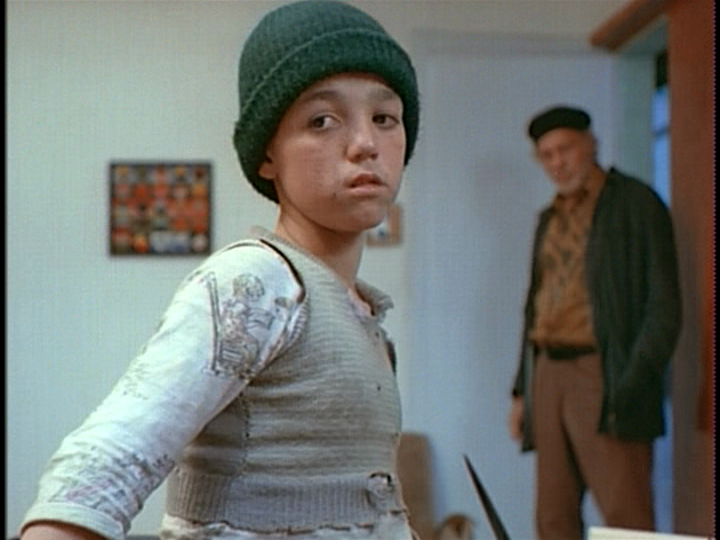
 Hector Babenco’s gripping, heart-wrenching docudrama is set in São Paulo, where a group of young boys struggle to survive on the streets and in a reform school that is more like a prison. When four of them bust out, they get caught up in a dangerous life of drugs, prostitution, and guns. Marília Pêra won numerous international awards for her performance as a prostitute, but the film belongs to eleven-year-old Fernando Ramos da Silva, who plays the title character; you won’t be able to take your eyes off him, except to wipe away the tears. Unable to get his life together after the film, Fernando was later killed by police under suspicious circumstances when he was only nineteen. The Argentine-born Babenco went on to make such films as Kiss of the Spider Woman, Ironweed, and At Play in the Fields of the Lord, but Pixote is his masterpiece. Pixote is screening July 27 and 30 with Orlando Mesquita’s 2001 short, The Ball, as part of the MoMA film series “Unaccompanied Minors: Views of Youth in Films from the Collection,” being held in conjunction with the new exhibit “Century of the Child: Growing by Design, 1900-2000.” Running through August 14, the festival includes such other compelling films about childhood as Vittorio De Sica’s Bicycle Thieves, François Truffaut’s The 400 Blows, Djibril Diop Mambéty’s The Little Girl Who Sold the Sun, Laslo Benedek’s Sons, Mothers, and a General, and Charles Laughton’s The Night of the Hunter.