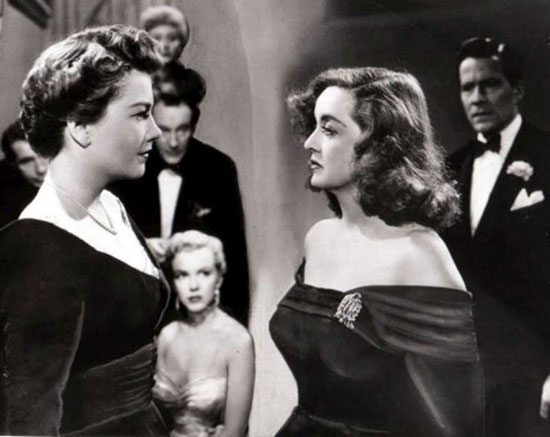
Anne Baxter and Bette Davis put on quite a show in ALL ABOUT EVE (yes, that’s Marilyn Monroe in the center)
ALL ABOUT EVE (Joseph L. Mankiewicz, 1950)
Bryant Park Summer Film Festival
41st St. at Sixth Ave.
Monday, August 13, free, dusk
212-512-5700
www.bryantpark.org
 Nominated for fourteen Academy Awards and winner of six, including Best Picture, Best Director, and Best Screenplay, All About Eve is one of Hollywood’s all-time greatest movies, a searing depiction of naked ambition set on the Great White Way. Based on Mary Orr’s 1946 short story “The Wisdom of Eve,” writer-director Joseph L. Mankiewicz’s flawless drama stars Anne Baxter as Eve Harrington, who is not exactly the mousey wallflower she at first appears to be. She quickly worms her way into an inner circle of Broadway vets populated by superstar Margo Channing (Bette Davis), her younger lover, Bill Sampson (Gary Merrill), playwright and director Lloyd Richards (Hugh Marlowe), and Richards’s wife, Karen (Celeste Holm), who takes Eve under her wing. Joining in on all the fun is powerful theater critic Addison DeWitt (Oscar winner George Sanders), who marvels at all the manipulation and backstage drama, much of which he wickedly orchestrates himself. “There never was, and there never will be, another like you,” DeWitt tells Eve in one of the film’s most poignant moments. All About Eve is filled with classic quotes, including the iconic “Fasten your seatbelts, it’s going to be a bumpy night,” boldly proclaimed by Davis. In a movie about acting and the theater, Mankiewicz never shows anyone onstage; instead, he focuses on the characters and the intrigue with a sly flair that is deliciously entertaining. All About Eve is screening August 13 as part of the Bryant Park Summer Film Festival, which concludes August 20 with Raiders of the Lost Ark.
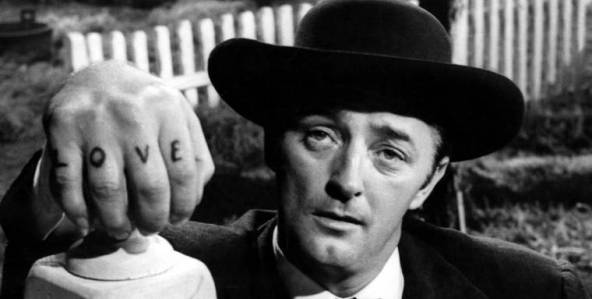
 Robert Mitchum stars in Charles Laughton’s lurid story of traveling preacher/con man/murderer Harry Powell, who has the word “love” tattooed on one set of knuckles and “hate” on the other. While in prison, Powell bunks with Ben Harper (Peter Graves), who got caught stealing $10,000 — but the only person who knows where the money is is Ben’s young son, John (Billy Chapin). When Preacher is released from jail, he shows up on the Harpers’ doorstep, ready to woo the widow Willa (Shelley Winters) — and get his hands on the money any way he can, including torturing John and his sister, Ruby (Gloria Castillo). Laughton’s only directorial effort is seriously flawed — the scenes in the beginning and end with Lillian Gish are wholly unnecessary and detract from the overall mood. Stanley Cortez’s cinematography is outstanding, featuring his unique use of shadows, the battle between light and dark (which plays off of several themes: old versus young, rich versus poor, good versus evil, and men versus women), and some marvelous silhouettes. The Night of the Hunter is screening August 11 at 8:00 as part of the MoMA film series “Unaccompanied Minors: Views of Youth in Films from the Collection,” being held in conjunction with the new exhibit “Century of the Child: Growing by Design, 1900-2000.” Running through August 14, the festival includes such other films about childhood as William A. Wellman’s Frisco Jenny, Darren Aronofsky’s Black Swan, Vittorio De Sica’s Bicycle Thieves, and David D. Williams’s Thirteen.
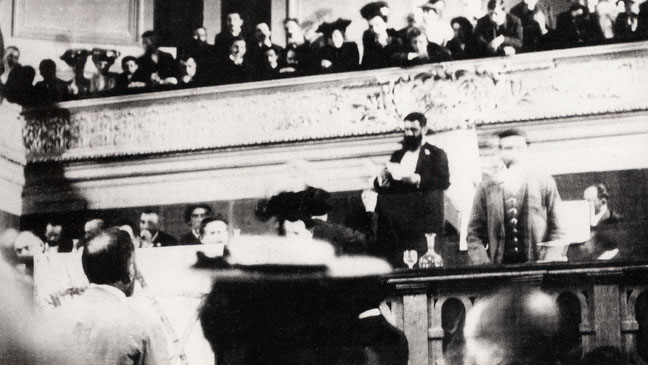
 One of the most important figures in the creation of the State of Israel, Budapest-born writer and activist Theodor Herzl was surprisingly not a strong believer in the Jewish religion and tradition, as revealed in the staid, plodding documentary It Is No Dream: The Life of Theodor Herzl. Produced by the filmmaking wing of the Simon Wiesenthal Center, the international human rights organization that promotes tolerance while focusing on the Holocaust, the well-meaning but overly reverential film clumsily begins with a look at the neo-Nazi movement before examining Herzl’s transformation from a journalist and wanna-be playwright into a zealot combating anti-Semitism as a result of his covering the trial of accused French traitor Alfred Dreyfus. Public cries of “Kill the Jews” led Herzl to write Der Judenstaat (The Jewish State), a controversial plan for the creation of a Jewish homeland in Palestine. Director Richard Trank (Winston Churchill: Walking with Destiny) and cowriter Rabbi Marvin Hier, who previously teamed up on the Oscar-winning documentary The Long Way Home, gloss over Herzl’s personal life, which appears to have had many interesting facets, and instead relies on choppy narration by Sir Ben Kingsley and excerpts from Herzl’s diary dryly read by Christoph Waltz. Trank also includes only one talking-head expert, historian Dr. Robert S. Wistrich (although Israeli president Shimon Peres makes a brief appearance), making it feel incomplete, as if there is much more to tell. Although it does feature many intriguing details, It Is No Dream: The Life of Theodor Herzl never quite captures the fervor of the Zionist campaign, coming off more like the kind of documentary shown as part of a museum retrospective, where the surrounding materials are needed to help bring life to the story. The film opens Friday night at the Quad, with Trank on hand for Q&As and introductions at several weekend screenings.