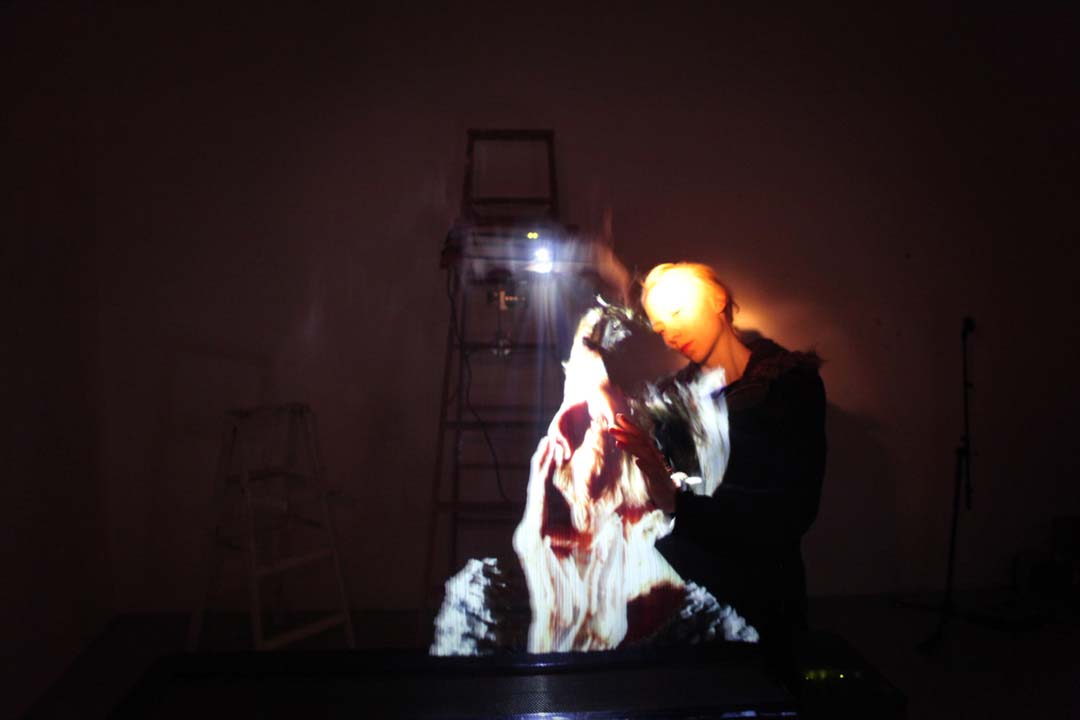
“Phosphene Variations” performance series will bring together live dancers and performance artists with their holographic versions
Location One
26 Greene St. between Grand & Canal Sts.
Exhibition runs Tuesday – Saturday through October 3, free; weekly Wednesday or Thursday performances, $10
212-334-3347
www.location1.org
Premiered as an experimental work-in-progress in December 2010 at the Watermill Center and later presented at the National Theatre of Paris, Brooklyn-based Virginia native Jason Akira Somma’s “Phosphene Variations” is now on view at Location One in SoHo through November 17. [Ed. note: Due to technical difficulties, the exhibition was forced to close on October 3.] The interactive exhibition features free-floating holograms of such dancers and performance artists as Robert Wilson, Laurie Anderson, Mikhail Baryshnikov, Carmen DeLavallade, Bill Shannon, Frances Wessells, Jirí Kylián, and Joan Jonas, who seemingly react when “touched.” In addition, there will be weekly live performances ($10, 7:00) Wednesdays in September and October and Thursdays in November in which several of Somma’s subjects will be on hand to improvise live with their holographic image, with real-time video feedback provided by Somma and live music by electro-acoustic cellist Christopher Lancaster. Curated by dance artist Luke Miller, the schedule includes Flexors on September 26, Miss Dirty Martini, Julie Atlas Muz, and Monstah Black on October 10, Brian Brooks on October 17, Jeanine Durning and Manelich Minniefee on October 24, and Susan Marshall & Company, Bill Shannon, and Vanessa Walters on November 8, concluding on November 15 with Phosphene Redux, a closing party highlighted by the return of various of the artists who previously performed. [Ed. note: The October 10 performance will be the last one, with the others canceled as a result of the unfortunate shutdown of the exhibition.]
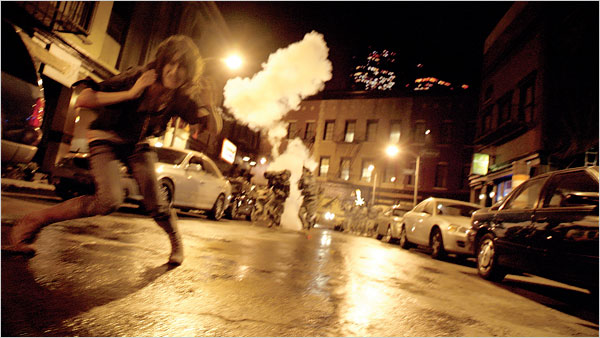
 A surprise going-away party turns into a nightmare in Matt Reeves’s highly anticipated Cloverfield. Michael Stahl-David stars as Rob, a young man who has accepted a promotion that will send him to Japan. Although he is in love with his best friend, Beth (Odette Yustman), he is unable to tell her. But everything changes when the ground starts to shake, buildings begin to collapse, and people are on the run, attempting to escape from an enormous monster on the loose in post 9/11 Manhattan. And when Rob discovers that Beth, who had left the party early, might still be alive, he decides to risk his life and head uptown to save her. He is joined on the dangerous journey by his brother, Jason (Mike Vogel); Jason’s girlfriend, Lily (Jessica Lucas); Lily’s friend Marlena (Lizzy Caplan); and Hud (T. J. Miller), who serves as the comic relief. The entire film is seen through the lens of a video camera that Hud was entrusted with at the party, giving the film the feel of The Blair Witch Project, mixed with such Gotham horror stories as King Kong, The Day After Tomorrow, and the ridiculous 1998 Godzilla remake. Cloverfield, which has an ever-widening back story growing online (similar to that of Lost, which is also the creation of J. J. Abrams), doesn’t try to be anything more than it is — a monster movie set in New York City. The creature is kept hidden for most of the film, which doesn’t try to make any grand statements about science, humanity, or, really, anything except true love — and brutal death. And yes, there is a secret message hidden in the brief sound clip at the end of the credits. Cloverfield is screening on September 23 as part of the Museum of the Moving Image’s “Film After Film” series, a collection of works selected by J. Hoberman focusing on how digital technology is changing the way movies are both made and viewed.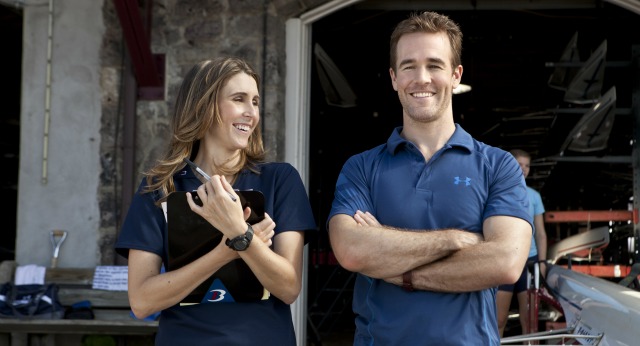
 Inspired by the true story of the Olympic dreams of a college teammate, actress and former rower Sarah Megan Thomas wrote, produced, and stars in Backwards, perhaps the biggest movie about crew since Rob Lowe picked up the oars to impress Amanda Pays in the 1984 cult-classic-wannabe Oxford Blues. Unfortunately, however, Backwards comes off as a well-meaning but overly earnest vanity project that is more like a basic-cable, family-friendly movie-of-the-week than a feature film for theaters. Thomas plays Abi Brooks, a champion rower who might have just one last shot to make the Olympic team as her thirtieth birthday approaches. But after being selected as an alternate, a wining Abi quits, eventually getting a job coaching the girls’ rowing team back at her old school, where her boss is her high school sweetheart, Geoff (James Van Der Beek). Searching for meaning in her life, Abi gets deeply involved in training Hannah (Alexandra Metz) and Susan (Meredith Apfelbaum) for an upcoming important tournament, until circumstances change and she is forced to make a crucial decision about her future, and that of her girls. Directed by Ben Hickernell (Lebanon, PA.), Backwards was admittedly made on a too-low budget, and it shows. The rowing scenes don’t ring true, the potential romance between Geoff and Abi is predictable, and Abi’s relationship with her mother (Margaret Colin) is riddled with clichés. That said, the film does have a good heart that makes you want to like it, but it never quite reaches that next level, with scene after scene mired in the obvious.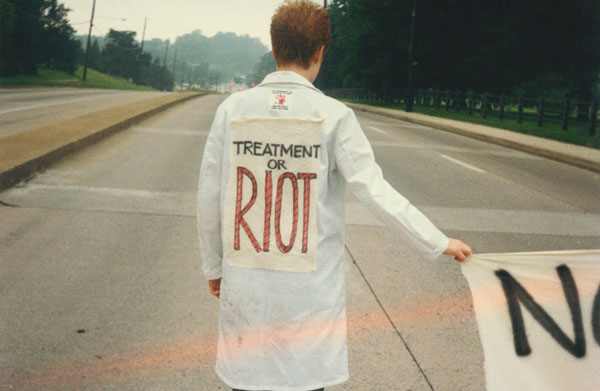
 Contemporary activists stand to learn a lot from the gripping documentary How to Survive a Plague. For his directorial debut, longtime journalist David France, one of the first reporters to cover the AIDS crisis that began in the early 1980s, scoured through more than seven hundred hours of mostly never-before-seen archival footage and home movies of protests, meetings, public actions, and other elements of the concerted effort to get politicians and the pharmaceutical industry to recognize the growing health epidemic and do something as the death toll quickly rose into the millions. Focusing on radical groups ACT UP and TAG (Treatment Action Group), France follows such activist leaders as Peter Staley, Mark Harrington, Larry Kramer, Bob Rafsky, and Dr. Iris Long as they attack the policies of President George H. W. Bush, famously heckle presidential candidate Bill Clinton, and battle to get drug companies to create affordable, effective AIDS medicine, all while continuing to bury loved ones in both public and private ceremonies. France includes new interviews with many key activists who reveal surprising details about the movement, providing a sort of fight-the-power primer about how to get things done. The film also shines a light on lesser-known heroes, several filled with anger and rage, others much calmer, who fought through tremendous adversity to make a difference and ultimately save millions of lives. France will be at the IFC Center to talk about How to Survive a Plague at numerous screenings on Friday, Saturday, and Sunday of opening weekend.
 Barry Levinson’s poignant drama follows the trials and tribulations of the Krichinsky family, Polish immigrants trying to make a life in America. The third in Levinson’s Baltimore series (following 1982’s Diner and 1987’s Tin Men and preceding 1999’s Liberty Heights), Avalon is heart-wrenchingly beautiful, led by a sweet, innocent performance by Armin Mueller-Stahl as Sam Krichinsky, the family patriarch, and Aidan Quinn as the son who has different dreams. The outstanding cast also includes Elijah Wood, Elizabeth Perkins, Kevin Pollak, Joan Plowright, and the great Lou Jacobi as Gabriel Krichinsky, who has a hysterical Thanksgiving Day fight with his brother Sam. One of the most tender and moving multigenerational dramas of the last few decades, Avalon is screening on September 22 as part of the Museum of the Moving Image’s “Film After Film” series, a collection of works selected by J. Hoberman focusing on how digital technology is changing the way movies are both made and viewed.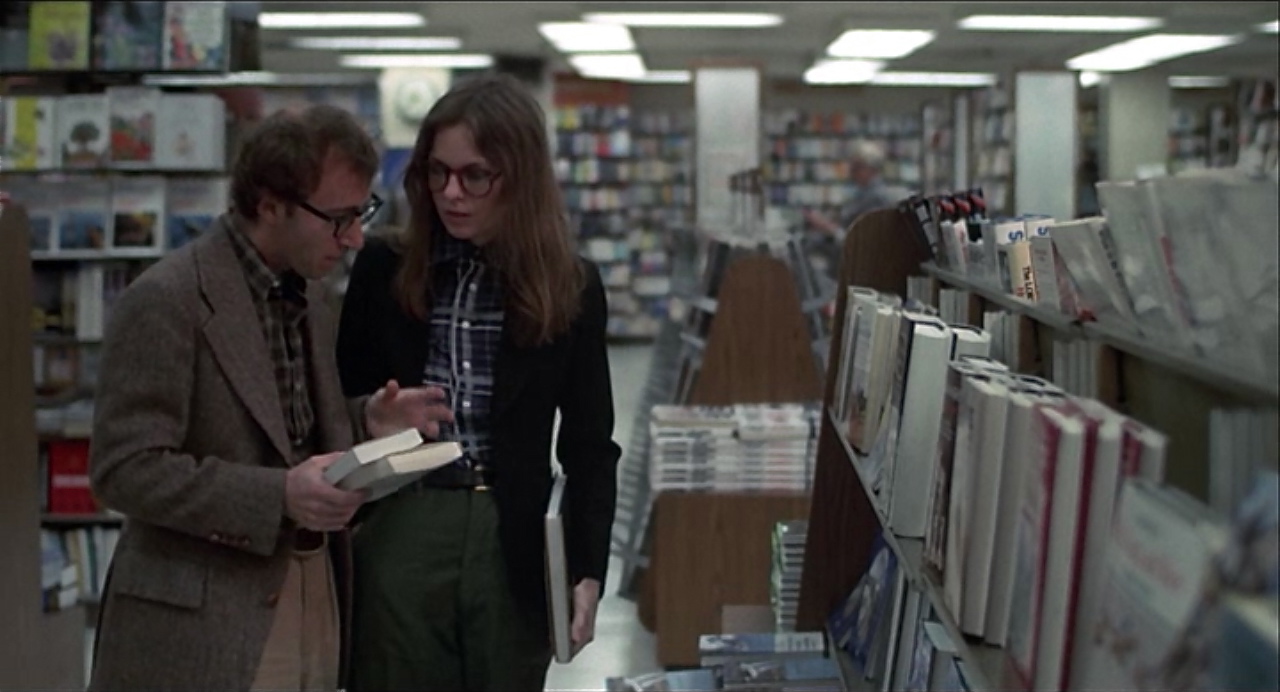
 “I feel that life is divided into the horrible and the miserable. That’s the two categories,” says Alvy Singer (Woody Allen) in Annie Hall. “The horrible are like, I don’t know, terminal cases, you know, and blind people, crippled. I don’t know how they get through life. It’s amazing to me. And the miserable is everyone else. So you should be thankful that you’re miserable, because that’s very lucky, to be miserable.” Allen’s classic 1977 Oscar-winning film — which had the working title “Anhedonia,” a medical term referring to the inability to experience pleasure — is one of the funniest, most-quoted romantic comedies in film history, a pure delight from start to finish. It’s ostensibly a luuuuuurve story about a nebbishy Jew and the ultimate WASPy goy (Diane Keaton as the title character), but it’s really about so much more: large vibrating eggs, right turns on red lights, television, Existential Motifs in Russian Literature, California, slippery crustaceans, driving through Plutonium, dead sharks, Freud, Hitler, Leopold and Loeb, religion, cocaine, Shakespeare in the Park, Buick-size spiders, planet Earth, and, well, la-di-da, la-di-da, la la. The film is screening on September 21 as part of the new Rubin Museum series “Happiness is…,” which consists of movies with a somewhat different idea of joy, including Alfred Hitchcock’s Strangers on a Train, Bob Rafelson’s Five Easy Pieces, Federico Fellini’s 8½, and Ingmar Bergman’s Cries and Whispers. Part of the larger Rubin program “