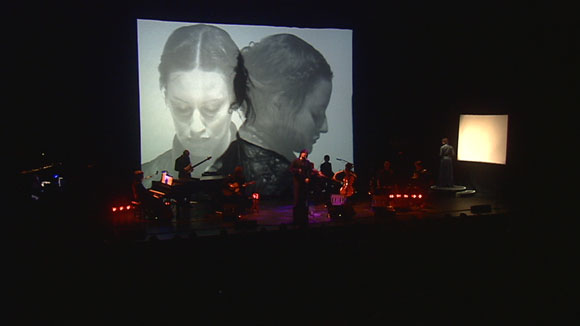
Antony and the Johnsons and Charles Atlas celebrate sexual identity and personal freedom in beautifully poignant TURNING
NEW YORK’S DOCUMENTARY FESTIVAL: TURNING (Charles Atlas, 2012)
SVA Theatre
333 West 23rd St. between Eighth & Ninth Aves.
Sunday, November 11, $20, 9:30
www.docnyc.net
www.turningfilm.com
 In 2004, musician and composer Antony Hegarty and film and video pioneer Charles Atlas premiered their multimedia collaboration, Turning, at the Whitney Biennial. The performance featured Antony and the Johnsons playing songs in front of a large screen on which Atlas projected live multiple images of a parade of “beauties” who one at a time slowly turned on a circular platform, standing tall and proud. The production went on an international tour, which Atlas and Antony document in a beautiful, intimate film version that is making its U.S. premiere November 11 as part of the DOC NYC festival before opening theatrically on November 16. Atlas, a former filmmaker-in-residence with the Merce Cunningham Dance Company and director of the widely hailed The Legend of Leigh Bowery, takes viewers behind the scenes as the cast rehearses, puts on their costumes and makeup, gets pep talks from Antony, and opens up about their lives. Throughout the film, the women — Julia Yasuda, Catrina Delapena, Honey Dijon, Joie Iacono, Joey Gabriel, Kembra Pfahler, Nomi Ruiz, Stacey Mark, Johanna Constantine, Eliza Douglas, and Morisane Sunny Shiroma, who come from very different backgrounds and professional disciplines — share their poignant, emotional stories, addressing deeply personal issues of androgyny, transsexuality, and other aspects of sexual and gender identity. The soundtrack features Antony and the Johnsons — violinist Maxim Moston, cellist Julia Kent, bassist Jeff Langston, guitarist and violinist Rob Moose, drummer Parker Kindred, pianist Thomas Bartlett, horn player Christian Biegai, and accordionist Will Holshouser — performing such hauntingly evocative songs as “Everything Is New,” “For Today I Am a Buoy,” “Kiss My Name,” “Twilight,” and “Spiralling” as the women celebrate the freedom to be themselves in a defiant, public way. “Are you a boy / Are you a girl,” Antony, himself a former member of the underground avant-garde LGBT performance troupe Blacklips, repeats in “I Fell in Love with a Dead Boy.” In the subtly powerful Turning, such labels don’t matter as a group of women face their future with confidence and hope. Antony and Atlas will be in attendance at the November 11 screening at the SVA Theatre to talk about the film, which will be followed by a free after-party, open to the general public, at the Bowery Electric, highlighted by a live performance by Nomi.


 Seán Ó Cualáín puts one of the most iconic photographs ever of New York City under the microscope in the interesting yet too often slipshod documentary Men at Lunch. In 1932, a photographer snapped a picture of eleven construction workers having lunch while sitting atop a girder on what would become the sixty-ninth floor of the RCA Building in Rockefeller Center. The men are casually talking, having a smoke, and holding white cardboard lunchboxes while dangling their feet some 850 feet in the air, a bustling city below them, Central Park sprawled out behind them. Narrated by Fionnula Flanagan (Ulysses, Waking Ned Devine), the film delves into who the men might be, attempts to figure out whether it was indeed Charles C. Ebbets who took the photo, and seeks to put the picture into the social and cultural context of the depression and the wave of immigration, focusing on the Irish (the film is an Irish production), many of whom went into the construction industry. “This is a photograph in which every element of photography and of New York City kind of come together with spectacular panache,” filmmaker Ric Burns says. But while Ó Cualáín employs captivating archival footage as he tries to solve the photograph’s many mysteries, he extends the focus too far, biting off more than he can chew in a mere seventy minutes, as a handful of talking heads and Niall Murphy’s text make grand statements about the human condition in the twentieth century that are too often a reach, then spends too much time with a pair of Irish characters who believe they are related to two of the men in the picture. Still, the part of the film that zeroes in on the taking of the photograph is absolutely fascinating. Men at Lunch is making its U.S. premiere at the DOC NYC festival November 10 at the SVA Theatre and November 14 at the IFC Center, with Ó Cualáín on hand at the first screening to talk about the film.
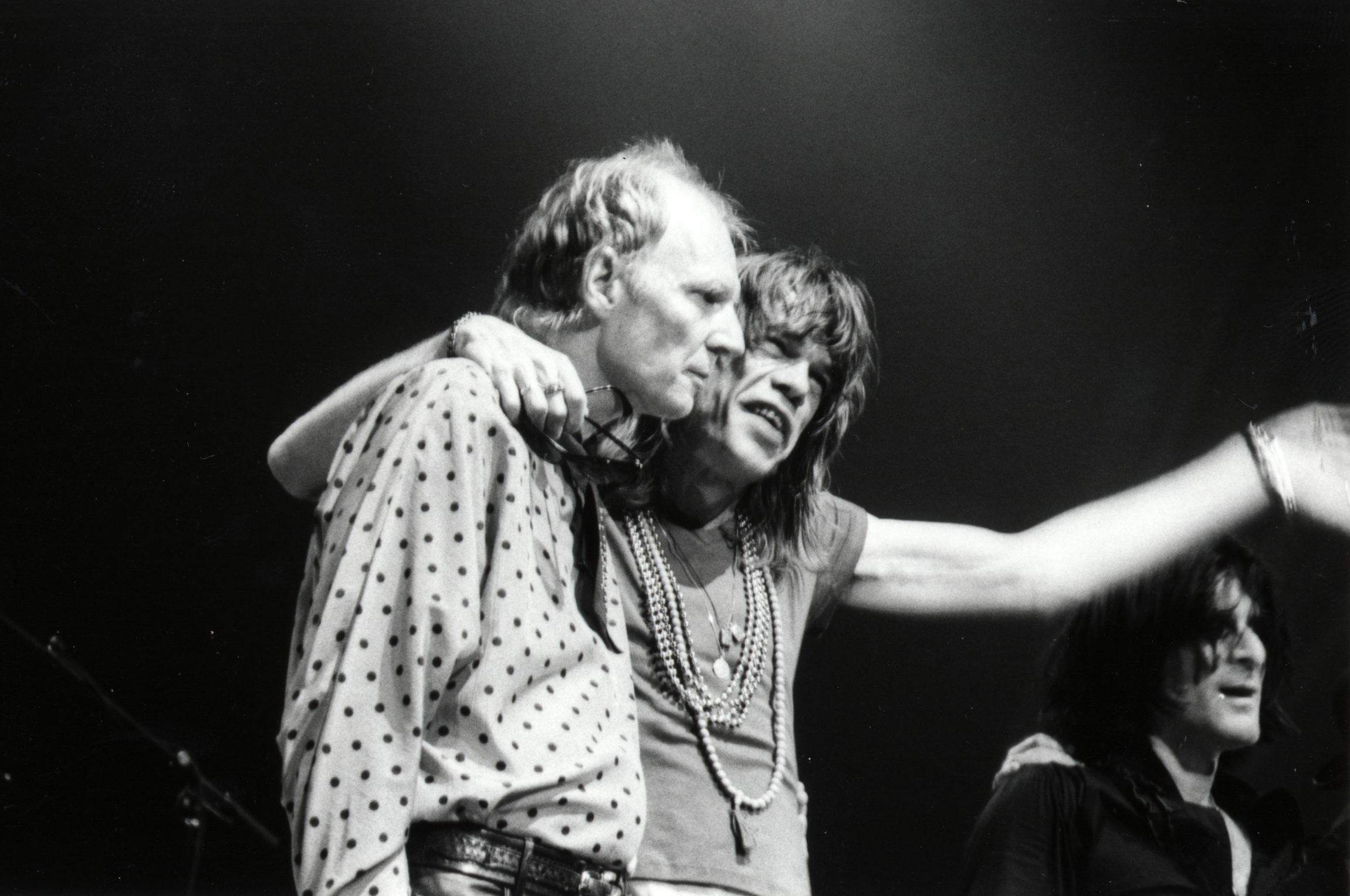
 New York Doll is an unforgettable documentary about Arthur “Killer” Kane, a man who went to the heights of ecstasy as a member of the New York Dolls in the early 1970s, hit the depths of depression in the late 1980s, and rediscovered himself in the 1990s as a Mormon librarian. As bassist for the New York Dolls, Kane, dressed wildly in heavy makeup and women’s clothes, anchored the glam rock idols, which also included David Johansen, Sylvain Sylvain, Johnny Thunders, and Jerry Nolan. The band dissolved after only two studio albums, and while the rest of the band remained in the music business (Thunders and Nolan died in the early ’90s), Kane’s drug- and alcohol-addled life spiraled downward. As Johansen started showing up in mediocre Hollywood movies (Married to the Mob, Scrooged, Car 54, Where Are You?) and his alter ego, Buster Poindexter, could be heard singing “Hot, Hot, Hot” at every bar mitzvah and wedding in town, Kane languished in obscurity until, in 1989, after a ridiculous suicide attempt, he became a Mormon. Fellow Mormon Greg Whiteley follows Kane around with a handheld camera as the former underground rock star goes about his daily life, working in a Mormon Family History Center library in California, taking the bus to work, hanging out with old ladies, paying “rent” on his pawned basses, and living a simple existence — until he gets a call from British pop star Morrissey, who wants the Dolls to reunite for the 2004 Meltdown festival in London. Kane is a soft-spoken, earnest, gentle man who seems a little bit off yet genuine, but this is what he’s been waiting for — although he is also afraid of failure yet again. Whiteley intersperses classic Dolls songs (“Looking for a Kiss,” “Lonely Planet Boy,” “Private World,” “Puss ‘n’ Boots,” “Trash,” and Johnny Thunders’s “You Can’t Put Your Arms Round a Memory”) with talking heads who share their love of the band (including Sir Bob Geldof, Chrissie Hynde, Mick Jones from the Clash, Blondie’s Clem Burke, and especially Morrissey, who is always seen in extreme close-up and is oh-so-serious), although we wish the film included more music, of a higher quality. Yet the remarkable story and ridiculously bizarre ending, which has a This Is Spinal Tap quality to it throughout — except it’s very real — rises above it all to create one of the best rockumentaries we’ve ever seen.

 Craig Cataldo, also known as Craig Schwartz, is a New York icon. Better known as Radioman, he travels across the city on an old bicycle, wearing a boombox around his neck like a treasured jewel. The life of this eccentric character is now on view in the entertaining documentary Radioman. Although many might assume that Radioman is a crazy homeless drunk — something he did struggle with in the past — it turns out that Radioman is a beloved figure in the film world, appearing in more than one hundred films and television shows. He devotes his life to being an extra and hanging out on movie sets, where he converses with the stars and approaches his bit parts like they are starring roles. The documentary, directed by British filmmaker Mary Kerr, features a slew of celebrities singing the praises of Radioman, including George Clooney, Helen Mirren, Whoopi Goldberg, Tina Fey, Meryl Streep, Ron Howard, and, most philosophically, Josh Brolin and Robin Williams. Kerr follows Radio, as he’s known to his closer friends, as he does his thing on local film sets, discusses his childhood and the difficult time when he was arrested and hospitalized against his will, shows off his frighteningly cramped and bug-infested apartment, and travels to Hollywood to try to get into some Oscar parties. A gregarious, well-spoken, and occasionally crude fellow with a big, scraggly gray beard, Radioman, who looks much older than his sixty-one years, is like a giant old teddy bear that you just can’t get yourself to throw away because it means that much to you. Radioman is screening November 9 and 15 at the IFC Center, with Kerr and Radioman on hand to talk about the work, as part of DOC NYC, a weeklong celebration of nonfiction film at IFC and the SVA Theatre comprising more than seventy documentaries, along with panel discussions and master classes. Among the other highlights are Artifact, about Jared Leto’s band, Thirty Seconds to Mars, and their battle with their record label; Eddie Adams: Saigon ’68, which tells the story of the iconic photograph of a gun pointed at the head of a Vietnamese man; Informant, about activist and FBI mole Brandon Darby; and Plimpton! Starring George Plimpton as Himself, a look at the life and career of the beloved participatory journalist.