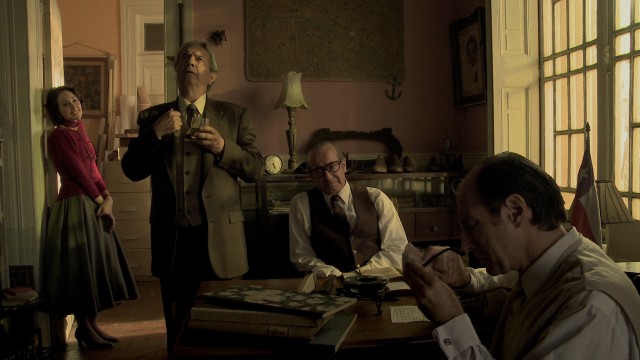
Raúl Ruiz’s final film, NIGHT ACROSS THE STREET, is an abstract, surreal examination of time and memory
THE NIGHT ACROSS THE STREET (LA NOCHE DE ENFRENTE) (Raúl Ruiz, 2012)
Film Society of Lincoln Center
Elinor Bunin Munroe Film Center: Francesca Beale Theater
144 West 65th St. between Broadway & Amsterdam Ave.
February 8-14
212-875-5601
www.filmlinc.com
 Raúl Ruiz’s last film, Night Across the Street, proves to be a fitting finale for the long career of the Chilean-French auteur, who died at the age of seventy in August 2011, leaving behind a legacy of more than one hundred movies and one hundred plays. An adaptation — or as Ruiz explained it, “adoption” — from a pair of short stories by Imaginist writer Hernán del Solar Night Across the Street follows the odd meanderings of Don Celso (Sergio Hernandez), an old man about to retire from his office job. Past, present, and future, the real and the imagined, merge in abstract, surreal ways as Don Celso goes back to his childhood, where he (played as a boy by Santiago Figueroa) takes his idol, Beethoven (Sergio Schmied), to the movies and gets life lessons from Long John Silver (Pedro Villagra). As an adult, he hangs out with the fictional version of French teacher and writer Jean Giono (Christian Vadim), whose real self and family appear to be elsewhere. And he visits a haunted hotel run by Nigilda (Valentina Vargad) where he believes he will meet his doom. Memories and hallucinations mingle in front of obviously fake backgrounds, strange, unexplained characters appear then disappear, and Don Celso (and Ruiz, of course) has fun with such words as “Antofagasta” and “rhododendron” in a film that Ruiz created to be shown only after his death. (He made the film after being diagnosed with liver cancer, which he survived by getting a transplant, only to die shortly thereafter of a lung infection.) And at the center of it all is one of Ruiz’s favorite themes, time — Don Celso is regularly interrupted by an annoying alarm clock that signals him to take unidentified medication, keeping him alive even as the end beckons. Night Across the Street is an elegiac swan song by a master filmmaker.
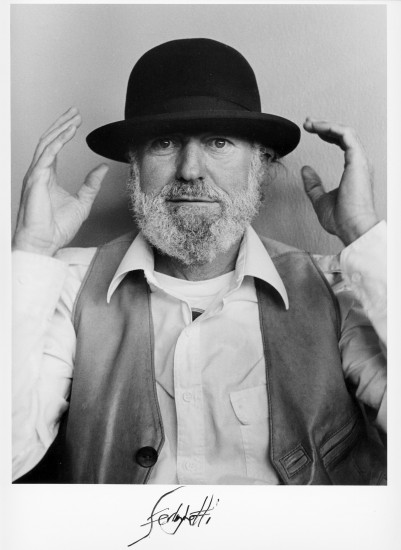
 “Poetry should be dissident, and subversive, and an agent for change,” poet, publisher, painter, activist, and military veteran Lawrence Ferlinghetti says in Ferlinghetti: A Rebirth of Wonder, a refreshing and revealing documentary about the author of A Coney Island of the Mind and owner of the famous

 Kirby Dick’s The Invisible War is one of the bravest, most explosive investigative documentaries you’re ever likely to see. Dick (This Film Is Not Yet Rated) busts open the military’s dirty little secret, revealing that episodes of horrific sexual abuse such as the Tailhook scandal are not an aberration but a prime example of a rape epidemic that seems to an accepted part of military culture. Dick speaks with many women and one man who share their incredible stories, describing in often graphic detail the sexual abuse they suffered, then faced further abuse when they reported what had happened. Their superiors, some of whom were the rapists themselves, either looked the other way, laughed off their allegations as no big deal, or threatened the victims’ careers. Dick includes remarkable Defense Department statistics — the government admits that approximately one out of every five female soldiers suffers sexual abuse and that there were nineteen thousand violent sex crimes in 2010 alone — even as such military officials as Dr. Kaye Whitley, Rear Admiral Anthony Kurta, and Brigadier General Mary Kay Hertog make absurd claims that they are satisfied with the way they are handling the alarming trend. The central figure in the film is Kori Cioca, a former member of the Coast Guard whose face was broken when she was raped by a superior and now keeps getting denied necessary medical services from the VA. Such courageous women as USAF Airman 1st Class Jessica Hinves, former Marine Officer Ariana Klay, USN veteran Trina McDonald, USMC Lieutenant Elle Helmer, USN Lieutenant Paula Coughlin, and even Special Agent Myla Haider of the Army Criminal Investigation Command also open up about the physical and psychological damage the abuse has left on their lives and careers. Inspired by Helen Benedict’s 2007 Salon.com article “The Private War of Women Soldiers,” Dick and producer Amy Ziering (The Memory Thief) have presented a searing indictment of an endemic military culture that has to come to an end, and fast. The Invisible War, which earned Dick and Ziering this year’s Nestor Almendros Award for courage in filmmaking at the Human Rights Watch Film Festival at Lincoln Center and has been nominated for a Best Documentary Academy Award, is screening February 10 at 12 noon as part of the third annual Athena Film Festival at Barnard College and will be followed by a Q&A with Dick and executive producers Maria Cuomo Cole and Regina Kulik Scully.
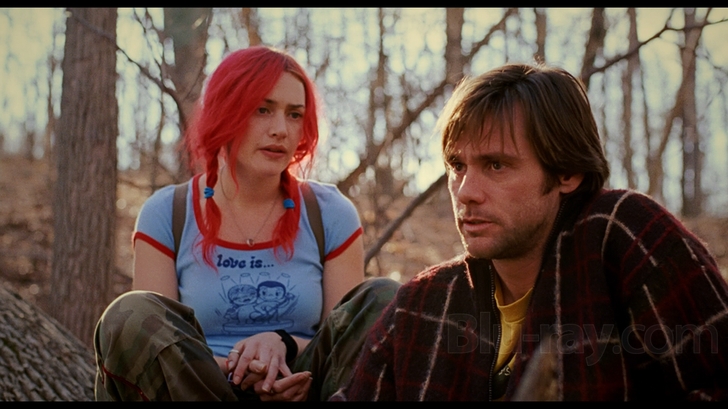
 Going to a hip new overrated Brooklyn restaurant for Valentine’s Day is so, well, 2012. For something completely different this year, Nitehawk Cinema’s monthly Beer, Dinner, and a Movie series is hosting a special presentation on February 13, screening Michel Gondry’s wickedly entertaining Eternal Sunshine of the Spotless Mind and serving a three-course meal inspired by the film (and dished out at very specific, related times), featuring drink pairings courtesy of Brooklyn’s own KelSo Beer Co. The brilliant film comes from the warped mind of Charlie Kaufman, the sensational scribe behind Being John Malkovich, Adaptation., and Confessions of a Dangerous Mind. (Chris Elliott fans will get a kick out of knowing that Kaufman was a writer for Get a Life, one of the great warped series of all time.) Eternal Sunshine of the Spotless Mind stars Jim Carrey and Kate Winslet as a couple looking to erase each other from their memories by . . . ah, don’t worry what it’s about. The less you know, the better. Just be prepared for a visual, metaphysical spectacle that will both exhilarate and depress you, filling you with wonder and amazement. The only thing keeping it from perfection is the ordinariness of the subplot involving Elijah Wood. Kaufman and Gondry (The Science of Sleep) mix in a little Punch-Drunk Love and Groundhog Day, both of which also starred former television comedians in more serious roles, but end up with something wholly original and, quite simply, one of the most romantic movies we have ever seen. As far as the food goes, after a welcoming KelSo pale ale, the dining kicks off with creamy tomato soup, grilled sourdough, and smoked Gouda with KelSo Rauchbier, followed by Blue Point oysters, local striped bass, vermouth, cauliflower, and KelSo pilsner. For dessert there’s Clementine vanilla sorbet, coconut “snow,” and KelSo rye aged pale ale. That frees you up on Valentine’s Day to snuggle with your loved one while everyone else is out eating mediocre food at mediocre restaurants that will not provide nearly the kinds of memories Nitehawk served up the night before.