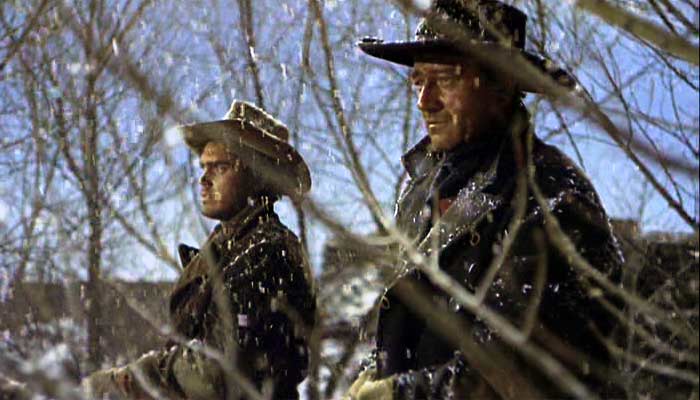
In iconic Western, Jeffrey Hunter and Ethan Edwards search for Natalie Wood, with very different motives
THE SEARCHERS (John Ford, 1956)
IFC Center
323 Sixth Ave. at West Third St.
February 15-18, $13.50, 11:00 am
212-924-7771
www.ifccenter.com
 That’ll be the day when someone tries to claim there’s a better Western than John Ford’s ethnocentric look at the dying of the Old West and the birth of the modern era. Essentially about a gunfighter’s attempt to find and kill his young niece, who has been kidnapped and, ostensibly, ruined by Indians, The Searchers is laden with iconic imagery, inside messages, and not-so-subtle metaphors. Hence, it is no accident that John Wayne’s son, Patrick, plays an ambitious yet inept officer named Greenhill. The elder Wayne stars as Ethan Edwards, a tough-as-nails Confederate veteran seeking revenge for the murder of his brother’s family; he’s also out to save Debbie (Natalie Wood) from the Comanches, led by a chief known as Scar (Henry Brandon), by ending her life, because in his world view, it’s better to be dead than red. Joining him on his trek is Debbie’s adopted brother, Martin Pawley (Jeffrey Hunter), who wants to save her from Edwards. The magnificent film balances its serious center with a large dose of humor, particularly in the relationships between Ethan and Martin and Ethan with his Indian companion, Look (Beulah Archuletta). And keep your eye on that blanket in front of the house. The Searchers is screening in a DCP projection February 15-18 at 11:00 as part of the IFC Center series “Weekend Classics: John Ford,” which continues with such other Ford fare as Young Mr. Lincoln, The Whole Town’s Talking, and The Last Hurrah.
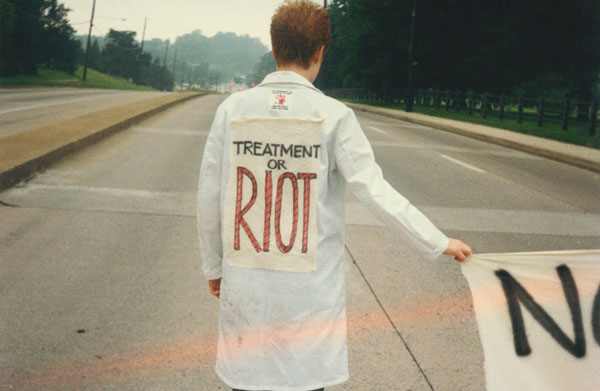
 Contemporary activists stand to learn a lot from the gripping documentary How to Survive a Plague. For his directorial debut, longtime journalist David France, one of the first reporters to cover the AIDS crisis that began in the early 1980s, scoured through more than seven hundred hours of mostly never-before-seen archival footage and home movies of protests, meetings, public actions, and other elements of the concerted effort to get politicians and the pharmaceutical industry to recognize the growing health epidemic and do something as the death toll quickly rose into the millions. Focusing on radical groups ACT UP and TAG (Treatment Action Group), France follows such activist leaders as Peter Staley, Mark Harrington, Larry Kramer, Bob Rafsky, and Dr. Iris Long as they attack the policies of President George H. W. Bush, famously heckle presidential candidate Bill Clinton, and battle to get drug companies to create affordable, effective AIDS medicine, all while continuing to bury loved ones in both public and private ceremonies. France includes new interviews with many key activists who reveal surprising details about the movement, providing a sort of fight-the-power primer about how to get things done. The film also shines a light on lesser-known heroes, several filled with anger and rage, others much calmer, who fought through tremendous adversity to make a difference and ultimately save millions of lives. Nominated for Best Documentary Feature, How to Survive a Plague is screening February 14 at the Maysles Institute as part of the “Oscar Buzz” series, which continues February 15-16 with the Oscar-nominated Detropia, with the Saturday show followed by a Q&A with codirectors Rachel Grady and Heidi Ewing, and culminates with a free Oscar viewing party on February 24 that includes unlimited refills of organic popcorn.
 Audrey Hepburn won an Oscar for her delightful performance in William Wyler’s romantic charmer about a foreign princess who gets to spend a day of anonymity in the city of Rome with a good-looking American newsman (Gregory Peck) who knows at least some of her secrets. The film was nominated for a total of seven Oscars, also capturing the prize for Dalton Trumbo’s script and Edith Head’s costume design. Roman Holiday is screening at 6:15 and 8:45 on Valentine’s Day at BAM, with an optional $67 prix-fixe menu that includes a glass of champagne, an amuse bouche of green-pea flan with poached shrimp, a choice of baby arugula salad, lobster bisque, or spaetzle with Brussels sprout leaves and duck confit for appetizers, and an entrée choice of red-wine braised short ribs, spice-crusted salmon, roasted French-cut chicken breast gnocchi, or crispy wild mushroom risotto cake, followed by a shared lovers dessert of warm chocolate cake with fresh raspberries and vanilla ice cream.
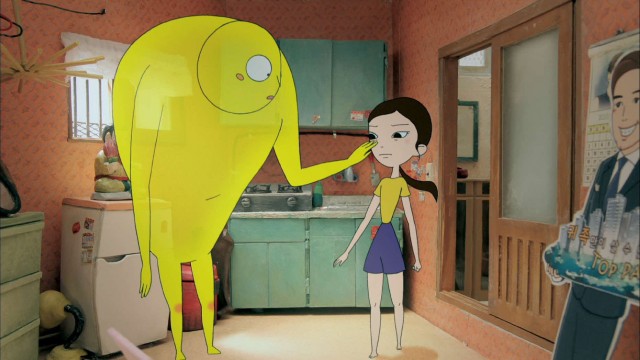
 The Korean Academy of Film Arts takes on urban renewal in their annual collaboration, The House. Ban Joo-young, Lee Hyun-jin, Lee Jae-ho-I, Park Eun-young-I, and Park Mi-sun team up to tell the story of a young woman, Ga-young (voiced by Kim Kkobbi), struggling to get by in modern-day Korea. With no money and no real job, she moves into a ramshackle apartment with Hee-ju (Ha Jae-sook) while dreaming of winning the lottery and being able to move into a nearby wealthy complex. But when she finds a magic bracelet, she suddenly can see the spirits of the old houses, who would die if their buildings were torn down by the city, changing Ga-yong’s attitude about just what home means. The filmmakers combine CGI and real photographs with the drawing style of Yoshitoro Nara and the look and sensibility of Hayao Miyazaki’s classic Spirited Away in The House, an admirable if ultimately unsatisfying story that has too many holes and lacks nuance. It ends up feeling overly derivative and unsentimentally political, even if it is based on some real circumstances, as evidenced by the pictures that accompany the closing credits. Also featuring the voices of Choi Jeong-ho, Choi Ha-na, Kim Hee-jin, and Oh In-sil as multiple characters, The House is screening for free February 12 at 7:00 at Tribeca Cinemas as part of the latest biweekly Korean Movie Night series, “Drawn into Film: Korean Animation!,” which continues February 26 with Yuen Sang-ho’s debut, The Window.