
Aude Moreau’s installation at Smack Mellon contains two tons of refined sugar (photo by twi-ny/mdr)
AUDE MOREAU: SUGAR CARPET
JANET BIGGS: SOMEWHERE BEYOND NOWHERE
Smack Mellon
92 Plymouth St. at Washington St.
Wednesday – Sunday through February 24, free, 12 noon – 6:00
www.smackmellon.org
www.brooklynmontreal.com
This past fall, Brooklyn-based visual artist Janet Biggs showed four of her video works — her Arctic Trilogy, made during an extraordinary trip to the far North, and A Step on the Sun, about a sulfur miner in the Ijen volcano in Indonesia — at the Musée d’art contemporain de Montréal as part of the “Brooklyn/Montréal” cultural exchange, which involves forty artists and sixteen institutions. In conjunction with that, French-born Montréal installation artist Aude Moreau presented her film of the New York City skyline, Reconstruction. The two have joined forces again for the second part of the exchange, a pair of solo exhibitions at Smack Mellon in DUMBO. Although Biggs’s and Moreau’s pieces reinforce each other so well it seems they might have planned the shows together, actually each artist had no idea what the other was going to do at the Brooklyn gallery. Biggs is very familiar with the area, however; Smack Mellon is just steps from the East River where Biggs staged the impressive Wet Exit for the DUMBO Arts Festival in September 2011. Moreau’s “Sugar Carpet” is a large-scale rectangular Persian rug made from two tons of refined sugar, bordered by an intricate black and red floral design. The piece is installed in the center of the gallery, incorporating eight of Smack Mellon’s structural posts, which pierce into the sides of the sugar, adding to the industrial feel referencing mass production. “Sugar Carpet” also evokes the abandoned Domino Sugar Factory in Williamsburg, a memorial to a past era, and serves as a splendid introduction, fittingly a white carpet rather than a red one, to the brilliantly bright expanse of Biggs’s latest video.
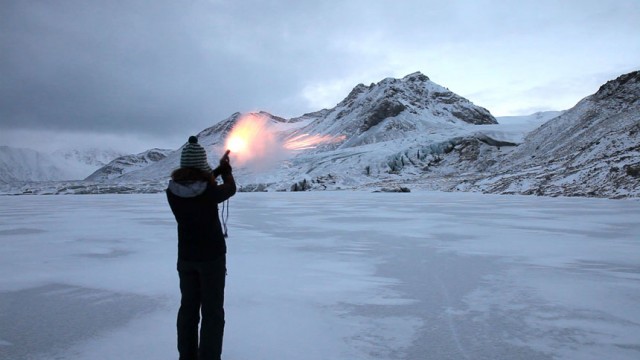
Janet Biggs fires a flare across a vast white landscape in SOMEWHERE BEYOND NOWHERE (photo courtesy of Janet Biggs)
Somewhere Beyond Nowhere, Biggs’s six-minute, two-channel follow-up to the Arctic Trilogy, which consists of Fade to White, Brightness All Around, and In the Cold Edge, was made during a 2010 art and science expedition aboard a hundred-year-old schooner. Over an electronic score by Will Martina, the camera-shy Biggs, in voice-over, narrates the tale of an early journey gone wrong as she shoots flares across an empty, vast white horizon that immediately makes one think of climate change and the melting of the glaciers. “The act of shooting off a flare became both an aggressive assertion of my presence and a cry for help that implied a condition of emergency,” she explains in an artist statement. “My efforts to either establish power or seek assistance failed as a thousand miles from civilization, I was too far north for anyone to see or respond to my act.” The nearly blinding whiteness of Somewhere Beyond Nowhere echoes that of “Sugar Carpet,” the frozen landscape Biggs walks across providing a stark contrast to the fragility of Moreau’s sugar sculpture, which would be ruined by the trampling of people’s feet. In addition, the pieces work particularly well in tandem during what has been an extremely cold winter, which has featured several powerful snowstorms. Biggs’s and Moreau’s installations continue through February 24; you can also catch Biggs’s In the Cold Edge through March 10 at Present Company as part of the group show “Through This to That,” which also features Biggs’s lightboxes from her Kawah Ijen series. For our 2011 twi-ny talk with Biggs, go here.
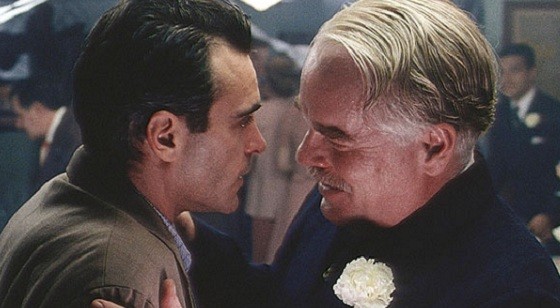
 One of America’s most daring and adventurous filmmakers, California native Paul Thomas Anderson, who has dazzled, amazed, challenged, and confused audiences with such previous gems as Boogie Nights, Magnolia, Punch-Drunk Love, and There Will Be Blood, has done it again with his latest, The Master. The film is built around the fascinating relationship between Freddie Quell (Joaquin Phoenix), a WWII vet struggling to fit into the real world after seeing so much violence and death overseas, and the Master (Philip Seymour Hoffman), the leader of a cultlike organization known as the Cause that believes in past-life regression and invasive questioning known as Processing to help people deal with personal trauma. The Master essentially adopts Quell, intrigued by his distorted outlook on life, making him a member of the family, which also includes his wife, Peggy (Amy Adams), his son, Val (Jesse Plemons), and his daughter, Elizabeth (Ambyr Childers). Inspired by the real-life tale of L. Ron Hubbard and Scientology — and incorporating war stories he was told by Jason Robards on the set of Magnolia, elements from the life of John Steinbeck, and discarded scenes from the script for There Will Be Blood — Anderson crafts a, dare we say, masterful cinematic experience built around a pair of extraordinary performances. Phoenix absolutely inhabits the role of Quell, staggering about with an awkward gait, with impossibly deep lines on his face and eyes that seem to be able to look through lead. Hoffman is his equal as the much cooler and calmer spiritual leader, until he is faced with sudden turmoil. The scenes in which the two men sit across from each other, going through a Processing session, are mesmerizing, the most powerful moments to be found onscreen last year. (Both Phoenix and Hoffman received Oscar nods, along with Adams.) But despite the title, the focus remains on Quell, a lost soul searching for somewhere to belong in a changing postwar America. Anderson’s first film in four years, The Master is a bold, audacious work that is as unsettling as it is exhilarating.
 Japanese filmmaker Shohei Imamura blurs the lines between reality and fiction in his cinéma vérité masterpiece, A Man Vanishes. The 1967 black-and-white documentary delves into one of Japan’s annual multitude of missing persons cases, this time investigating the mysterious disappearance of Tadashi Ôshima, a plastics wholesaler who vanished during a business trip. Imamura sends out actor Shigeru Tsuyuguchi (The Insect Woman, Intentions of Murder) to conduct interviews with Ôshima’s fiancée, Yoshie Hayakawa, who develops an interest in her inquisitor; Yoshie’s sister, Sayo, who quickly finds herself on the defensive; business associates who talk about Ôshima’s drinking, womanizing, and embezzling from the company; and several people who remember seeing Sayo together with Ôshima, something she adamantly denies despite building evidence. Throughout the 130-minute work, the film references itself as being a film, culminating in Imamura’s pulling the rug out from under viewers and calling everything they’ve seen into question in an unforgettable moment that breaks down the fourth wall and explodes the very nature of truth and cinematic storytelling itself. It also explores individual identity and just how much one really knows those closest to them. Originally supposed to be the first of a twenty-four-part series exploring two dozen missing-persons cases, A Man Vanishes ended up being such a challenging undertaking that it was the only one Imamura made, but what a film it is; it would be more than a decade before he returned to fiction, with 1979’s Vengeance Is Mine, which led the way to a spectacular final two decades that also included The Ballad of Narayama, Eijanaika, Black Rain, The Eel, Dr. Akagi, and Warm Water Under a Red Bridge. The amazing A Man Vanishes is screening February 19 at the IFC Center as part of the Tuesday-night series “Stranger than Fiction,” followed by a Q&A with documentarian Amir Bar-Lev (The Tillman Story, Fighter) and John Walter (How to Draw a Bunny).
 French auteur Leos Carax’s adaptation of Herman Melville’s controversial 1852 novel, Pierre: or, The Ambiguities, is a dour, plodding tale of family dysfunction reaching ridiculous heights. Named after the first letter of each word in the French title of Melville’s tome, Pierre ou les ambiguities, and the tenth and final draft of the script, POLA X follows the trials and tribulations of an aristocratic clan facing its ultimate demise. The patriarch, a cold war diplomat, has died, and his beautiful blonde wife, Marie (Catherine Deneuve), is going through his boxes of papers. Their son, novelist Pierre (Guillaume Depardieu), who refers to his mother as his sister and is not uncomfortable talking to her while she is naked, is engaged to the prim and proper Lucie (Delphine Chuillot). Pierre, Lucie, and his very serious cousin, Thibault (Laurent Lucas), form a sort of Jules and Jim trio. But Pierre is haunted by a dark-haired woman lurking in his dreams, a somewhat feral creature who ends up claiming to be his half-sister, Isabelle (Yekaterina Golubeva), the result of an indiscretion their father had while on an assignment. Angered by the story Isabelle tells him, Pierre takes off with her and her companions, Razerka (Petruta Catana) and Razerka’s young daughter (Mihaella Silaghi). Pierre and Isabelle grow too close very quickly, soon finding themselves posing as husband and wife while living with an underground radical organization. And it only gets crazier from there. POLA X attempts to be epic in scope, its central tale of incest and ennui echoing France’s treatment of Eastern Europe and its refugees, but Carax makes virtually every character unlikable, and nearly every scene stretches credulity, resulting in two hours of annoying people making annoying choices and doing annoying things. POLA X is screening on February 19 at Florence Gould Hall as part of the French Institute Alliance Française CinémaTuesdays series “When Boy Meets Girl: The Cinema of Leos Carax”; it was initially supposed to be preceded by Carax’s 1997 short, Sans titre, also starring Depardieu, Golubeva, and Deneuve, but that has been canceled. The series concludes February 26 with Carax’s widely hailed latest film, Holy Motors, with the director on hand to participate in a Q&A with Richard Brody following the 7:00 show.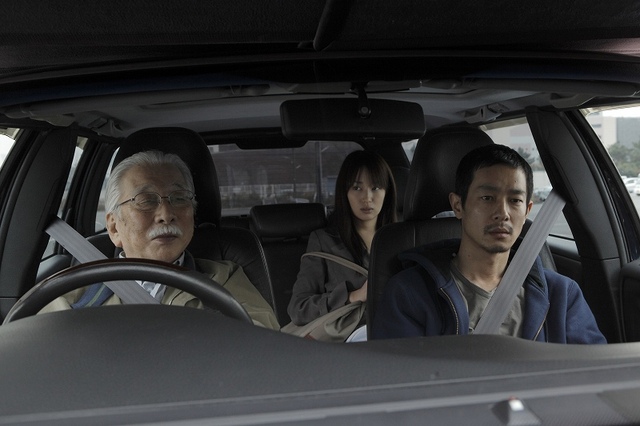

 In his 1994 autobiography, Hard Stuff, former Detroit mayor Coleman Young wrote, “In the evolutionary urban order, Detroit today has always been your town tomorrow.” That’s precisely the warning that permeates Detropia, the latest documentary by director-producers Rachel Grady and Heidi Ewing, who have previously teamed up on such films as The Boys of Baraka, the Oscar-nominated Jesus Camp, and the Peabody-winning