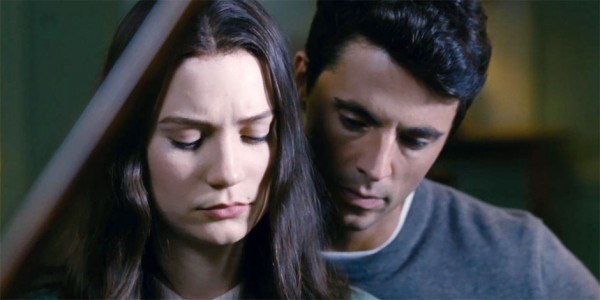
India (Mia Wasikowska) and Uncle Charlie (Matthew Goode) develop a rather unusual relationship in STOKER
STOKER (Park Chan-wook, 2013)
Opens Friday, March 1
www.foxsearchlight.com/stoker
 Korean auteur Park Chan-wook has made some of the most suspenseful and violent films of the young century, beginning with the military thriller Joint Security Area and continuing with the Vengeance trilogy, consisting of Sympathy for Mr. Vengeance, Oldboy, and Lady Vengeance, as well as Thirst and the romantic comedy I’m a Cyborg But That’s OK. A master of mood, Park finally makes his long-awaited English-language debut with Stoker, a creepy, atmospheric work that evokes Alfred Hitchcock’s Shadow of a Doubt, Roman Polanski’s Rosemary’s Baby, Michael Haneke’s Funny Games, Paul Wendikos’s The Mephisto Waltz, the television show Dark Shadows, and Richard Donner’s The Omen while also managing to be wholly original. Rising Australian actress Mia Wasikowska (In Treatment, The Kids Are All Right) stars as India Stoker, a shy, introverted high school student whose father, Richard (Dermot Mulroney), has just died in a terrible accident and whose mother, Evelyn (Nicole Kidman), is too quick to grow close with Richard’s brother, Charlie (Matthew Goode) — whom India and her mom didn’t even know existed until he just showed up at the funeral. Uncle Charlie seems to have a mysterious power over people and a chilling need to control situations, especially when it comes to those who know about his secret past, including the old housekeeper, Mrs. McGarrick (Phyllis Somerville), and Charlie’s aunt, Gin (Jacki Weaver). He also takes great pleasure in placing himself firmly in the middle of a potential incestuous love triangle with Evelyn and India. But once India learns more than she ever wanted to know about her uncle, she is both repulsed by and attracted to what he is capable of. Written and coproduced by actor Wentworth Miller (The Human Stain, Prison Break), Stoker is another compelling mood piece from Park, who creates a gripping, fearful, claustrophobic world inside the Stoker’s large Nashville mansion. He releases information ever-so-slowly over the course of the film’s ninety-nine minutes, resulting in plenty of frustration as well as suspense. The look of the film, courtesy of production designer Thérèse DePrez and cinematographer Chung Chung-hoon, often has a dated, 1950s feel to it, even though it is set in the present day, with flat colors that offset India’s black-and-white shoes. The film suffers from several leaps of faith Park requires the audience to make, asking them to forgive some relatively unforgivable plot holes, and Goode is not quite convincing enough as Charlie, but Wasikowska’s portrayal of the troubled young woman is riveting, and everything comes around full circle in the shattering conclusion.

 In 2010, filmmaker and Gallatin School professor Keith Miller made a short film,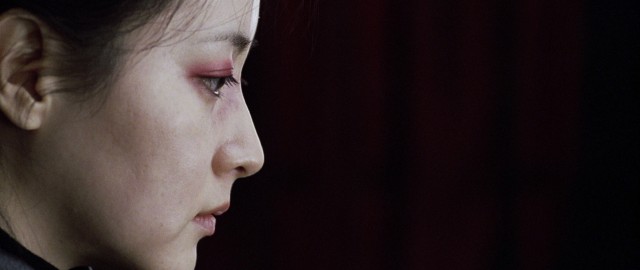
 Park Chan-wook’s awesome revenge trilogy (following Sympathy for Mr. Vengeance and Oldboy) comes to a stirring conclusion with the thrilling tale of Lee Geum-ja (Lee Young-ae), a beautiful thirty-one-year-old woman who has just been released from prison after serving thirteen years for the kidnapping and murder of a five-year-old boy (Nam Song-woo). While behind bars, Geum-ja plotted out a detailed, complex plan to gain revenge on her co-conspirator (Oldboy’s Choi Min-sik as Mr. Baek), who harbors a dark secret. As Geum-ja, known as both “Angel” and “Witch,” visits each former prisoner participating in the elaborate set-up, Park flashes back to reveal the woman’s original crime and her relationship to Geum-ja — who is also being followed by a wacky preacher with a great hairdo (Kim Byeong-ok). Now working in a bakery, Geum-ja has become a magical pastry chef as part of her scheme to feed Mr. Baek his just desserts, but, as Park shows rather gruesomely, vengeance — and repentance — comes with a heavy price. As with the first two parts of this masterful series, Lady Vengeance serves up a cunning concoction of bizarre characters, stunning surprises, existential exegesis, and plenty of psychological terror. You need not have seen the first two to love this one; in fact, all three films are stand-alones as well as stand-outs. Lady Vengeance is screening on March 3 at 6:00 as part of a Museum of the Moving Image/Korea Society tribute to Park in conjunction with the release of his first English-language film,

 Park Chan-wook kicked off his revenge trilogy with Sympathy for Mr. Vengeance (even though the second film, Oldboy, was the first one released in the States), a creepy, quirky tale that lays low for quite a while before busting loose with a massive splattering of the old ultra-violence. After deaf-mute Ryu (Shin Ha-kyun) fails miserably in a desperate, ridiculous attempt to get his dying sister (Lim Ji-eun) a kidney, the recently laid-off Ryu is convinced by his anarchist girlfriend, Youngmin (Bae Doo-na), to kidnap the four-year-old daughter (Han Bo-bae) of Park (Song Kang-ho), the man who owned the factory that kicked him out. But when the plan goes awry, both Ryu and Park become obsessed with avenging their torn-apart lives. Although the first half of the film is too slow and heads off in too many directions, the second half brings everything together, chock full of the kind of violence promised by the title. Sympathy for Mr. Vengeance is screening on March 3 at 3:00 as part of a Museum of the Moving Image/Korea Society tribute to Park in conjunction with the release of his first English-language film,
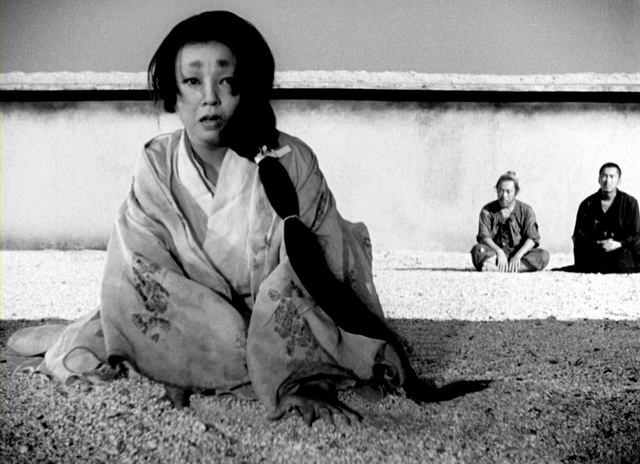
 One of the most influential films of all time, Akira Kurosawa’s 1950 masterpiece stars Toshirô Mifune as a bandit accused of the brutal rape of a samurai’s wife (Machiko Kyo) and the murder of her husband (Masayuki Mori). However, four eyewitnesses tell a tribunal four different stories, each told in flashback as if the truth, forcing the characters — and the audience — to question the reality of what they see and experience. Kurosawa veteran Takashi Shimura — the Japanese Ward Bond — plays a local woodcutter, with Minoru Chiaka as the priest. The mesmerizing work, which won an Oscar for Best Foreign Language Film, is beautifully shot by Kazuo Miyagawa; Rashomon is nothing short of unforgettable. (What is forgettable is the English-language remake, The Outrage, directed by Martin Ritt and starring Edward G. Robinson, Paul Newman, Laurence Harvey, Claire Bloom, and William Shatner.) Rashomon is screening March 1 at 9:30 as part of the Rubin Museum Cabaret Cinema series “Illusions Revealed,” consisting of films that address misperception, and will be introduced by neuroscientist John J. Sakon. The series continues with such films as Rosemary’s Baby, Cinema Paradiso, Black Moon, and Cross of Iron through April 26.