Solomon R. Guggenheim Museum
1071 Fifth Ave. at 89th St.
March 28-29, $30-$50
212-423-3587
www.guggenheim.org
In conjunction with the major Guggenheim exhibition “Gutai: Splendid Playground,” which continues through May 8, the museum is teaming up with Japan Society to present the North American premiere of Sanbaso, divine dance, taking place in the rotunda of the Frank Lloyd Wright building March 28 at 2:00 and 8:00 and March 29 at 8:00. The ancient celebratory ritual dance will feature Kyogen actor Mansai Nomura (Onmyoji, Ran) as the title character, joined by five noh musicians and three noh chanters, with the set and costumes designed by Japanese artist Hiroshi Sugimoto based on his recent “Lightning Fields” series of photographs. “It is believed that the roots of Sanbaso lie in the myth of Amaterasu-omikami, the goddess of the sun, who hid in the heavenly rock cave Ama-no-Iwato,” Sugimoto explained in a statement. “This performance expresses how the gods descend to earth and is regarded as the most important performance piece among all the Shinto rituals. . . . The audience of this performance will witness the gods’ presence even in these jaded modern times.” This special program, a tribute to Gutai avant-garde artist Shiraga Kazuo’s Ultramodern Sanbasō, which opened the seminal “Gutai Art on Stage” presentation in 1957, is sold out, but there will be a standby line, with each person allowed to buy one ticket if any become available. In addition, on March 26, Japan Society will host a screening of Yuko Nakamura’s 2012 documentary Memories of Origin — Hiroshi Sugimoto, which follows Sugimoto around the world and includes appearances by architect Tadao Ando, artist Lee Ufan, critic and curator Akira Asada, and actor Mansai Nomura; Sugimoto will introduce the film and participate in a Q&A afterward.

Striking production of SANBASO, DIVINE DANCE lights up the Guggenheim (photo by Enid Alvarez; © 2013 Solomon R. Guggenheim Foundation, New York)
Update: Slow and steady, performed with split-second timing, Sanbaso, divine dance is a striking piece, a highly stylized, precisely choreographed combination of music, vocalization, movement, architecture, and design, beautifully tailored to its surroundings in the Guggenheim rotunda. The mesmerizing performance begins with a noh music medley featuring drums and flute, a traditional sonic introduction that sets the mood for what follows. After the trio of musicians departs, the full cast enters, with Kazunori Takano as Senzai, Haruo Tsukizaki as Koken, and kyogen star Mansai Nomura as the title character, along with a slightly larger group of musicians and vocalists. They all proceed slowly down the spiral from the Guggenheim’s second floor, emerging from behind one of Hiroshi Sugimoto’s lightning-themed curtains and winding their way to the bare stage, which stands about three feet off the ground. As the musicians play — the earlier trio of Rokurobyoe Fujita on fue (flute), Atsushi Ueda on ko-tsuzumi (small hand drum), and Keinosuke Okura on o-tsuzumi (large hand drum) is joined by Yotaro Uzawa on ko-tsuzumi (lead hand drum), Kensaku Araki on waki-tsuzumi (second small hand drum), and a ji-utai (chorus) of Ren Naito, Hiroharu Fukata, and Shuichi Nakamura — a ritual takes place in which the senzai is presented with gold hand chimes, known as suzu, from a box held by the koken. Soon Sanbaso approaches the koken and is given a small, dark mask of an old man’s face that he puts on, then starts taking loud steps and shaking the chimes in unison with the drummers. Flashing his lightning-patterned blue robe designed by Sugimoto, he stops, jerks his head, then lifts and brings down a heavy foot, creating an echo that reverberates throughout the Guggenheim. Nomura is also wearing a tall, dark hat — similar to the one he wore in the two fantastical Onymoji films — that reflects light and the late Motonaga Sadamasa’s water tubes, which arc across the museum, in such a way that it looks like bolts of lightning are streaking down it. At times, Nomura’s foot stomps are like thunder, matching Rie Ono’s lighting that makes the bolts on Sugimoto’s curtains come alive, as if a storm has suddenly arrived. Having honored the gods, Sanbaso returns the mask and chimes to the koken, and the company prepares for the finale, after which they go back up the winding Guggenheim ramp and disappear behind the lightning curtains. It’s nearly impossible to take your eyes off Nomura, who inhabits his role like it’s part of his soul. He even adds a final flourish as he accepts the accolades of the delighted audience, which on Thursday night included Sugimoto as well as Cai Guo-Qiang, whose stunning “I Want to Believe” exhibition filled the Guggenheim five years ago.
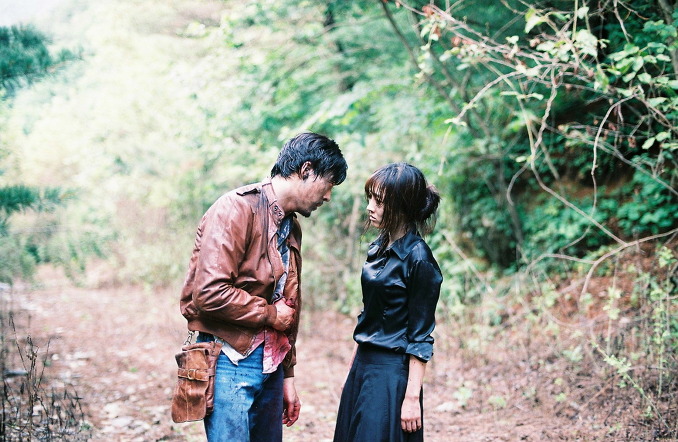
 Writer-director Ji Ha-jean offers new twists on the Korean revenge thriller in Bloody Fight in Iron-Rock Valley. Winner of the European Fantastic Film Festival Asian Award for best Asian genre film and the Fujifilm Eterna Award for best Korean independent at the 2011 Puchon International Fantastic Film Festival in South Korea, Bloody Fight stars Lee Moo-saeng as a nameless antihero who is released from prison with vengeance on his mind. He sets out on his motorcycle, carrying with him a music box with a ballerina on top of it, determined to find the cold-blooded killers known as Ghostface and Ax who work for a gangster boss in a wheelchair and his drug-addled son. As he gets closer to his prey, coming upon gambling dens, a corrupt construction business, and a quiet monastery where a prostitute is staying, bits and pieces of his past are shown in flashback, slowly explaining the motive behind his spree. Filmed for thirty-five thousand dollars in a month in Gangwon province, Bloody Fight in Iron-Rock Valley combines such spaghetti Westerns as Once Upon a Time in the West and High Plains Drifter with such violent revenge films as Old Boy and Death Wish. Ji uses a wide range of weaponry throughout, including a nail gun, a blowtorch, and a unique little ax, in scenes that often involve torture as well as some head scratching, as Ji does not fill up the various plot holes and several inexplicable elements. Still, it’s a compelling revenge thriller that doesn’t try to be anything more than what it is. Bloody Fight in Iron-Rock Valley is screening for free March 26 at Tribeca Cinemas as part of the Korean Cultural Service Korean Movie Night series “Micro-Budget Genre Invasion!,” which continues April 16 with Oh Young-doo’s Invasion of Alien Bikini and April 30 with the four-part omnibus The Neighbor Zombie.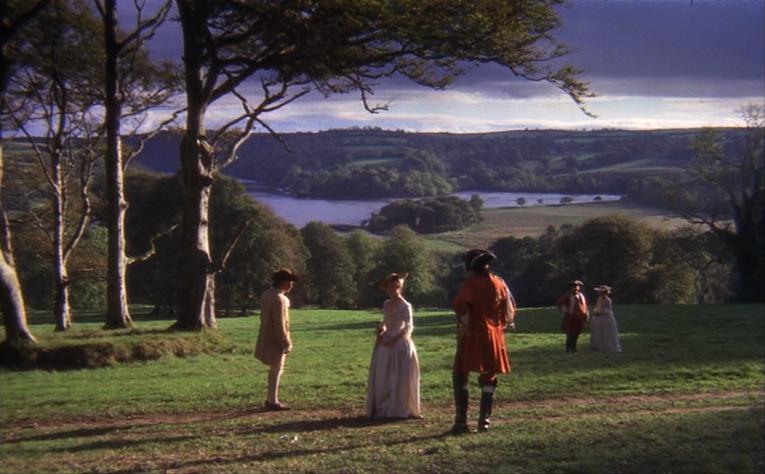
 Stanley Kubrick’s lush, romantic epic, Barry Lyndon, is one of the most elegantly visual pictures ever made. Based on William Makepeace Thackeray’s 1844 serialized picaresque novel The Luck of Barry Lyndon, Kubrick’s extravagant three-hour tale follows the shenanigans of one Redmond Barry, played with endless charm by Ryan O’Neal. The man soon to be known as Barry Lyndon has a remarkable knack for survival — or maybe it’s just plain old Irish luck — as he rises in English society via a series of duels (with epees, guns, and bare knuckles), military battles (the Seven Years’ War), and, most prominently, sexual conquests. Consisting of two sections, “By What Means Redmond Barry Acquired the Style and Title of Barry Lyndon” and “Containing an Account of the Misfortunes and Disasters Which Befell Barry Lyndon,” the film features glorious music by Bach, Vivaldi, Handel, Mozart, Schubert, and the Chieftains in addition to absolutely divine locations that lay the groundwork for the sumptuous Oscar-winning art direction by Ken Adam, Vernon Dixon, and Roy Walker and cinematography by John Alcott; virtually every scene contains beautiful shots based on famous paintings, a treat for the eyes and the ears. (Leonard Rosenman took home an Academy Award as well for his adapted score.) The overly long story does drag at times, but it flows better once you get used to O’Neal in the title role. The underappreciated film also has a great supporting cast, with Marisa Berenson as Lady Lyndon, Patrick Magee as the Chevalier de Balibari, Hardy Krüger as Captain Potzdorf, Steven Berkoff as Lord Ludd, Leonard Rossiter as Captain John Quin, and Gay Hamilton as Nora Brady. A DCP projection of the film is screening March 26 as part of the IFC Center series “The Films of Stanley Kubrick,” which includes every one of the director’s feature works as well as A.I. Artificial Intelligence, a collaboration with Steven Spielberg, all shown in advance of the March 29 theatrical release of Rodney Ascher’s Room 237, a documentary that delves into the many metamysteries surrounding the making of The Shining.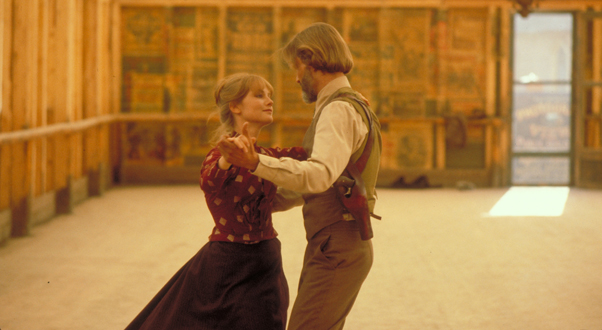
 When I was a kid in school, one of the first movies I ever reviewed was Heaven’s Gate, Michael Cimino’s brazenly overbudget famous Hollywood disaster. Incensed that professional film critics were obsessed with the meta surrounding the making of the epic Western instead of simply taking it for what it was, I was determined to treat it like any other movie, forgetting about all the behind-the-scenes gossip and tales of financial gluttony. And what I found back then was that it was a noble failure, a bold exercise in genre that had its share of strong moments but ultimately fell apart, leaving me dissatisfied and disappointed but glad I had seen it; I did not want my three-plus hours back. In fact, I probably would have checked out the rumored five-hour version if it had been shown, hoping it would fill in the many gaps that plagued the official theatrical release. More than thirty years later, Cimino’s follow-up to his Oscar-winning sophomore effort, The Deer Hunter, has returned in a 216-minute digital restoration supervised by Cimino, playing March 22-28 at Film Forum, and it does indeed shed new light on the unfairly ridiculed work, which is still, after all this time, a noble failure. Inspired by the 1882 Johnson County War in Wyoming, the film stars Kris Kristofferson as Jim Averill, a Harvard-educated lawman hired by a group of immigrants, called “citizens,” whose livelihood — and lives — are being threatened by a wealthy cattlemen’s association run by the elitist Frank Canton (Sam Waterston). The association has come up with a kill list of 125 citizens, offering fifty dollars for each murder, a plan that has been authorized all the way up to the president of the United States. Leading the way for the cattlemen is hired killer Nate Champion (Christopher Walken), who has a particularly fierce aversion to the foreign-speaking immigrants. With a major battle on the horizon, Averill and Champion also fight for the love of the same woman, the luminous Ella Watson (Isabelle Huppert), a successful madam who soon finds herself in the middle of the controversy.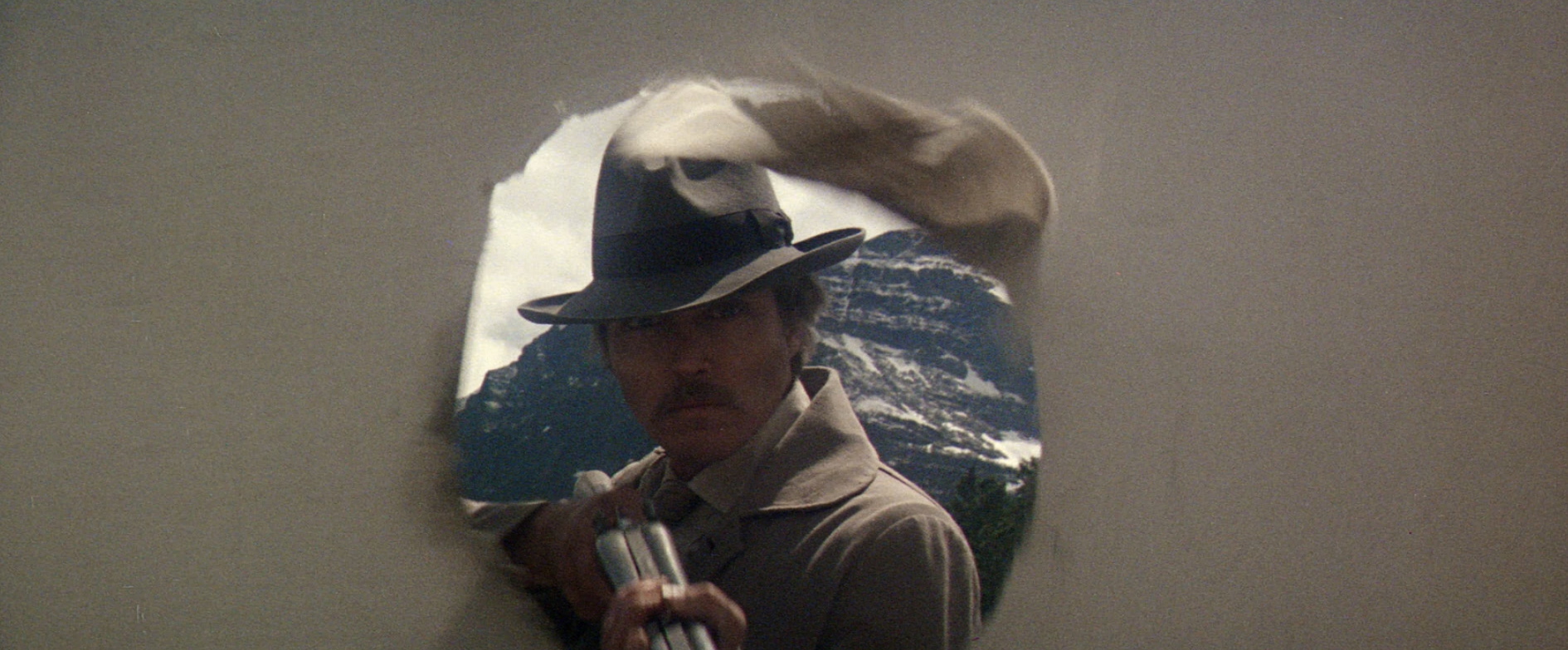

 Stanley Kubrick’s Dr. Strangelove, or How I Stopped Worrying and Learned to Love the Bomb is one of the grandest satires ever made, the blackest of black comedies. With the threat of nuclear annihilation looming over the United States and the Soviet Union, General Jack D. Ripper (Sterling Hayden) has a meltdown, becoming obsessed with protecting the country’s “precious bodily fluids” and threatening to launch the bombs. While President Merkin Muffley (Peter Sellers) tries to make nice with the Soviets, General Buck Turgidson (George C. Scott) gets caught up in all the military excitement, Colonel Bat Guano (Keenan Wynn) defends the Coca-Cola Company, Group Captain Lionel Mandrake (Sellers) can’t get anyone to listen to him, and Major T. J. “King” Kong (Slim Pickens) prepares for the ride of his life. Based on Peter George’s novel Red Alert and written by George, Kubrick, and Terry Southern, Dr. Strangelove is hysterically funny and wickedly prescient, an absolute hoot from start to finish, featuring razor-sharp dialogue, inspired slapstick, and just enough truth to scare the hell out of you. (Be sure to watch for Peter Bull not being able to stop laughing as Sellers goes crazy in a wheelchair at the end.) A DCP projection of the film is screening March 21-28 as part of the IFC Center series “The Films of Stanley Kubrick,” which includes every one of the director’s feature works as well as A.I. Artificial Intelligence, a collaboration with Steven Spielberg, all shown in advance of the March 29 theatrical release of Rodney Ascher’s Room 237, a documentary that delves into the many metamysteries surrounding The Shining.