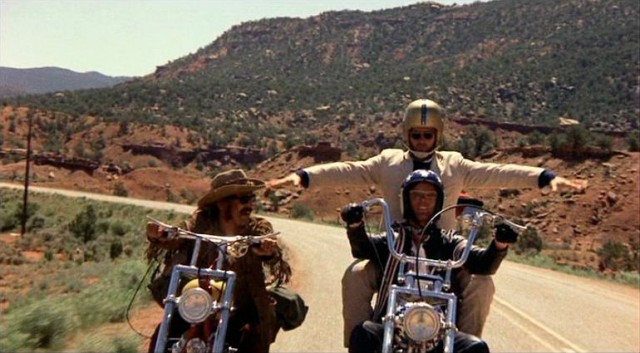
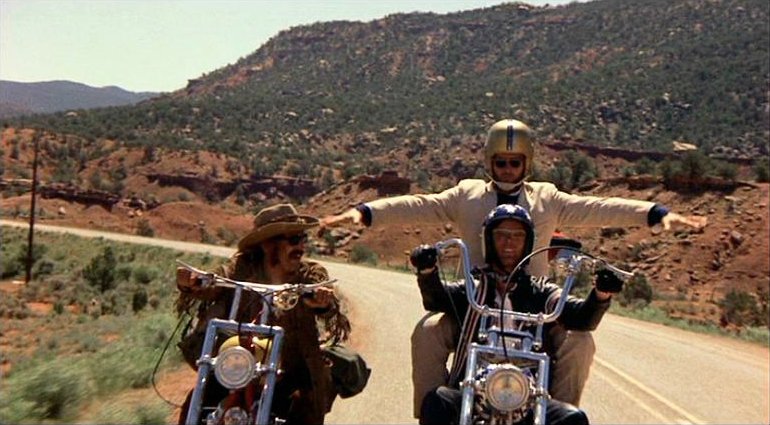
Dennis Hopper, Peter Fonda, and Jack Nicholson play a trio who get their motor running and head out on the highway in EASY RIDER
EASY RIDER (Dennis Hopper, 1968)
Nitehawk Cinema
136 Metropolitan Ave. between Berry St. & Wythe Ave.
April 5-6, 12:10 am
718-384-3980
www.nitehawkcinema.com
 No mere relic of the late 1960s counterculture movement, Easy Rider still holds up as one of the truly great road movies, inviting audiences to climb on board as two peace-loving souls search for freedom on the highways and byways of the good ol’ U.S. of A. Named after a pair of famous western gunslingers, Wyatt (producer and cowriter Peter Fonda), as in Earp, and Billy (director and cowriter Dennis Hopper), as in “the Kid,” make some fast cash by selling coke to a fancy connection (Phil Spector!), then take off on their souped-up bikes, determined to make it to New Orleans in time for Mardi Gras. Along the way, they break bread with a rancher (Warren Finnerty) and his family, hang out in a hippie commune, pick up small-town alcoholic lawyer George Hanson (an Oscar-nominated Jack Nicholson), don’t get served in a diner, and eventually hook up with friendly prostitutes Karen (Karen Black) and Mary (Toni Basil) in the Big Easy. “You know, this used to be a helluva good country. I can’t understand what’s gone wrong with it,” George says to Billy as they start discussing the concept and reality of freedom. “Oh, yeah, that’s right. That’s what it’s all about, all right. But talkin’ about it and bein’ it, that’s two different things. I mean, it’s real hard to be free when you are bought and sold in the marketplace. Of course, don’t ever tell anybody that they’re not free, ’cause then they’re gonna get real busy killin’ and maimin’ to prove to you that they are. Oh, yeah, they’re gonna talk to you, and talk to you, and talk to you about individual freedom. But they see a free individual, it’s gonna scare ’em.” The always calm Wyatt, who is also known as Captain America, and the nervous and jumpy Billy make one of cinema’s coolest duos ever as they personally experience the radical changes going on in the country, leading to a tragic conclusion. The Academy Award–nominated script, written with Terry Southern, remains fresh and relevant as it examines American capitalism and democracy in a way that is still debated today. And the soundtrack — well, it virtually defined the era, featuring such songs as Steppenwolf’s “The Pusher” and “Born to Be Wild,” Jimi Hendrix’s “If 6 Was 9,” the Electric Prunes’ “I Had Too Much to Dream (Last Night),” the Chambers Brothers’ “Time Has Come Today,” Thunderclap Newman’s “Something in the Air,” and Roger McGuinn’s “Ballad of Easy Rider.”
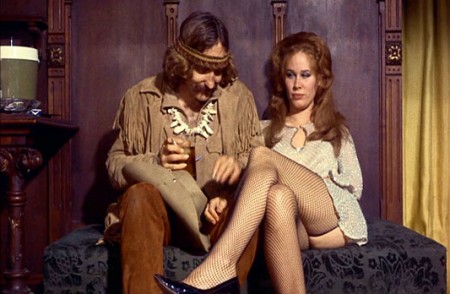
Nitehawk Cinema kicks off Karen Black festival with EASY RIDER
Easy Rider, which also was named Best First Work at Cannes in 1969, is screening just past midnight on April 5 & 6 as part of Nitehawk Cinema’s “The Works” series focusing on otherworldly actress and goddess Karen Black, the sexy, cross-eyed star of such films as Nashville, The Great Gatsby, Invaders from Mars, and the unforgettable Trilogy of Terror. Sean Young, who starred with Black in 1998’s Men, will introduce the Friday-night show, and both screenings will include a pretaped Q&A with Black about Easy Rider. The Nitehawk mini-retrospective continues with Dan Curtis’s Burnt Offerings (April 12-13; beware the chauffeur), Bob Rafelson’s Five Easy Pieces (May 3-4), Alfred Hitchcock’s Family Plot (May 17-18), Jack Smight’s Airport 1975 (May 31 – June 1), and John Schlesinger’s The Day of the Locust (June 14-15).

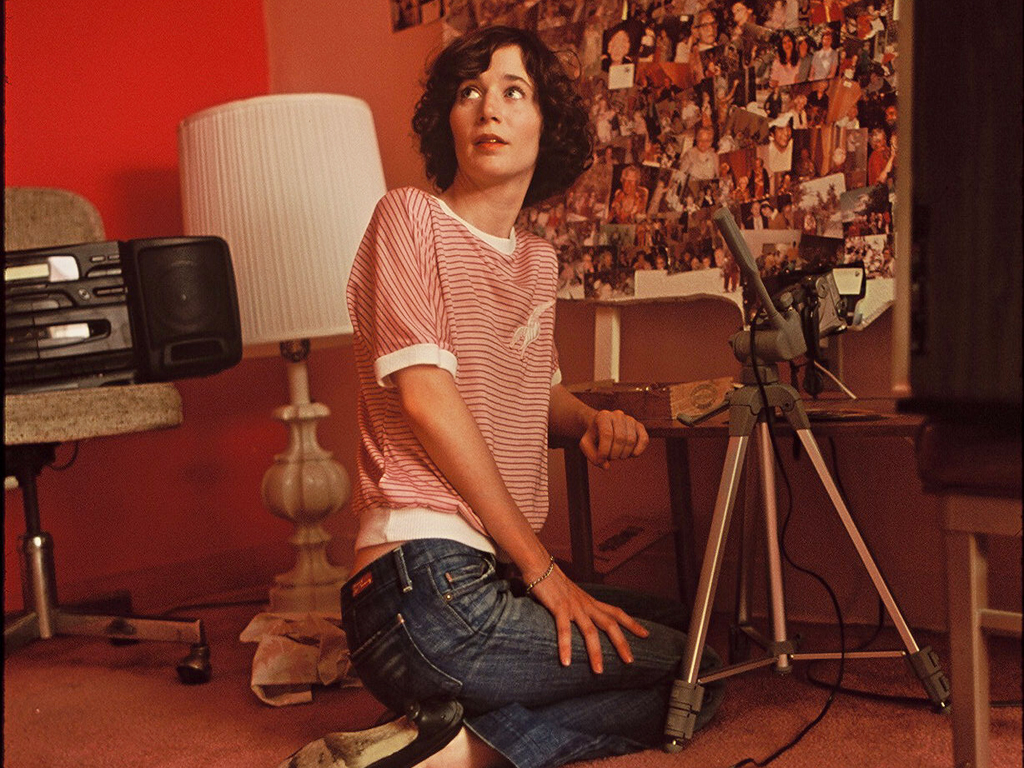
 Winner of a Special Jury Prize at Sundance “for originality of vision,” performance artist Miranda July’s feature-film directorial debut is a success from start to finish, an original, engaging, and utterly charming romantic comedy that is as unique as it is familiar. July, who also wrote the screenplay, stars as a quirky young performance artist who is looking for a relationship in her rather mundane life. She immediately falls for a shoe salesman (John Hawkes) who is separating from his wife and trying to understand his kids (Brandon Ratcliff and Miles Thompson), who are having a strange online dalliance with a mystery e-mailer. Meanwhile, two high school girls (Najarra Townsend and Natasha Slayton) are sexually tormenting a bizarre loner (Brad Henke) who is sexually tormenting them right back, both humorously and dangerously. It’s nearly impossible to take your eyes off of July, whose innovative audio and visual installations and short films have been shown at the Andy Warhol Museum, the Whitney Biennial, the Kitchen, Lincoln Center, the Museum of Modern Art, Union Square Park, and the Rotterdam International Film Festival, among many other prestigious places. Me and You and Everyone We Know is screening at MoMA on April 5 & 10 as part of “Carte Blanche: Scott Macaulay and 20 Years of Filmmaker Magazine,” which celebrates the continuing success of the IFP publication that focuses on independent film from the filmmakers’ point of view. Curated by the magazine’s editor in chief, Scott Macaulay, the series runs April 4-15 and also includes such gems as Darren Aronofsky’s Pi, Nick Gomez’s Laws of Gravity, Errol Morris’s Fast, Cheap and Out of Control, Laura Poitras’s The Oath, and Todd Haynes’s Safe. “Me and You and Everyone We Know is a tremendously winning collection of interlocking stories dealing with love, longing, and the ways children and adults connect in our modern age, and it adeptly imports the concerns of July’s visual art to the world of feature films,” Macaulay writes on the MoMA website. “July was selected by Filmmaker as one its 25 New Faces of Independent Film in 2004, and the film was on the cover of the magazine’s Spring 2005 issue.”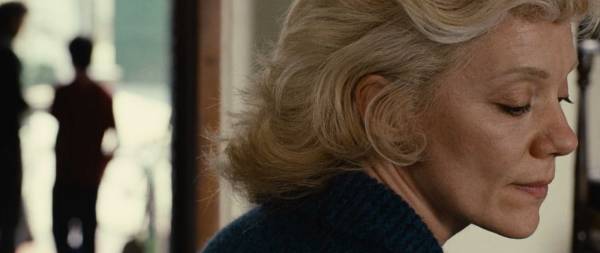
 Inspired by nightmares she has in which she commits murder, Lucrecia Martel’s The Headless Woman details a woman’s emotional and psychological reaction after having possibly killed someone. María Onetto gives a mesmerizingly cool, distant performance as Veronica, a middle-aged, upper-class wife and mother whose biggest worry appears to be the turtles that have infested the new pool built behind a veterinary office. But one afternoon, while out driving carelessly in her Mercedes along a twisting, barren road, she hits something. Not sure if it was a child, an adult, or an animal, she decides to continue on, telling no one what she has done. But when a poor, local boy goes missing, she begins to suspect that she might have killed him. An intriguing mix of Buñuel’s class-consciousness and Poe’s flair for suspense, The Headless Woman is an unusual kind of murder mystery. In Veronica, Argentine writer-director Martel (La Cienaga, The Holy Girl) has created a compelling protagonist/villain, played with expert calm and faraway eyes by Onetto.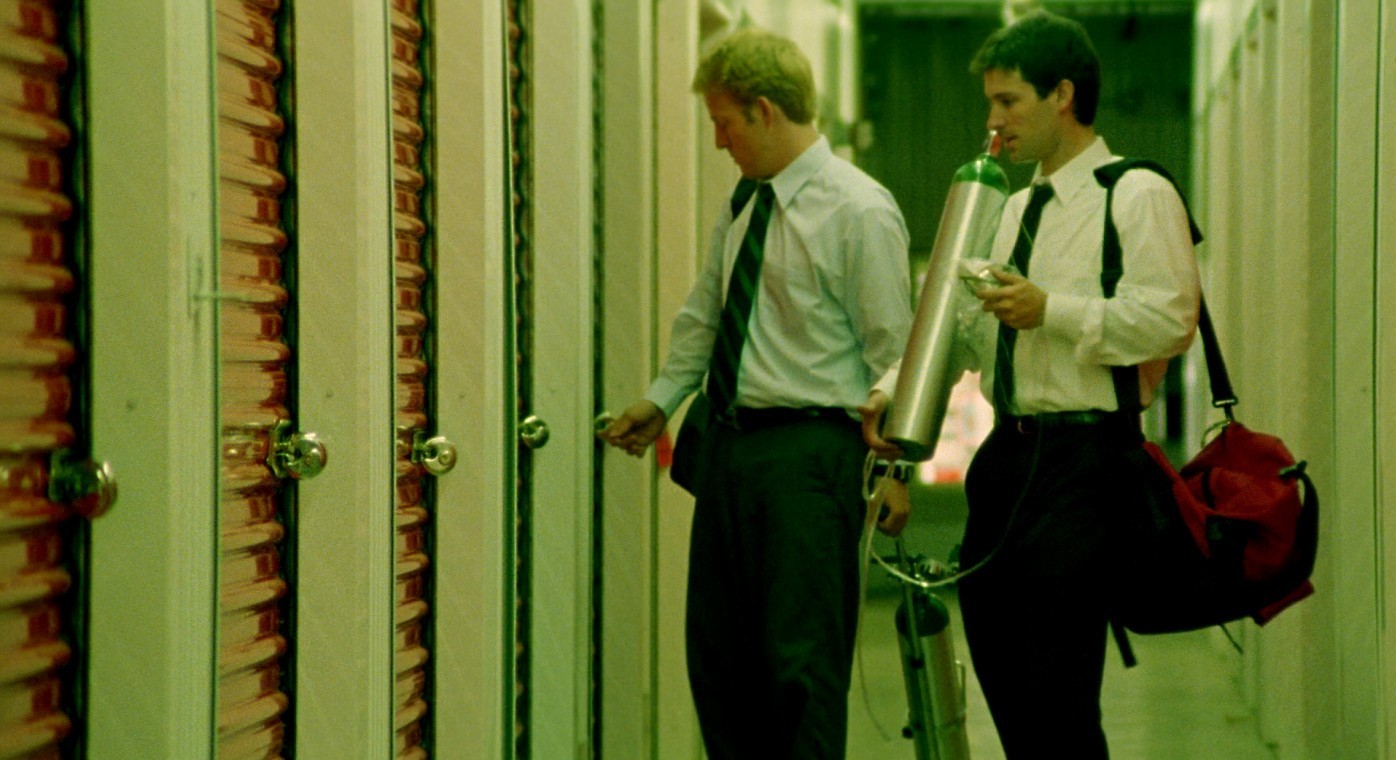
 Former engineer and first-time filmmaker Shane Carruth wrote, directed, edited, scored, and stars in Primer, an utterly confusing, confounding, and ultimately uninvolving tale of two engineers (Carruth and David Sullivan) who accidentally develop a machine that breaks through the time-space continuum and can create doubles of — well, it’s better not to get too specific, because we’re not really sure what it’s all about and what really happens. That can sometimes be a good thing, but not this time around, we’re afraid. Carruth, who made the film for a mere seven grand, is purposefully vague, but it’s to his own detriment, resulting in a story that plays more like an episode of a mediocre sci-fi series than the intriguing, unique, imaginative movie he wanted to make, even if it did win the Grand Jury Prize at Sundance. Carruth wouldn’t make another film for nine years, the romantic thriller Upstream Color, which he wrote, directed, produced, and stars in and opens in New York City on April 5. Primer kicks off the Museum of the Moving Image series “The Life of Film: Celebrating a Decade of Reverse Shot” on April 4, with Carruth on hand to talk about his work. The festival consists of four days of screenings, Q&As, and a panel discussion paying tribute to the tenth anniversary of the quarterly online film magazine founded by editors Michael Koresky and Jeff Reichert (who curated this series) and writers Erik Syngle and Neal Block. We might not have cared much for Primer, but Reverse Shot’s Matthew Plouffe had this to say about it in the autumn 2004 issue: “Irrespective of Shane Carruth’s heroic story or the film’s potential effect on American cinema, Primer ranks among the brightest beacons of uncompromised creative light to hit the silver screens of Utah in recent history. It’s hard to believe. The posh festival that has steadily spiraled into a mire of mediocrity over the last decade finally got it right. Shane Carruth deserves every accolade thrown his way, and if Primer signals what we’ve got to look forward to, his Sundance honors won’t be the last.”

 Australian writer-director PJ Hogan’s latest film, Mental, seems, well, a bit mental itself, but it gets even crazier when you learn that much of it is based on Hogan’s own childhood. A wild romp through the very serious world of mental illness, Mental opens with Shirley Moochmoore (Rebecca Gibney) wandering outside her suburban home belting out “The Sound of Music,” but her obsession with that movie — and her desire for her family to be like the Von Trapps — embarrasses her five daughters, annoys the snooty neighbors, and soon lands her in an institution. Not knowing how to take care of his girls, each of whom has her own psychological issues, Shirley’s philandering husband, Barry (Anthony LaPaglia), the mayor of Dolphin Heads, picks up a stray hitchhiker, Shaz (Toni Collette), and hires her to take care of his family while he continues to live elsewhere. The boozing, smoking, knife-wielding, straight-shooting Shaz, who has some very deep problems of her own, sets out to whip the girls into shape via unusual methods, which initially troubles and frightens them, but soon the sisters, led by the oldest, Coral (Lily Sullivan in her splendid acting debut), develop a rather unique relationship with their newfound caretaker. With Mental, Hogan (Muriel’s Wedding, My Best Friend’s Wedding) walks the fine line between dysfunctional family drama and wacko surreal fantasy, particularly in such characters as neat-freak next-door-neighbor Nancy (Kerry Fox) and doll-obsessed relative Doris (Caroline Goodall). The subplot involving shark hunter Trevor Blundell (Liev Schreiber) never quite works, ending up literally and figuratively going overboard. The final scenes are a mess and a major letdown, but much of the rest of the film is a whole lot of loony, absurdist fun as Hogan takes on suburbia, local politics, marriage, parenthood, and conventionality in general.