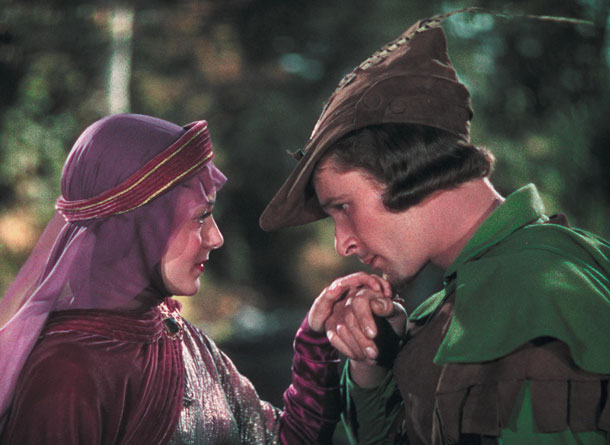
Olivia de Havilland and Errol Flynn capture each other’s fancy in one of the grandest adventure movies ever made
THE ADVENTURES OF ROBIN HOOD (Michael Curtiz, 1938)
Film Forum
209 West Houston St.
Sunday, April 14, $7, 11:00 am
Series continues through August 11
212-727-8110
www.filmforum.org
 With King Richard the Lionheart (Ian Hunter) off fighting the Crusades, his scheming brother, Prince John (Claude Rains), has taken over England, planning to become king with the help of the conniving Sir Guy of Gisbourne (Basil Rathbone) and the cowardly Sheriff of Nottingham (Melville Cooper). But one brave man stands in his way, “an impudent, reckless rogue who goes around the shire stirring up the Saxons against authority,” according to the Bishop of the Black Canons (Montagu Love). “And he has the insolence to set himself up as a protector of the people.” Sir Robin of Locksley (Errol Flynn), better known as Robin Hood, is fiercely loyal to King Richard and will do anything to preserve the sanctity of the throne and fight for the rights of the common people as he occupies Sherwood Forest with his band of merry men in tights, including Will Scarlet (Patric Knowles), Little John (Alan Hale Sr.), Friar Tuck (Eugene Pallette), and Much (Herbert Mundin). He also falls for the lovely Maid Marian (Olivia de Havilland), King Richard’s ward whom John promises to Gisbourne. Directed with appropriate flair and fanfare by Michael Curtiz (Casablanca, Mildred Pierce) and William Keighley (Each Dawn I Die, The Man Who Came to Dinner) The Adventures of Robin Hood is a rollicking romp through the famous legend, complete with exciting fight scenes, lots of male camaraderie, and just the right touch of romance. Flynn and de Havilland, who ended up making eight films together, are magnetic as Robin Hood and Maid Marian, a classic love story mired in life-threatening danger. There have been numerous versions of Robin Hood, starring such actors as Douglas Fairbanks, Russell Crowe, Kevin Costner, Patrick Bergin, Cary Elwes, and the voice of Brian Bedford, but there’s no Sir Robin quite like Flynn, who flits about with an endless supply of charm, humor, grace, and bravery. By the way, Marian’s horse, then known as Golden Cloud, was sold after the movie to Roy Rogers and was renamed Trigger, going on to have quite a career himself. Winner of Three Oscars (for art direction, editing, and original score — it lost Best Picture to Frank Capra’s You Can’t Take It with You) — The Adventures of Robin Hood is screening in a new Technicolor restoration on April 14 at 11:00 am as part of the Film Forum Jr. series for kids and families, which continues April 28 with the Marx Brothers’ A Night at the Opera and May 5 with Charlie Chaplin’s The Kid.

 Polarizing auteur Terrence Malick follows up his Oscar-nominated, Palme d’Or-winning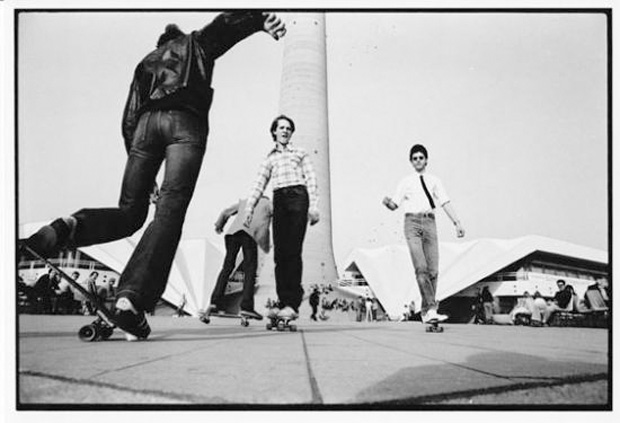
 Marten Persiel’s award-winning This Ain’t California begins with a section entitled “The Legend,” slyly pointing out from the start that what we’re about to see is the stuff of myth, not necessarily the straightforward documentary many have taken it for. Using real archival footage, re-created scenes, animation, and contemporary Super-8 footage posing as archival, Persiel, cinematographer Felix Leiberg, and editor Maxine Gödecke tell the story of Denis “Panik” Paracek, a 1980s skateboarding legend who has just been killed in Afghanistan. His old friends reunite to pay tribute to him, sharing tales of his remarkable skill, his fearlessness, and his ability to attract the opposite sex. While doing so, they paint a fascinating picture of East and West Germany in a decade that ended with the tearing down of the Berlin Wall. “For him, skating was a liberation,” one friend says, getting to the heart of the film, which is about freedom, both on an individual and global scale. Persiel also speaks with a former member of the secret service, who describes keeping a close eye on the underground skateboard culture and attempting to use the participants for propaganda during the Cold War. The film is intimate and playful, serious and involving, even if it’s all not necessarily true. This Ain’t California won the Dialogue en Perspective prize at the 2012 Berlin Film Festival, but the key word there is “perspective,” because as it turns out, the character of Panik is played by actor Kai Hillebrandt, and Panik might just be a complete fantasy created by Persiel. Most of the other characters are portrayed by actors as well. However, Persiel does an outstanding job re-creating the importance of the underground skater culture during a perilous time in East and West Germany, as a group of punks fought the power the only way they knew how. This Ain’t California is having its U.S. theatrical premiere at the Maysles Cinema April 12-18 at 7:30, with Persiel taking part in a Skype Q&A following a special Saturday afternoon 4:00 matinee.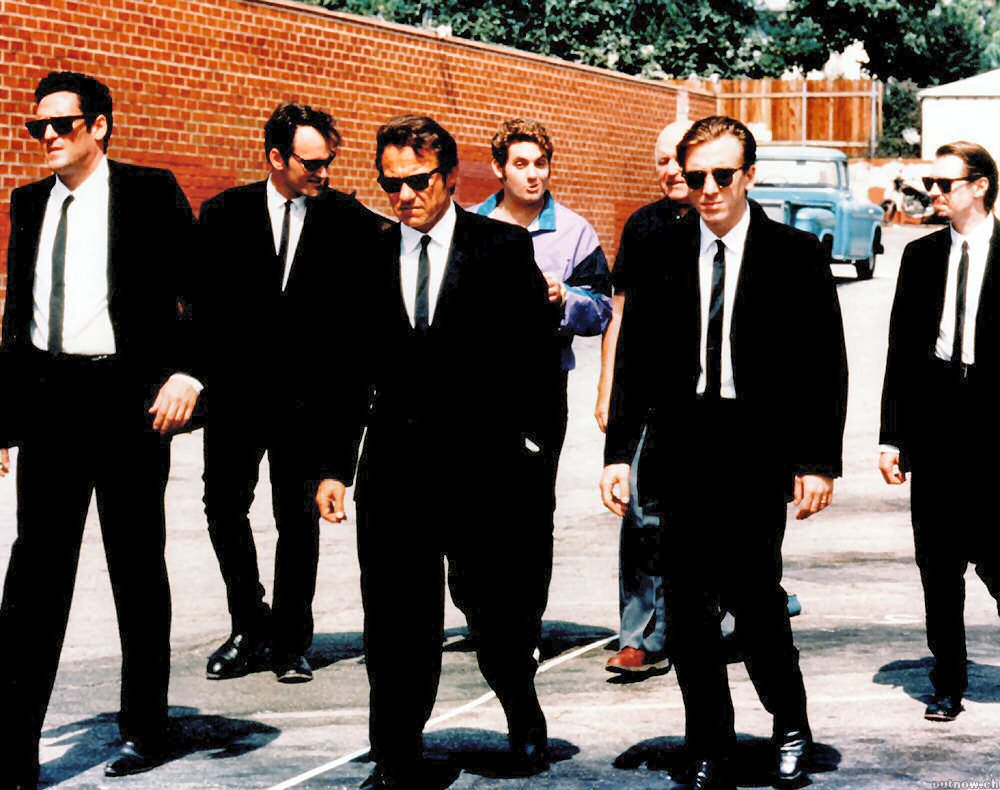
 Why does Steve Buscemi have to be Mr. Pink? Because Quentin Tarantino said so. Tarantino burst onto the indie film scene with the ultraviolent genre picture Reservoir Dogs, about a diamond heist gone horribly wrong. You know there’s a problem if Mr. White (Harvey Keitel) has to be called in to clean up the mess made by Mr. Blonde (Michael Madsen), Mr. Blue (Eddie Bunker), Mr. Brown (Tarantino), Mr. Orange (Tim Roth), and, of course, Mr. Pink. The robbery was organized by Joe (Lawrence Tierney) and his son, Nice Guy Eddie (Chris Penn), who has issues of his own. Double crosses, Madonna discussions, and a torture scene set to the Stealers Wheel song “Stuck in the Middle with You” make things go from funny to frightening in hysterical blasts of bloody irony as tensions mount and the criminals debate whether they were set up. Reservoir Dogs served as quite a debut for writer-director Tarantino, instantly making him an indie-film hero and sending him on his way, to be followed by his great script for True Romance (1993) and his Palme d’Or winner Pulp Fiction (1994), pulling off quite a triple play in three awesome years.