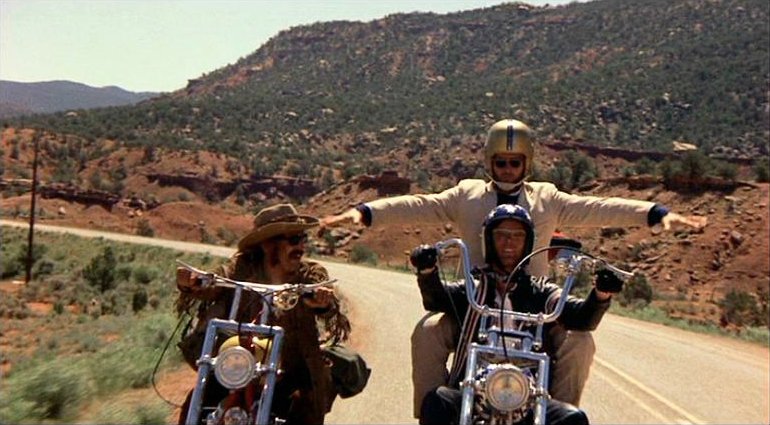
Dennis Hopper, Peter Fonda, and Jack Nicholson play a trio who get their motor running and head out on the highway in EASY RIDER
EASY RIDER (Dennis Hopper, 1968)
Tompkins Square Park
Ave. A between Seventh & Tenth Sts.
Thursday, July 11, free, 6:00
718-777-6800
www.filmsintompkins.com
 No mere relic of the late 1960s counterculture movement, Easy Rider still holds up as one of the truly great road movies, inviting audiences to climb on board as two peace-loving souls search for freedom on the highways and byways of the good ol’ U.S. of A. Named after a pair of famous western gunslingers, Wyatt (producer and cowriter Peter Fonda), as in Earp, and Billy (director and cowriter Dennis Hopper), as in “the Kid,” make some fast cash by selling coke to a fancy connection (Phil Spector!), then take off on their souped-up bikes, determined to make it to New Orleans in time for Mardi Gras. Along the way, they break bread with a rancher (Warren Finnerty) and his family, hang out in a hippie commune, pick up small-town alcoholic lawyer George Hanson (an Oscar-nominated Jack Nicholson), don’t get served in a diner, and eventually hook up with friendly prostitutes Karen (Karen Black) and Mary (Toni Basil) in the Big Easy. “You know, this used to be a helluva good country. I can’t understand what’s gone wrong with it,” George says to Billy as they start discussing the concept and reality of freedom. “Oh, yeah, that’s right. That’s what it’s all about, all right. But talkin’ about it and bein’ it, that’s two different things. I mean, it’s real hard to be free when you are bought and sold in the marketplace. Of course, don’t ever tell anybody that they’re not free, ’cause then they’re gonna get real busy killin’ and maimin’ to prove to you that they are. Oh, yeah, they’re gonna talk to you, and talk to you, and talk to you about individual freedom. But they see a free individual, it’s gonna scare ’em.” The always calm Wyatt, who is also known as Captain America, and the nervous and jumpy Billy make one of cinema’s coolest duos ever as they personally experience the radical changes going on in the country, leading to a tragic conclusion. The Academy Award–nominated script, written with Terry Southern, remains fresh and relevant as it examines American capitalism and democracy in a way that is still debated today. And the soundtrack — well, it virtually defined the era, featuring such songs as Steppenwolf’s “The Pusher” and “Born to Be Wild,” Jimi Hendrix’s “If 6 Was 9,” the Electric Prunes’ “I Had Too Much to Dream (Last Night),” the Chambers Brothers’ “Time Has Come Today,” Thunderclap Newman’s “Something in the Air,” and Roger McGuinn’s “Ballad of Easy Rider.”
Easy Rider, which also was named Best First Work at Cannes in 1969, is screening July 11 as part of the free Films in Tompkins programming in Tompkins Square Park and will be preceded by a live performance by the Main Street Quintet. The summer series continues into August with such other fab films as The Big Lebowski (with Jade Pinto and the Yeahtones) and O Brother, Where Art Thou?, which was rescheduled for August 22 after getting rained out on June 13.
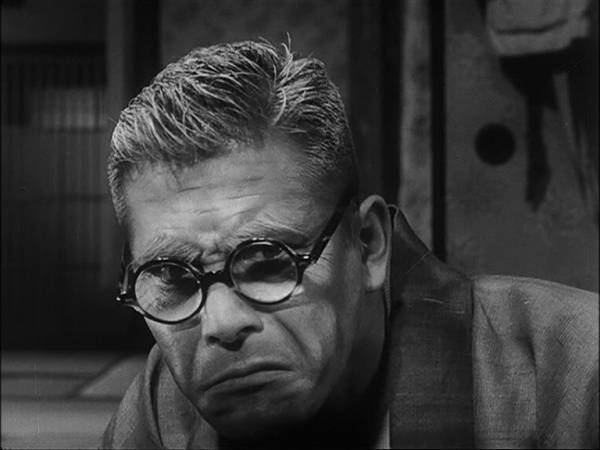
 Akira Kurosawa’s powerful psychological drama begins with a jazzy score over shots of a bustling Japanese city, people anxiously hurrying through as a Theremin joins the fray. But this is no Hollywood film noir or low-budget frightfest; Kurosawa’s daring film is about the end of old Japanese society as the threat of nuclear destruction hovers over everyone. A completely unrecognizable Toshirô Mifune stars as Nakajima, an iron foundry owner who wants to move his large family — including his two mistresses — to Brazil, which he believes to be the only safe place on the planet where he can survive the H bomb. His immediate family, concerned more about the old man’s money than anything else, takes him to court to have him declared incompetent; there he meets a dentist (the always excellent Takashi Shimura) who also mediates such problems — and fears that Nakajima might be the sanest one of all. Also known as Record of a Living Being, I Live in Fear is screening July 12, 18, and 20 as part of the Anthology Film Archives series “agnès b. selects,” consisting of ten films chosen by the Versailles-born fashion designer that, she explains, “taught me to appreciate other points of view, seen from a different angle, showing passion and the wounds, of every sort, that left their mark on me forever.” Among her other selections are Lindsay Anderson’s If, Luchino Visconti’s Rocco and His Brothers, Miloš Forman’s Loves of a Blonde, Bernardo Bertolucci’s The Conformist, and Ken Russell’s Women in Love.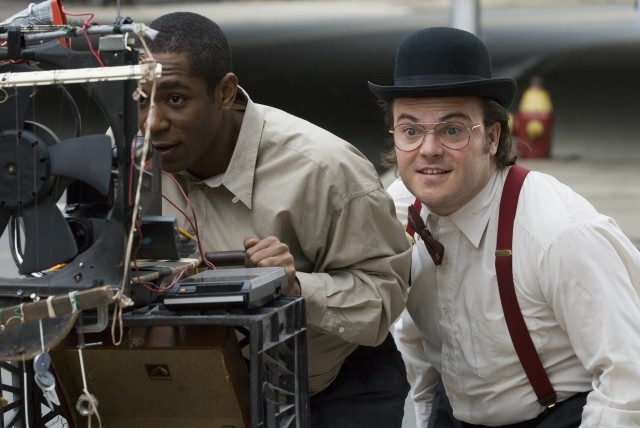
 When old man Fletcher (Danny Glover) takes off for a week, leaving Mike (Mos Def) in charge of his soon-to-be-demolished video store called Be Kind Rewind (they don’t have any DVDs or recent movies), his most important rule is to “Keep Jerry Out.” Jerry (Jack Black) is a crazy conspiracy theorist who covers himself in metal to ward off alien rays. After a botched attack on the local power plant, Jerry becomes a walking magnet (in a laugh-out-loud hysterical scene) and unknowingly erases all the videos in the store. Taking a page from the Little Rascals plots when Spanky and Alfalfa would suddenly put on a show for some local cause, Mike and Jerry recruit Alma (Melonie Diaz) as they proceed on their very strange attempts at Sweding — making their own versions of such films as Ghostbusters, Rush Hour 2, and Robocop and renting them out as if they were the real thing. Following the brilliant Eternal Sunshine of the Spotless Mind and the extremely strange The Science of Sleep, writer-director Michel Gondry has fashioned a really stupid movie that has an overabundance of heart and charm. Glover and Mos Def are soft and gentle in this Capra-esque comedy, offsetting Black’s hyperactivity. Every time you’re ready to write the film off as being just too silly and ridiculous, something comes along to make you double over in laughter. Be Kind Rewind is having a special sold-out screening July 11 at Videology in Williamsburg, presented by BBQ Films, beginning with $5 themed drinks (the Sweded Mule, the Footage Eraser) at 7:00, followed by the film at 8:00, with gourmet popcorn and a special sweded intermission featuring a live performance by DJ Cherry Magdalene and a ticket raffle for BBQ Films’ August event.
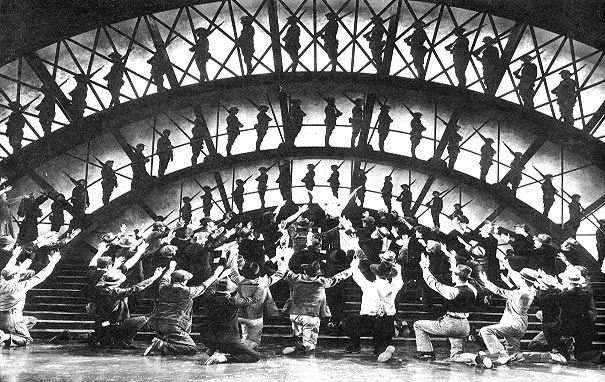
 Hitting a little too close to home in recent years, Gold Diggers of 1933 is a depression-era musical directed by Mervyn LeRoy (Little Caesar, Mister Roberts) and featuring dance numbers choreographed by Busby Berkeley. Polly Parker (Ruby Keeler), Trixie Lorraine (Aline MacMahon), Carol King (Joan Blondell), and Fay Fortune (Ginger Rogers) are four out-of-work actresses desperate to find a job on Broadway. When cigar-chomping producer Barney Hopkins (Ned Sparks) teams up with newcomer Brad Roberts (Dick Powell) to create a show about the Great Depression itself, the women get excited about the possibility of getting back on the Great White Way, but mistaken identity, financing problems, and class warfare — in the form of wealthy old-money barons Lawrence Bradford (Warren William) and Faneul H. Peabody (Guy Kibbee) — threaten the show and their love lives. Gold Diggers of 1933 is screening in Riverside Park on July 10 as part of the free “Summer on the Hudson: Movies under the Stars” series, the theme of which this year is “Song & Dance,” which continues with such other films as Duck Soup, The 5,000 Fingers of Dr. T, Fiddler on the Roof, and the 1986 version of Little Shop of Horrors. Oh, and for this outdoor screening, the “Pettin’ in the Park” number should be particularly titillating. For a day-by-day listing of free summer movie screenings in New York City, go