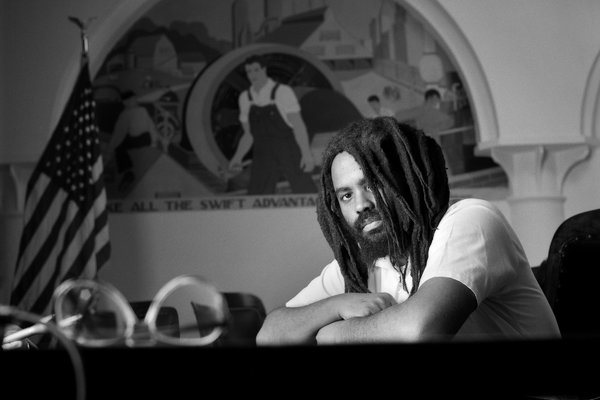
MUMIA: LONG DISTANCE REVOLUTIONARY examines the life and career of controversial African American journalist Mumia Abu-Jamal
MUMIA: LONG DISTANCE REVOLUTIONARY (Stephen Vittoria, 2013)
Quad Cinema
34 West 13th St.
October 25-31
212-255-2243
www.quadcinema.com
www.mumia-themovie.com
 In Stephen Vittoria’s overly reverential documentary Mumia: Long Distance Revolutionary, actors, activists, journalists, writers, and others celebrate the life and career of the former Wesley Cook, who changed his name to Mumia Abu-Jamal and helped found the Philadelphia wing of the Black Panther Party. The two-hour film begins with right-wing media mouths and the owner of Geno’s Steaks decrying the left’s embracing of Abu-Jamal, who was convicted in 1982 of killing Philadelphia police officer Daniel Faulkner. Denied access to Abu-Jamal in prison, Vittoria uses staged re-creations, archival footage, radio interviews, and such actors as Giancarlo Esposito, Ruby Dee, and Peter Coyote reading from his many books in order to portray him as a dedicated and talented journalist who became a feared target of FBI head J. Edgar Hoover and controversial Philly mayor Frank Rizzo, ultimately being set up for a murder he did not commit. Vittoria does not delve into the details of the case, instead exploring the man himself, with stories from Abu-Jamal’s sister Lydia Barashango, comedian and activist Dick Gregory, wrongly incarcerated boxer Rubin “Hurricane” Carter, philosopher Cornel West, Pulitzer Prize-winning writer Alice Walker, fellow investigative journalist Juan Gonzalez, radical activist Angela Davis, and radio host Amy Goodman, who has broadcast numerous phone interviews with Abu-Jamal, whose 1982 death sentence was commuted to life in prison last year. Mumia: Long Distance Revolutionary is completely one-sided, showing anyone against the golden-throated Abu-Jamal to be crazy as the filmmakers glorify its subject. However, it does reveal the City of Brotherly Love to be a frightening hotbed of violence and racism, even if that is not necessarily news. “Philadelphia has a veneer of liberalism and this whole Quaker mystique,” explains Temple associate professor and journalist Linn Washington. “The reality is it has been this ruthlessly racist city — really from its inception.” Mumia: Long Distance Revolutionary works better when it examines the social history of the civil rights movement and the Black Panthers as covered by Abu-Jamal but falters when it treats his writings as if they were Shakespearean soliloquies. Vittoria, producer Noelle Hanrahan, and attorney Rachel Wolkenstein will be at the Quad to participate in Q&As following the 8:15 screenings on October 25 and 26, and King Downing and other former Black Panthers will take part in a Q&A following the 1:10 show on October 27.
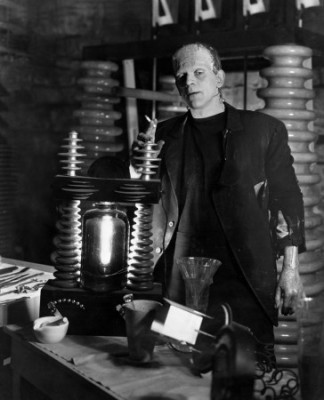
 At the start of James Whale’s Frankenstein, actor Edward Van Sloan, who plays Dr. Waldman in the film, steps out from behind a curtain and tells the audience that what they are about to see “is one of the strangest tales ever told. It deals with the two great mysteries of creation; life and death. I think it will thrill you. It may shock you. It might even horrify you. So, if any of you feel that you do not care to subject your nerves to such a strain, now’s your chance to uh, well — we warned you!” Instead of staying away, people flocked to the theaters, making Frankenstein such a hit that Universal produced a sequel, although it took longer than expected. At the beginning of Whale’s 1935 follow-up, Bride of Frankenstein, Mary Wollstonecraft Shelley (Elsa Lanchester) tells Percy Bysshe Shelley (Douglas Walton) and Lord Byron (Gavin Gordon), “The publishers did not see that my purpose was to write a moral lesson, the punishment that befell a mortal man who dared to emulate god,” letting them know that there was more to her story, picking up where the first movie left off. The Monster (Boris Karloff again, billed only by his last name) has survived the fire, and he is on the loose. Dr. Henry Frankenstein (Colin Clive, reprising his role as the godlike creator) has survived as well and is ready to finally marry his sweetheart, Elizabeth (Valerie Hobson, taking over for an ill Mae Clarke).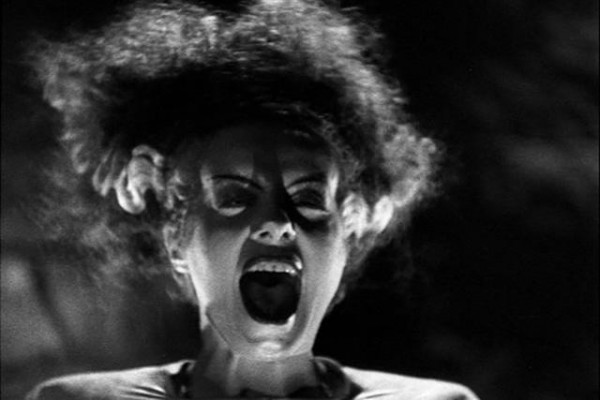
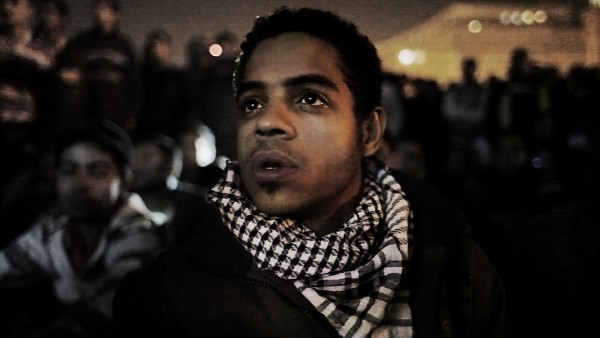
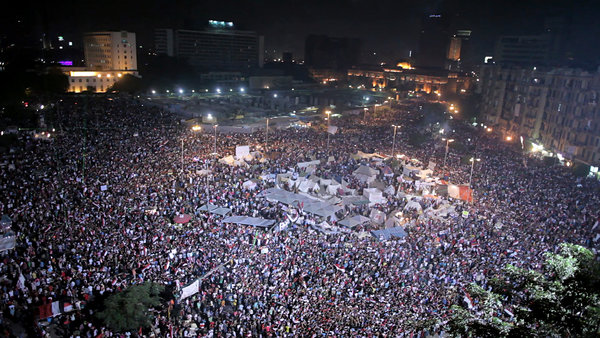
 “During the early days, we agreed to stay united no matter what,” Ahmed Hassan tells those around him in Jehane Noujaim’s powerful and important documentary The Square. “When we were united, we brought down the dictator. How do we succeed now? We succeed by uniting once again.” But Ahmed, one of several Egyptian revolutionaries who Noujaim follows for two years in the film, finds that it is not that easy to bring everyone together, as the government leaders continue to change and factions develop that favor the military and the Muslim Brotherhood. Putting her own life in danger, Noujaim (The Control Room, Startup.com) is right in the middle of it all as she shares the stories of Ahmed, a young man who is determined to see the revolution through until peace and justice prevail; Magdy Ashour, a member of the Muslim Brotherhood who must choose between his own personal beliefs and that of his power-hungry organization; and Khalid Abdalla, the British-Egyptian star of The Kite Runner and United 93 who becomes an activist like his father, serving as the revolution’s main link to the international community through the media and by posting videos. In The Square, a 2013 New York Film Festival selection, Noujaim also introduces viewers to human rights lawyer Ragia Omran, protest singer Ramy Essam, and filmmaker Aida El Kashef, none of whom are willing to give in even as the violence increases.