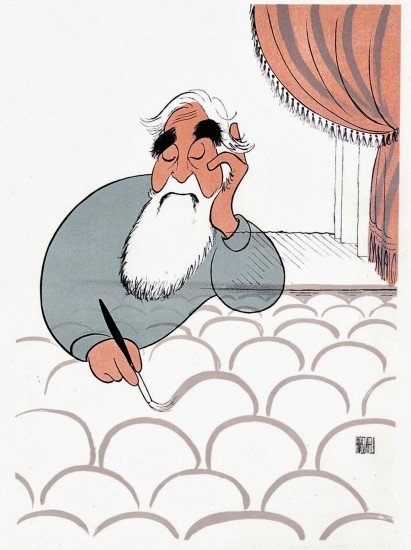
Al Hirschfeld’s long relationship with the New York Public Library and the arts is celebrated in exhibit at Lincoln Center
New York Public Library for the Performing Arts
40 Lincoln Center Plaza
Exhibition continues through January 4
Film screening: Bruno Walter Auditorium, 111 Amsterdam Ave., Monday, November 18, free, 6:00
212-642-0142
www.nypl.org/lpa
Twelve years ago, New York celebrated the life and eighty-plus-year career of legendary artist Al Hirschfeld with a major retrospective at the Museum of the City of New York and an exhibit of his celebrity caricatures at the New York Public Library’s main branch; in addition, Abrams released two books of his work, one focusing on New York, the other on Hollywood, and Hirschfeld made appearances to promote the publications. Nearly eleven years after his passing in January 2003 at the age of ninety-nine, the New York Public Library is honoring Hirschfeld again with a lovely exhibit at the Dorothy and Lewis B. Cullman Center, “The Line King’s Library: Al Hirschfeld at the New York Public Library.” Visitors can first stop by a re-creation of Hirschfeld’s work area, complete with his drawing table and barber chair, which is on permanent view at the library entrance. The exhibition is straight ahead, consisting of more than one hundred color and black-and-white drawings and lithographs, posters, books, letters, video, newspaper and magazine clippings, and various other ephemera, divided by the discipline of Hirschfeld’s subjects: theater, music, dance, and film, in addition to a section on those artists who influenced the man known as the Line King.
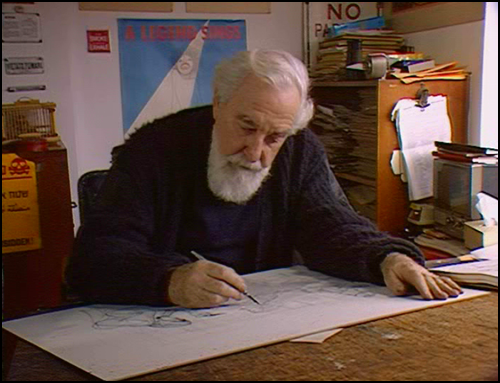
Oscar-winning documentary on Al Hirschfeld screens for free at NYPL on November 18
“My contribution is to take the character — created by the playwright and acted out by the actor — and reinvent it for the theater,” Hirschfeld once explained, and the evidence is on the walls, including works depicting Jack Lemmon in Tribute, Lee J. Cobb in Death of a Salesman, Christopher Plummer in Macbeth, Jessica Tandy and Marlon Brando in A Streetcar Named Desire, Rex Harrison and Julie Andrews in My Fair Lady, Alan Cumming in Cabaret, and Jackie Mason in The World According to Me, among so many more. There are also caricatures of Marcel Marceau, S. J. Perelman, George Bernard Shaw, Leonard Bernstein, Vladimir Horowitz, Dizzy Gillespie, Katharine Hepburn, and a dazzling, rarely shown 1969 print of Martha Graham. Another highlight is the original drawing for “Broadway First Nighters,” along with a key identifying the dozens of celebrities gathered in a packed room, and paraphernalia from Hirschfeld’s musical comedy Sweet Bye and Bye, a collaboration with Perelman, Vernon Duke, and Ogden Nash. And for those fans who have spent years trying to find all the inclusions of “Nina” in Hirschfeld’s drawings, “Nina’s Revenge” features his daughter holding a brush and smiling, the names “Al” and “Dolly” (for Dolly Haas, her mother and Hirschfeld’s second wife) in her long hair. In conjunction with the exhibition, there will be a free screening of the Oscar-winning 1996 documentary The Line King: The Al Hirschfeld Story, introduced by the director, Susan W. Dryfoos, on November 18 at 6:00 in the Bruno Walter Auditorium at the New York Public Library for the Performing Arts.

 “During the early days, we agreed to stay united no matter what,” Ahmed Hassan tells those around him in Jehane Noujaim’s powerful and important documentary The Square. “When we were united, we brought down the dictator. How do we succeed now? We succeed by uniting once again.” But Ahmed, one of several Egyptian revolutionaries who Noujaim follows for two years in the film, finds that it is not that easy to bring everyone together, as the government leaders continue to change and factions develop that favor the military and the Muslim Brotherhood. Putting her own life in danger, Noujaim (The Control Room, Startup.com) is right in the middle of it all as she shares the stories of Ahmed, a young man who is determined to see the revolution through until peace and justice prevail; Magdy Ashour, a member of the Muslim Brotherhood who must choose between his own personal beliefs and that of his power-hungry organization; and Khalid Abdalla, the British-Egyptian star of The Kite Runner and United 93 who becomes an activist like his father, serving as the revolution’s main link to the international community through the media and by posting videos. In The Square, a 2013 New York Film Festival selection, Noujaim also introduces viewers to human rights lawyer Ragia Omran, protest singer Ramy Essam, and filmmaker Aida El Kashef, none of whom are willing to give in even as the violence increases.



 We used to think that Aki Kaurismäki’s
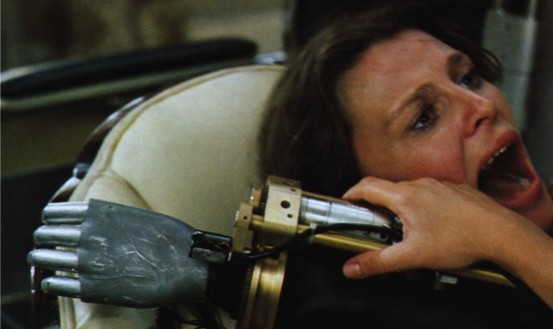
 Based on the novel by Dean R. Koontz, Donald Cammell’s creepy, claustrophobic 1977 futuristic thriller Demon Seed offers a very different look at motherhood. The film stars a surprisingly game Julie Christie as Susan Harris, a frustrated housewife whose husband, Alex (Fritz Weaver), is the leader of a team that has built a master computer known as Proteus (voiced by Robert Vaughn). When Alex goes off for several months to further Proteus’s already impressive attributes, the supercomputer starts developing a mind of its own, locking Susan in the house and deciding she must give birth to its child. Cammell, who codirected Performance with Nicolas Roeg, fills Demon Seed with trippy, psychedelic visuals and cool technological flourishes, along with an electronic score by Ian Underwood and Lee Ritenour supplementing Jerry Fielding’s central musical themes. The film delves into suburban paranoia with Toffler-esque flare and an Orwellian fear of artificial intelligence. The film harkens back to Stanley Kubrick’s 2001: A Space Odyssey and Joseph Sargent’s Colossus: The Forbin Project while influencing such future films as John Badham’s WarGames, which also names its supercomputer “Joshua” and casts Weaver look-alike John Wood as computer creator Dr. Stephen Falken. Demon Seed is screening with Ron Hays’s 1981 Earth, Wind & Fire video Let’s Groove on November 15 at 7:00, kicking off the Museum of the Moving Image series “Computer Age: Early Computer Movies, 1952-1987,” which continues through November 17 with such other computer-prescient films as Steven Lisberger’s Tron and Nick Castle’s The Last Starfighter, several shorts programs (including one featuring works by Larry Cuba, John Whitney, and John Whitney Jr.), and a conversation with computer artist Lillian Schwartz.
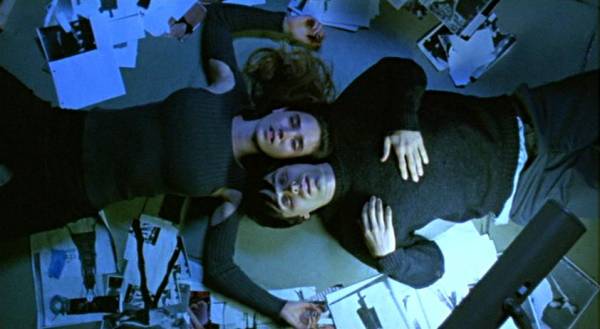
 Darren Aronofsky’s Requiem for a Dream is a devastating portrait of addiction, featuring one of the most brutal endings in cinema history. Based on the novel by Hubert Selby Jr. (Last Exit to Brooklyn), who cowrote the screenplay with Aronofsky, the Coney Island-set film focuses on four central figures: Sara Goldfarb (Ellen Burstyn), a lonely widow living in Brighton Beach who learns that she might appear on a television program so is desperate to lose weight to fit into her red dress, ultimately getting lost in a haze of prescription drugs; her son, Harry (Jared Leto), a junkie looking to make a big score; Harry’s girlfriend, Marion Silver (Jennifer Connelly), who dreams of becoming a fashion designer but has to decide how far she will go for her next taste; and Harry’s partner in crime, Tyrone Love (Marlon Wayans), who shoots up while remembering the warm comfort of his mother’s arms. Using repetitive fast-paced editing, enhanced sound effects, and a harrowing score by Clint Mansell, Aronofsky (Black Swan, The Wrestler, PI) creates a nightmare world where delusional dreams come crashing down with horrific consequences. The acting throughout is a veritable tour de force, led by Burstyn’s Oscar-nominated descent into hell. Requiem for a Dream is screening November 15-16 at 12:05 am as part of the Nitehawk Cinema series “November Brunch & Midnite: Thx Bklyn,” a month-long collection of films either set in Brooklyn or written and/or directed by Brooklynites, being shown on weekend mornings and midnights, continuing with J. Michael Muro’s Street Trash, Morris Engel’s Little Fugitive, Sidney Lumet’s Serpico, and Noah Baumbach’s The Squid and the Whale.