Michel Gondry details a series of animated conversations with Noam Chomsky in brilliant new documentary
IS THE MAN WHO IS TALL HAPPY? AN ANIMATED CONVERSATION WITH NOAM CHOMSKY (Michel Gondry, 2013)
Thursday, November 21, SVA Theatre, 333 West 23rd St. between Eighth & Ninth Aves., 7:00
IFC Center
323 Sixth Ave. at West Third St.
Opens Friday, November 22
212-924-7771
www.docnyc.net
www.ifccenter.com
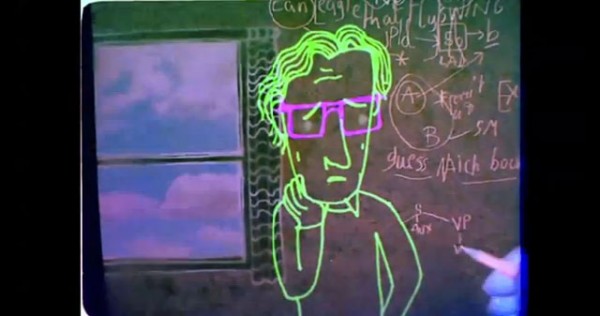
 As it turns out, Michel Gondry’s exciting new documentary, Is the Man Who Is Tall Happy? An Animated Conversation with Noam Chomsky, is animated in more ways than one. The fifty-year-old French director initially set out to go toe-to-toe with the controversial octogenarian linguist and philosopher, but he realized early on that the battle was lost. So when editing the series of interviews he had with Chomsky over the course of several months in 2010, he decided to illustrate the film with animated cartoon drawings, only occasionally showing the live-action Chomsky, often in a small box or circle within a colorfully rendered scene. After an attempt to impress Chomsky — the author of such books as Syntactic Structures; Cartesian Linguistics: A Chapter in the History of Rationalist Thought; Studies on Semantics in Generative Grammar; and The Logical Structure of Linguistic Theory — with his own views on image and representation, Gondry becomes embarrassed. “As you can see,” he says while the handwritten words appear on the screen, “I felt a bit stupid here. Let me explain: I think I couldn’t get my point through to Noam. Misuse of words and heavy accent aggravated my attempt.” Chomsky and Gondry go on to explore such concepts as generative grammar, language acquisition, and psychic continuity as Gondry, the director of such offbeat films as Eternal Sunshine of the Spotless Mind, The Science of Sleep, Human Nature, and Be Kind, Rewind, makes his endearing, often childlike drawings, a genius counterpoint to Chomsky’s cool and calm super-intellectualism.
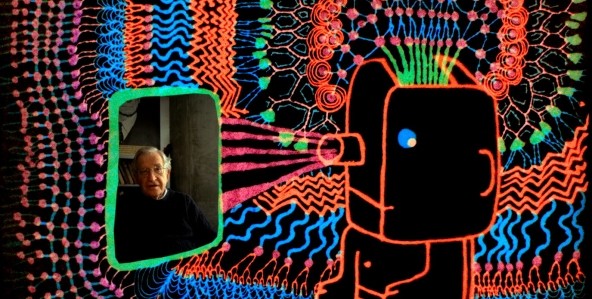
Michel Gondry comes up with a unique way to depict Noam Chomsky in IS THE MAN WHO IS TALL HAPPY?
Gondry does get Chomsky to open up a little about his personal life, especially his relationship with his late wife, and they wisely avoid politics. The film eventually takes a hysterical turn when Gondry realizes that he better finish it soon, since it’s been three years since he conducted the talks with Chomsky and he wants to make sure he finishes it before Chomsky dies. In the end, Gondry manages to level the playing field as the two men diagram the title question. Is the Man Who Is Tall Happy? is an absolute treat, a fun and fascinating examination of human intelligence, the creative process, the manipulative relationship between director and viewer, and the essence of film and storytelling itself. Is the Man Who Is Tall Happy? is the closing-night selection of DOC NYC, screening November 21 at 7:00 at the SVA Theatre, and will be followed by a discussion with Gondry and Chomsky, moderated by Anthony Arnove. The film then opens on Friday, November 22, at the IFC Center, with Gondry participating in Q&As following the 6:10 and 8:15 shows on Friday and Saturday.
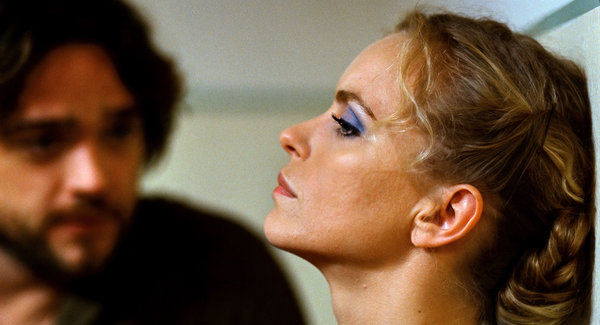
 Christian Petzold’s Barbara is a gripping, eerily slow-paced psychological thriller that explores fear, paranoia, and responsibility. Nina Hoss, in her fifth film with writer-director Petzold, gives a subtly powerful performance as Barbara Wolff, an East German doctor who has been shipped off by the government to a country hospital run by Andre (Ronald Zehrfeld). It is 1980, and Barbara has done something to get on the GDR watch list, causing her to be under near-constant surveillance. She carefully looks around everywhere she goes, wondering if the woman on the bus, the man out for a smoke, or the person on the pay phone is working for the Stasi. She is most suspicious of Andre as he attempts to get close to her, asking her personal questions and trying to spend more and more time with her. Meanwhile, Barbara has secret meetings with various people, including her West German lover, Jörg (Mark Waschke), who wants to get her out of the east. But as much as Barbara wants to live a free and open life, she is also a dedicated doctor who has become attached to two patients: Stella (Jasna Fritzi Bauer), a pregnant woman who does not want to be sent back to a labor camp, and Mario (Jannik Schümann), who has suffered a potentially fatal head injury following a suicide attempt.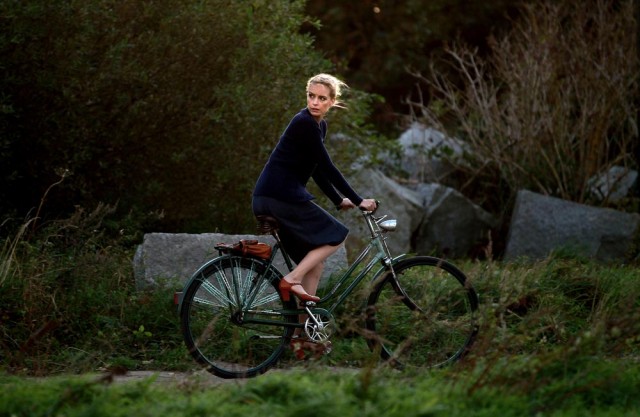
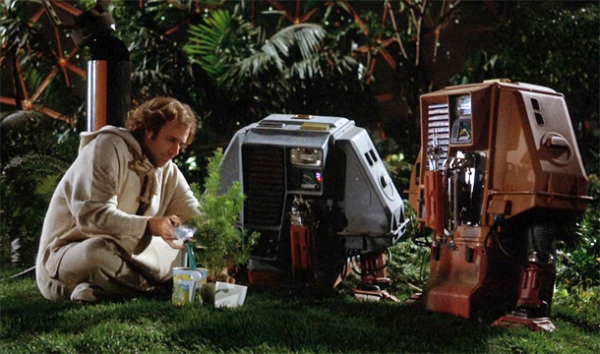
 Special effects master Douglas Trumbull, who worked on such sci-fi classics as 2001: A Space Odyssey, Close Encounters of the Third Kind, and Blade Runner, made his feature directorial debut with the environmentally prescient Silent Running. Bruce Dern stars as Freeman Lowell, one of four men stationed on the space terrarium Valley Forge, which is charged with protecting forests that can no longer grow on Earth. While it’s just another assignment for John Keenan (Cliff Potts), Marty Barker (Ron Rifkin), and Andy Wolf (Jesse Vint), it’s become an obsession for Lowell, who sleeps under a “Conservation Pledge” on the wall next to his bed and only eats food from his massive garden. But when the captain of the Berkshire (voiced by Joseph Campanella) informs them that the forests must be destroyed and they are to return home, Lowell takes matters into his own hands, fighting to protect what he has helped create. Soon he is alone on the Valley Forge, tending to the forest with drones Huey (Cheryl Sparks) and Dewey (Mark Persons), as Louie (Steven Brown) is no longer with them. At first Lowell thinks he is in his own private paradise, but extreme loneliness awaits him, along with some other shocks. Written by Deric Washburn and Michael Cimino (The Deer Hunter) and Steven Bochco (Hill Street Blues, L.A. Law), the low-budget Silent Running is a deserving cult classic, a worthy influence on such films and television shows as WALL-E, Moon, Mystery Science Theater 3000, and Red Dwarf. Emerging from the late-1960s Flower Power movement, the film’s ecological theme is boosted by environmentally friendly folk songs sung by Joan Baez, with overly melodramatic music by Peter Schickele. Dern gives a beautifully nuanced performance as Lowell, going from calm and meditative to distressed and angry in a heartbeat, and his paternal relationship with Huey and Dewey is both heartwarming and heartbreaking. A film that could only be made in the 1970s, with bright, bold colors and cheesy futuristic sets, Silent Running is screening on November 21 as part of the BAMcinématek series “Hot Dern!” which pays tribute to the seventy-seven-year-old Dern, the father of Laura Dern and former husband of Diane Ladd, on the occasion of the U.S. theatrical release of Alexander Payne’s Nebraska, for which Dern was named Best Actor at Cannes. The series continues through November 27 with such other wide-ranging Dern films as Psych-Out, Wild Bill, The Laughing Policeman, and Smile. In addition, Dern will be at BAM on December 4 for “An Evening with Bruce Dern,” which will include a screening of Nebraska followed by an extended Q&A with the actor.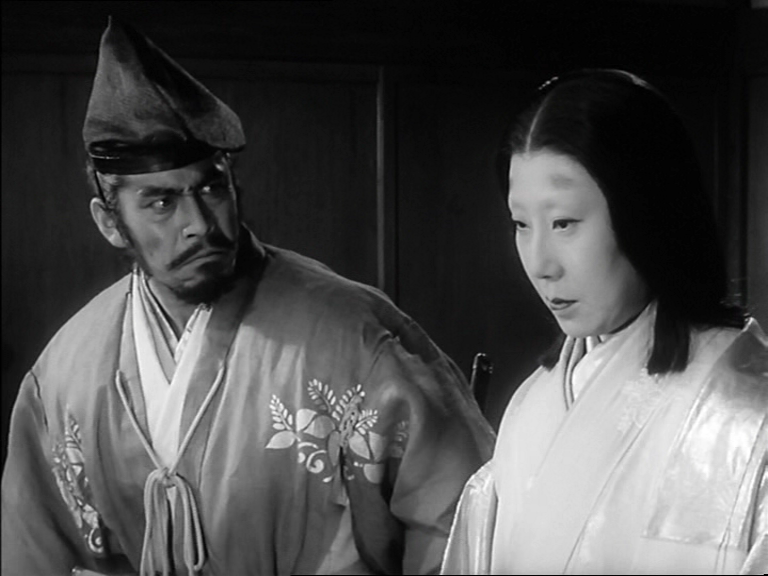
 Akira Kurosawa’s marvelous reimagining of Macbeth is an intense psychological thriller that follows one man’s descent into madness. Following a stunning military victory led by Washizu (Toshirô Mifune) and Miki (Minoru Chiaki), the two men are rewarded with lofty new positions. As Washizu’s wife, Asaji (Isuzu Yamada, with spectacular eyebrows), fills her husband’s head with crazy paranoia, Washizu is haunted by predictions made by a ghostly evil spirit in the Cobweb Forest, leading to one of the all-time classic finales. Featuring exterior scenes bathed in mysterious fog, cinematographer Asakazu Nakai’s interior long shots of Washizu and Asaji in a large, sparse room carefully considering their next bold move, and composer Masaru Sato’s shrieking Japanese flutes, Throne of Blood is a chilling drama of corruptive power and blind ambition, one of the greatest adaptations of Shakespeare ever put on film Throne of Blood is screening November 21, November 24, and December 1 as part of the Anthology Film Archives series “The Middle Ages on Film: Shakespeare,” consisting of ten cinematic adaptations of several of the Bard’s history plays, set in the Middle Ages, including Laurence Olivier’s Henry V, Roman Polanski’s Macbeth, Orson Welles’s Chimes at Midnight, and Peter Brook’s King Lear. The twelve-day festival was curated in collaboration with professor and scholar Martha Driver, who notes, “Through film, Shakespeare’s Middle Ages are not lost but revived and revitalized in translation. And much of what we think we know about the medieval period has been shaped by Shakespeare, the plays and film adaptations living on in our memories more vividly perhaps than the history books’ accounts.”