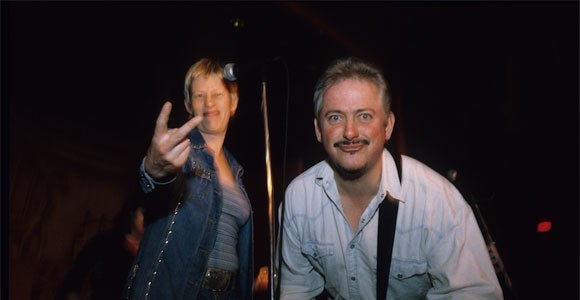
Sally Timms and Jon Langford fight the curse of the Mekons in stirring documentary
SONIC CINEMA: REVENGE OF THE MEKONS (Joe Angio, 2013)
SVA Theatre
333 West 23rd St. between Eighth & Ninth Aves.
Friday, November 15, 9:45
Festival runs November 14-21
212-924-7771
www.mekonsmovie.com
www.docnyc.net
 Called “the most revolutionary group in the history of rock ‘n’ roll” by Lester Bangs, the Mekons have been making some of the best music on the planet for more than thirty-five years. But despite a rabid fan base and constant critical adoration, the band, which formed at the University of Leeds back in 1977, has never quite made the big time. Joe Angio captures the wild, DIY spirit of this unique music and art collective in the stirring documentary Revenge of the Mekons. Angio (How to Eat Your Watermelon in White Company [and Enjoy It]) follows the self-deprecating band — the members of which are quick to joke about their lack of financial and popular success, especially when they’re onstage and learn from fans that an upcoming gig has been canceled — as they celebrate their thirtieth anniversary and record their most recent excellent album, Ancient and Modern. Angio talks with the current Mekons lineup, which includes cofounders Tom Greenhalgh and Jon Langford along with Susie Honeyman, Rico Bell, Lu Edmonds, Sarah Corina, Steve Goulding, and Sally Timms, as well as such former members as Kevin Lycett, Mark “Chalkie” White, Andy Corrigan, and Dick Taylor, as they recount the band’s rollicking history, beginning with its Leeds days as a socialist punk band battling over shows with Gang of Four through its mid-1980s transformation into alt-country folk rockers.
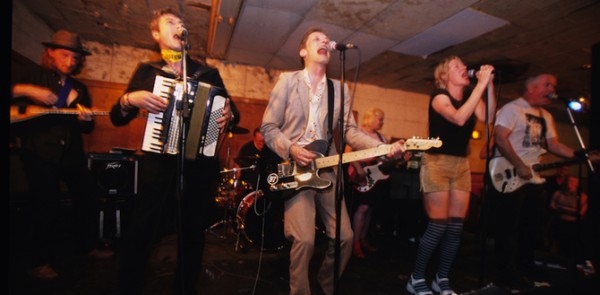
Mekons doc is one helluva wild and crazy ride, just like their long career
Angio mixes in amazing raw footage from the 1970s with more contemporary scenes as the Mekons, with their usual reckless abandon and utter joyfulness, play such songs as “Where Were You,” “The Hope and the Anchor,” “Ghosts of American Astronauts,” “Millionaire,” “Hello Cruel World,” “Hard to Be Human,” “Memphis, Egypt,” and “The Curse.” Sharing their love of all things Mekons are such wide-ranging pundits as Jonathan Franzen, Greil Marcus, Gang of Four’s Hugo Burnham and Andy Gill, Will Oldham, Greg Kot, Craig Finn, Luc Sante, Mary Harron, and performance artist Vito Acconci. Back in October 2011, we wrote that “a world that includes the Mekons is just a better place for everyone,” and that still holds true. So start by watching this wonderfully crazy documentary, about a group of crazy characters who have formed a crazy kind of family, then go out and pick up such seminal records as Fear and Whiskey, The Mekons Honky Tonkin’, So Good It Hurts, The Mekons Rock‘n’Roll, Natural, Ancient Modern, etc., and be sure to catch them live when they come anywhere near your town. Revenge of the Mekons is having its world premiere November 15 at 9:45 at the SVA Theatre as part of the “Sonic Cinema” section of this year’s DOC NYC festival, with Angio, Langford, Timms, Bell, and Goulding on hand to talk about the film. DOC NYC, which seeks to “cultivate new audiences [by] attracting newcomers with the excitement of a festival atmosphere,” runs November 14-21 at the IFC Center and the SVA Theatre; among the other “Sonic Cinema” selections are Rodrigo H. Vila’s Mercedes Sosa: Voice of Latin America, Trevor Laurence and Simeon Hutner’s Harlem Street Singer, and Jeremy Xido’s Death Metal Angola.

 Joshua Oppenheimer’s The Act of Killing is one of the most disturbing, and unusual, films ever made about genocide. In 1965-66, as many as a million supposed communists and enemies of the state were killed in the aftermath of a military coup in Indonesia. Nearly fifty years later, many of the murderers are still living in the very neighborhoods where they committed the atrocities, openly boasting about what they did, being celebrated on television talk shows, and even being asked to run for public office. While making The Globalization Tapes in Indonesia in 2004, the Texas-born Oppenheimer met some of these self-described gangsters and, struck by their brash, bold attitudes, decided to create a different kind of documentary. In addition to following them around as they go bowling, play golf, sing, and dance, proudly showing off how happy their lives are, Oppenheimer offered them the opportunity to tell their story as if it were a Hollywood movie. The men, whose love of American noir and Westerns heavily influenced the stylized killings they perpetrated, loved the idea and began to restage torture and murder scenes in great detail for the camera, getting in period costumes, putting on makeup, going over script details, reviewing the dailies, and playing both the violent criminals and their victims. The leader is master executioner Anwar Congo, who is perhaps the only one haunted by his deeds; although on the surface he is proud of what he did, he is tormented by constant nightmares. Such is not the case for the others, who laugh as they go over the gory details, especially paramilitary leader Herman Koto, Congo’s protégé and a man seemingly without a conscience. Meanwhile, fellow executioner Adi Zulkadry wonders whether telling the truth will actually negatively impact their legendary status. “Human rights! All this talk about ‘human rights’ pisses me off,” Congo says in one scene. “Back then there was no human rights.” Oppenheimer also depicts how frighteningly powerful the three-million-strong, government-connected Pancasila Youth is, ready to fight for the very same things that led to the genocide in the first place. It’s hard to comprehend how these men continue to walk free, and one can argue whether Oppenheimer should indeed be giving them the platform that he does. Watching these gangsters — or “free men,” as they like to call themselves, since the Indonesian word for gangster is “preman,” derived from the Dutch “vrijman” — artistically re-create scenes of horrific violence is both illuminating and infuriating on multiple levels that will leave viewers angry and incredulous. A selection of this year’s Human Rights Watch Film Festival, The Act of Killing is screening November 15 at 1:45 at the IFC Center as part of the annual DOC NYC fest in the “Short List” category, which consists of films expected to make an impact come awards season; among the other “shortlisted” documentaries, all of which have already been released theatrically, are Jehane Noujaim’s The Square, Morgan Neville’s 20 Feet from Stardom, Dawn Porter’s Gideon’s Army, and Sarah Polley’s Stories We Tell.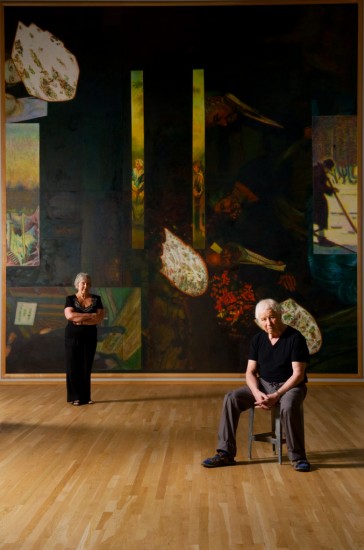

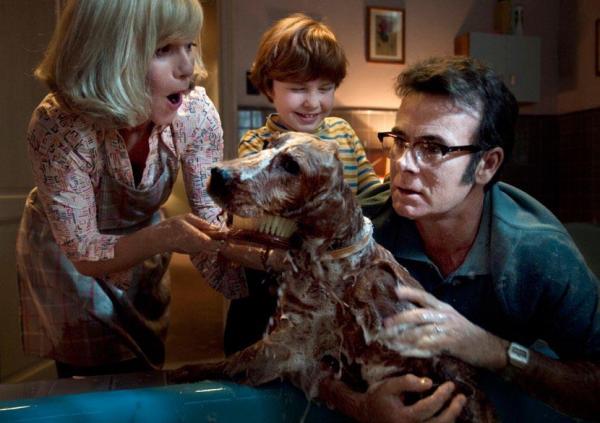
 In 1976 France, it’s love at first sight when eight-year-old Boule (Charles Crombez) sets his eyes on cocker spaniel Bill (voiced by Manu Payet) in Alexandre Charlot and Franck Magnier’s utterly delightful Boule & Bill, based on Jean Roba and Maurice Rosy’s popular comic strip. While Boule’s mother (Marina Foïs), a piano teacher, wants to adopt the dog for her son, his father (Franck Dubosc) is firmly against it. He’s not exactly in favor of adding a lost tortoise, Caroline (voiced by Sara Giraudeau), to the family either. Soon Bill and Caroline are on their way home with the clan, but Boule’s father, a stick-in-the-mud appliance designer, immediately begins planning how to get rid of the dog, even moving the family to an oddball apartment complex in the middle of nowhere. Once there, Bill continues wreaking havoc, including perpetually annoying the depressive neighbor (Nicolas Vaude) one floor below. Meanwhile, Caroline falls madly in love with Bill. But when Boule and Bill go too far, his parents begin considering whether they have to give the dog away. From the opening scene, it’s apparent that Boule & Bill is no mere silly kiddie movie, as Mother, Father, and Son are in their little red car, singing a song about male genitalia. Charlot and Franck, who previously collaborated on Imogène McCarthery, load the charming tale with laugh-out-loud flourishes, from the mother’s encounters with the downstairs depressive to Bill’s turning himself into a stuffed animal in an emergency. A series of brief dream sequences, along with several plot twists, feel forced and unnecessary, but Charlot and Franck always manage to turn things around and get back on track. And they really have a ball with Bill’s deepest dog thoughts, reminiscent of Jean Shepherd’s narration in A Christmas Story. Running at the Quad November 8-14, Boule & Bill is a colorful, fun adventure that is more than just your average boy meets dog movie.