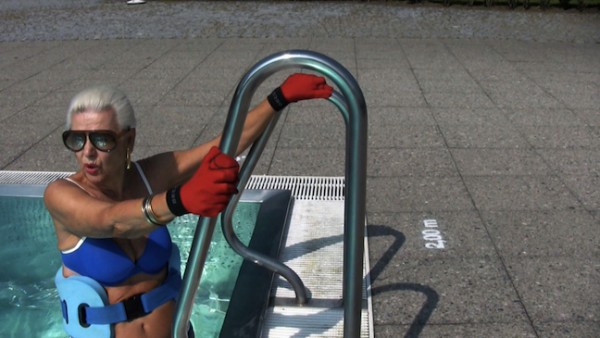
Hanna Schaich’s EVELYN is one of three of her works that will mark her New York debut on November 23
Microscope Gallery
4 Charles Pl. at Myrtle Ave.
Saturday November 23, free (suggested donation $6), 7:00
347-925-1433
www.microscopegallery.com
Earlier this year, Brooklyn-based visual artist Janet Biggs teamed up with French-born Montréal installation artist Aude Moreau on a dual show at Smack Mellon as part of the “Brooklyn/Montréal” cultural exchange. Now Biggs is collaborating with German artist Hanna Schaich on a one-night-only project November 23 at Microscope Gallery in Bushwick. The evening will consist of three short films by Schaich, in her New York debut, and two by Biggs, selected by Schaich, followed by an in-depth conversation. The two works by Biggs, Brightness All Around and In the Cold Edge, were both shot during trips to the Arctic and investigate individual identity amid unique, dangerous environments. “There is clearly a performative side to my work that has to do with me physically and psychologically pushing myself or assuming some kind of risk in order to capture the images and action needed for a piece,” Biggs told us in a 2011 twi-ny talk. “I didn’t realize I was such a thrill seeker until I set out to make this kind of work. This part of my process is compelling enough that I often find myself looking for new challenges, although my exploration of the addictive nature of risky behavior is primarily as a witness to someone else’s action and off-camera.”
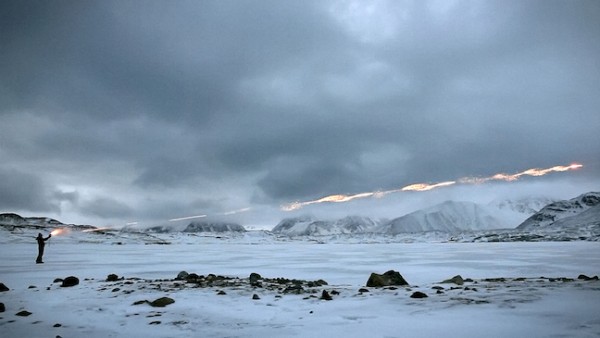
Janet Biggs fires a warning shot in the frozen north in her short film IN THE COLD EDGE
Schaich, who was born and raised in Berlin but is now based in Brooklyn as well, will be showing Evelyn, a portrait of an elderly woman going for a swim in a pool; Taking Over, which involves an ice-cream truck and an ice-skating rink; and Falling Into, which also deals with ice skating (and the Central Park Zoo). The latter two films evoke Biggs’s journeys to freezing zones, finding a common language between the filmmakers. “My artistic work focuses on body-related video performances and installations,” Schaich explains in her official artist statement. “My body is my tool in my artwork and takes up a large and important part of my conceptual work. Paradoxical action sequences and storylines, and playing with gender and gender roles, are key to my work.” Schaich and Biggs met earlier this year and have become fast friends, so this should be an intimate, fun, and fascinating evening.
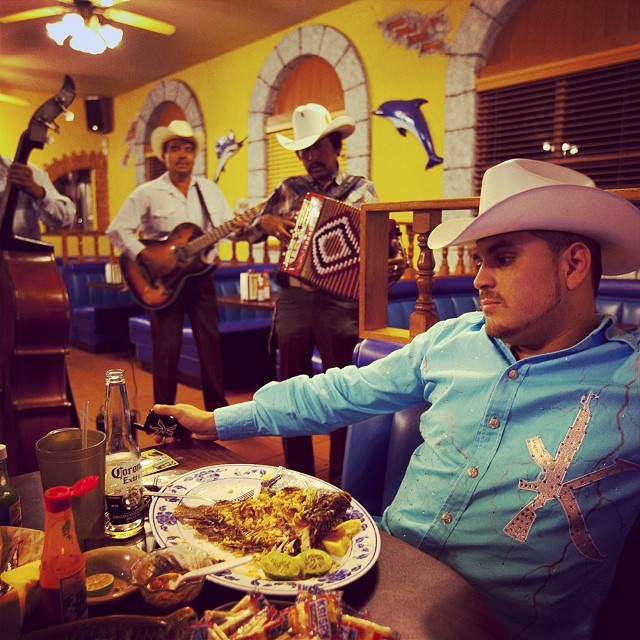
 “They say that it’s safe on the other side, that people don’t kill over there. But the narcos are over here,” a young boy says at the beginning of Shaul Schwarz’s startling documentary, Narco Cultura. The child is standing on the Mexican side of the fence that separates one of the most dangerous cities in the world, Juárez, where 3,622 murders occurred in 2010, from the safest in the United States, El Paso, Texas, which had only five murders that same year. In the film, Israeli-born, New York-based photojournalist Schwarz (The Block) examines the exploding narco culture, in which a growing number of men, women, and children in Mexico and America cheer on guns and violence and turn drug lords into heroes. Serving as director and cameraman, Schwarz follows Juárez native Richi Soto, a crime scene investigator who covers his face when on the job to hide his identity, as colleagues keep getting targeted for assassination, and LA-based narcocorrido singer-songwriter Edgar Quintero, who pens individually commissioned tunes for drug cartel members and later performs them with his popular group, BuKnas de Culiacan. While Soto lives in fear, continuing to do his duty even though some ninety-seven percent of murder cases end up not getting investigated by the police, Quintero is famous, appearing at sold-out concerts and starring in quickie films that glorify violence and drug culture. Schwarz, who served in the Israeli Air Force and has covered conflicts in Haiti, the Gaza Strip, and other hot spots around the world, gets right on the front lines, showing horrific scenes of violence while avoiding any talking-head experts, letting the staggering numbers and the rivers of blood speak for themselves, the real-life results of the failed war on drugs.
 Expanded from her 2010 short film of the same name, Rola Nashef’s first feature, Detroit Unleaded, is a well-meaning if ultimately standard romantic comedy set within the Motor City’s Arab-American community. Described by Nashef, who was born in Lebanon and raised in Michigan, as a melding of Clerks, Do the Right Thing, and My Big Fat Greek Wedding, the film stars E. J. Assi as Sami, a Lebanese American teenager preparing to go to college in California when his father, Ibrahim (Akram El-Ahmar), is suddenly shot and killed at the family’s gas station / convenience store. With no other choice but to take over the business, Sami soon finds himself behind newly installed protective glass, using a buzzer to let customers into his store. He works with his cousin Mike (Mike Batayeh), who will sell just about anything and has big plans for their operation. Bored and lonely, Sami is surprised when the pretty Najlah (Nada Shouhayib) begins to show an interest in him, although she’s hands-off when it comes to any physical contact, fearful of what her big brother, Fadi (Steven Soro), would do if he finds out she might have a boyfriend. Meanwhile, Sami starts giving his mother, Mariam (Mary Assel), driving lessons so she can begin putting her life back together. Assi and Shouhayib are charming in their film debuts, displaying an endearing chemistry, but the narrative staggers whenever side characters are involved, from Najlah’s friends to the various oddballs who come into the store. Even Mariam’s story feels stagnant and stale. While it’s interesting getting an inside look at the battle between the old ways and the new generation in the Lebanese-American community in Detroit, the film settles on some clichéd plot twists, leading to an ending that will have audiences scratching their heads, wondering if a scene or two was missing. Winner of the Grolsch Film Works Discovery Award at the 2012 Toronto International Film Festival, Detroit Unleaded opens on November 22 at Cinema Village, with Nashef participating in a half dozen Q&As on Friday, Saturday, Sunday, joined by Assi, Batayeh, and Shouhayib at some of them.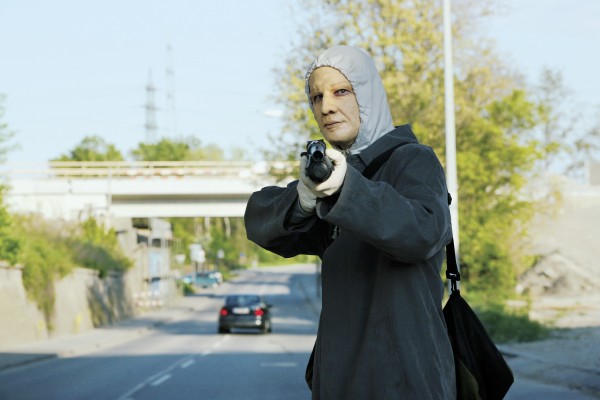


 Stanley Kubrick’s harrowing Paths of Glory, based on the novel by Humphrey Cobb, is quite simply the best English-language antiwar film ever made. Kirk Douglas stars as Colonel Dax, a French military man who disagrees with his superiors’ insistence on sending his men into certain annihilation in order to take a worthless hill during World War I. Dax’s verbal battles with Generals Broulard (Adolphe Menjou) and Mireau (George Macready) are unforgettable, as are the final scenes, in which three random men are chosen to pay the price for what the generals call cowardice. Filmed in stunning black and white, Paths of Glory puts you right on the front lines of the folly of war. Kubrick, who wrote the unrelenting script with Calder Willingham and Jim Thompson, also made the best film about the cold war (Dr. Strangelove, or How I Learned to Stop Worrying and Love the Bomb), the Roman slave revolt (Spartacus), and, arguably, the Vietnam War (Full Metal Jacket). One of the most emotional, powerful stories ever put on celluloid, Paths of Glory is screening for free on November 22 at 7:00 as part of the New-York Historical Society’s Bernard and Irene Schwartz Classic Film Series and will be introduced by author Michael Korda (Ike: An American Hero, With Wings Like Eagles: A History of the Battle of Britain) with a focus on “WWI and Its Legacy in Film.”