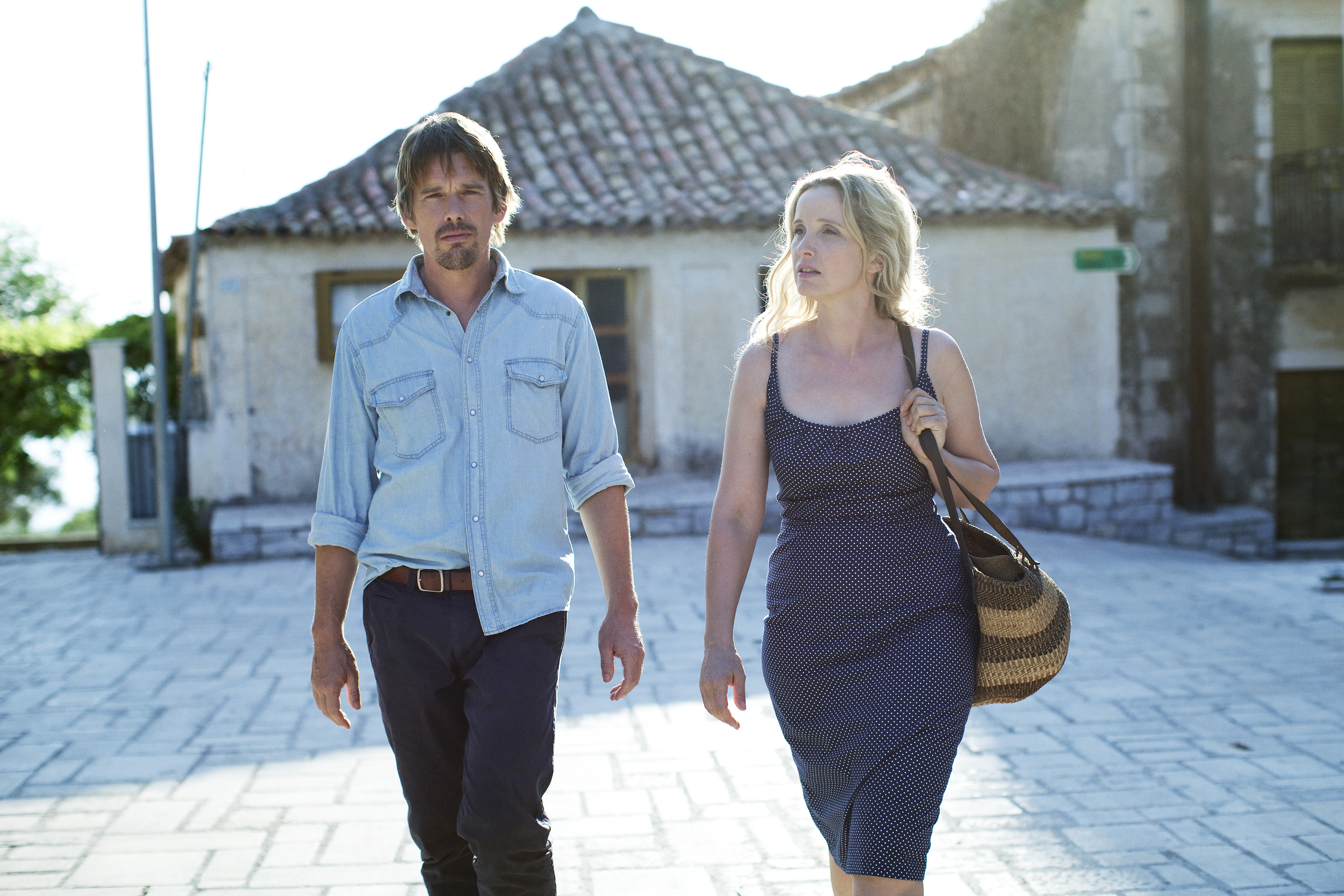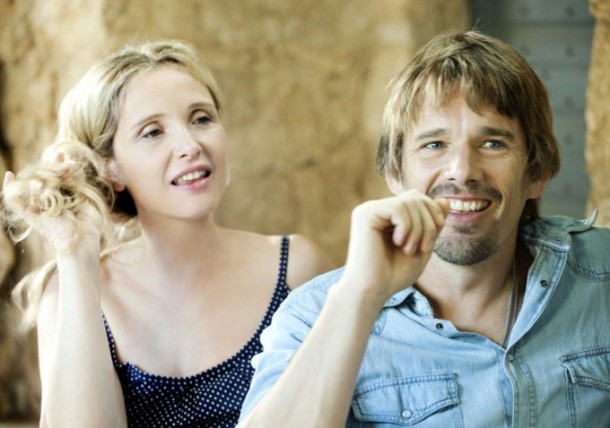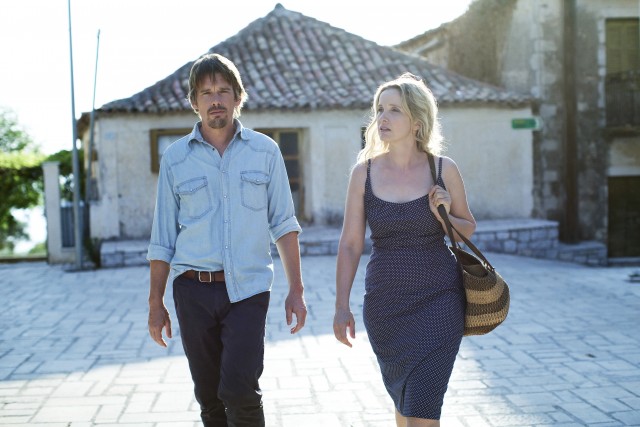
Jesse (Ethan Hawke) and Celine (Julie Delpy) are back together again in Richard Linklater’s BEFORE MIDNIGHT
BEFORE MIDNIGHT (Richard Linklater, 2013)
MoMA Film, Museum of Modern Art
11 West 53rd St. between Fifth & Sixth Aves.
Wednesday, November 27, 7:00
Series continues through January 16
Tickets: $12, in person only, may be applied to museum admission within thirty days, same-day screenings free with museum admission, available at Film and Media Desk beginning at 9:30 am
212-708-9400
www.moma.org
www.sonyclassics.com/beforemidnight
 Unable to resist revisiting the characters who first fell in love in 1995’s Before Sunrise and again in 2004’s Before Sunset, Ethan Hawke and Julie Delpy reprise their roles as Jesse and Celine, respectively, in Richard Linklater’s absolutely wonderful Before Midnight. The couple first met on a train to Vienna in 1994, talking at length about their hopes and desires and planning on getting together in six months’ time, but they don’t reconnect for another nine years, when Celine comes to one of Jesse’s book signings in Paris. In real time, they walk around the City of Light, catching up on what has happened in their lives as Jesse prepares to take a plane back home to his wife and son. And now another nine years have passed, and Jesse and Celine are living together, the parents of twins (Charlotte and Jennifer Prior). As the film opens, the divorced Jesse is putting his teenage son, Hank (Seamus Davey-Fitzpatrick), on a plane after having spent the summer together in Greece. What follows is a marvelous fourteen-minute scene of Jesse driving down a mountain road as he and Celine essentially let the audience know what has occurred over the last nine years: They have twin girls (sleeping in the back), Celine has been offered an important environmental job, and Jesse is considering moving to Chicago to be closer to Hank. They return to a country estate owned by Patrick (award-winning cinematographer Walter Lassally, making his acting debut at the age of eighty-six), who is hosting an outdoor lunch with a group of friends (including French actress Ariane Labed, coproducer and filmmaker Athina Rachel Tsangari, and Xenia Kalogeropoulou, who came out of retirement to appear in her first picture since 1985). They all talk of life and love, with Celine being particularly charming. But when Jesse and Celine go off to a hotel room for what is supposed to be a romantic rendezvous, some things are said and truths revealed that complicate things.
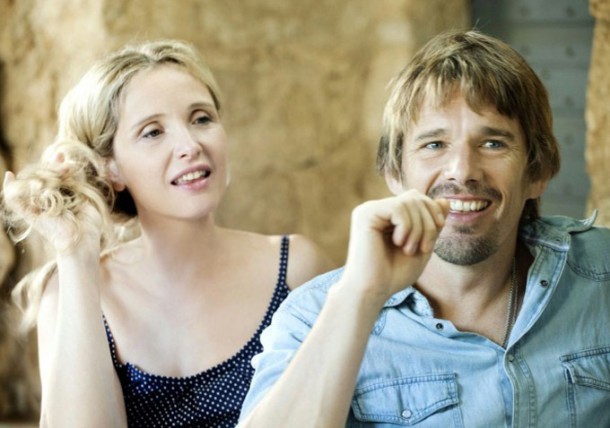
Cowriters Julie Delpy and Ethan Hawke explore life and love in Greece in third film about Celine and Jesse
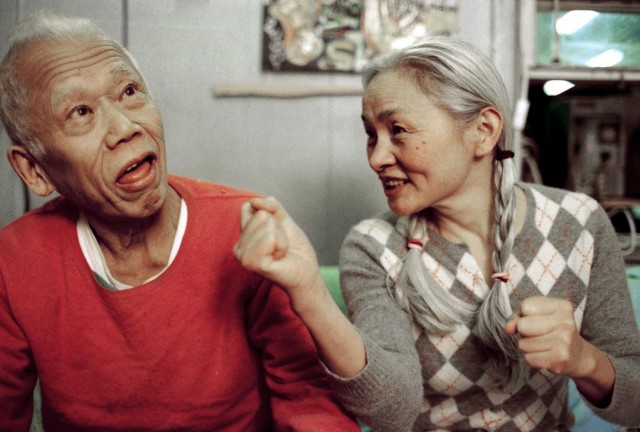
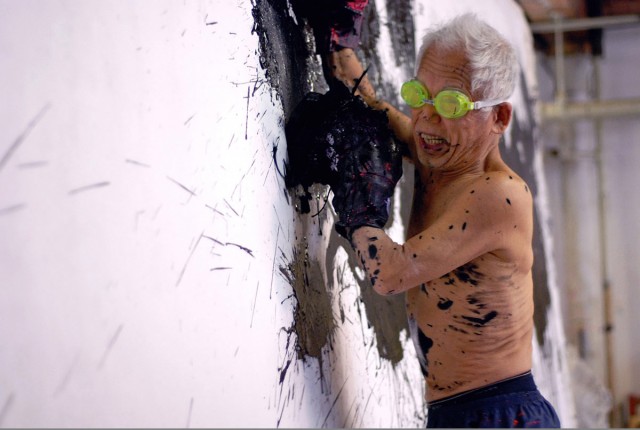
As with the first two films, Before Midnight consists of long takes of Jesse and Celine discussing their past, present, and future as cowriters Linklater (Slacker, Dazed and Confused), Delpy, and Hawke, who were nominated for an Oscar for their script for Before Sunset, continue to explore these engaging characters; both the dialogue and the acting have matured with an intelligent grace and elegance that are captivating. The couple wanders around Messinia examining their lives as only fortysomethings can, trying to figure out whether what they have is what they want. The central focus, though, once again is time, whether it is the years Jesse and Celine have spent together, the time they have left, time as a concept in Jesse’s semiautobiographical novels, or Jesse making a joke about being a time traveler. It’s been eighteen years since we first met Jesse and Celine, and we’ve grown eighteen years older too, lending fascinating perspectives that can’t help but force us to take a look at our own lives as well. The trilogy is America’s version of François Truffaut’s Antoine Doinel series, filled with humor, lyricism, and an inherent understanding of twenty-first-century realities. Will there be a fourth film in nine years? As of now, the principals aren’t saying because they just don’t know, but Before Midnight ends on just about the perfect ambiguous note. Before Midnight is screening November 27 at 7:00 as part of MoMA’s annual series “The Contenders,” which consists of exemplary films that MoMA believes will stand the test of time, continuing with such films as Jem Cohen’s Museum Hours, Jia Zhangke’s A Touch of Sin, Spike Jonze’s Her, and Noah Baumbach’s Frances Ha.
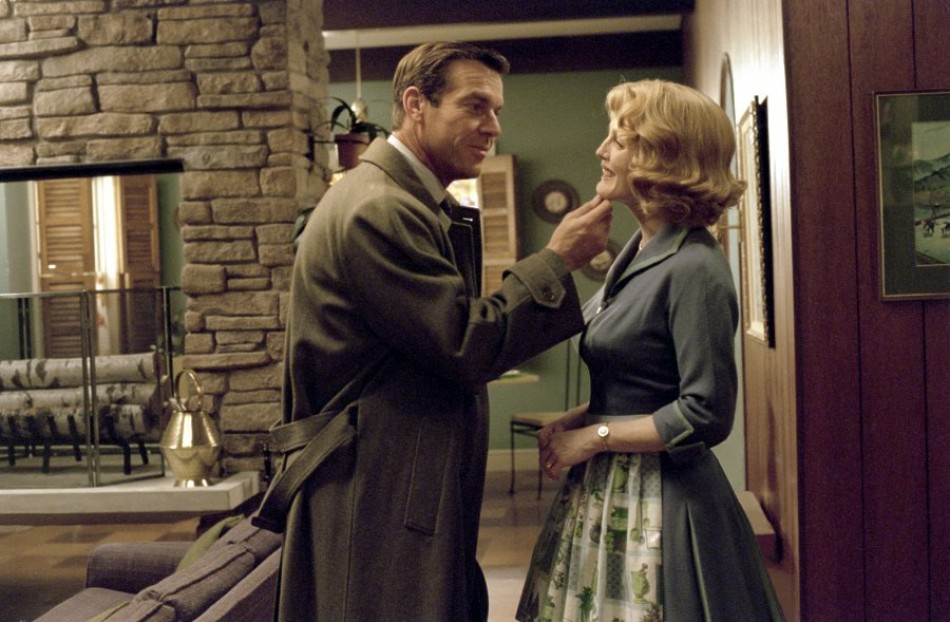
 Douglas Sirk and Thomas Mann would be proud. In Todd Haynes’s wonderfully retro Far from Heaven, Oscar-nominated Julianne Moore is amazing as 1950s housewife Cathy Whitaker, who thinks she has the perfect idyllic suburban life — until she discovers that her husband (Dennis Quaid) has a secret that dare not speak its name. Mr. & Mrs. Magnatech they are not after all. When she starts getting all chummy with the black gardener (Dennis Haysbert), people start talking, of course. Part Imitation of Life, part Death in Venice, and oh-so-original, Haynes’s awesome achievement will have you believing you’re watching a film made in the 1950s, propelled by Elmer Bernstein’s excellent music, Edward Lachman’s remarkable photography, and Mark Friedberg’s terrific production design. Far from Heaven is screening at the Museum of the Moving Image on November 30 at 4:00 as part of the weekend series “Julianne Moore,” which pays tribute to the award-winning actress known for taking on challenging roles by showing six of her films, including the Coen brothers’ The Big Lebowski, Steven Spielberg’s The Lost World: Jurassic Park, Paul Thomas Anderson’s Boogie Nights, Haynes’s Safe, and Lisa Cholodenko’s The Kids Are All Right.
 Two classic short works by Albert Lamorisse were recently lovingly restored by Janus Films and will be shown together in 35mm prints this weekend at BAM. In The Red Balloon, which won the Palme d’Or at Cannes and an Oscar for Best Original Screenplay, a young boy (Pascal Lamorisse, the director’s son) makes friends with an extraordinary red balloon, which follows him through the streets of Belleville in Paris, waits for him while he is in school, and obeys his every command. But the neighborhood kids are afraid of this stranger and go on a mission to burst the young boy’s bubble. Lamorisse gives life and emotion to the balloon (more than twenty-five thousand were used in the making of the film) in a masterful use of simple special effects well before CGI and other modern technology. The Red Balloon is being screened with another of Lamorisse’s classics, the lesser-known White Mane, in which a magnificent white stallion “who felt trapped in the world of men,” the “proud and fearsome” leader of a herd of wild horses, struggles to maintain his freedom from cowboys in Camargue in the south of France, helped by a young fisherman named Folco (Alain Emery). As in The Red Balloon, Lamorisse imbues the title character with, dare we say it, a unique humanity, as both the balloon and the horse fight for their individuality with only a single young boy at their side. The tender tale includes a new English translation spoken by Peter Strauss. Both films feature the splendid music of Maurice Leroux and the fine photography of Edmond Séchan. The two films are screening November 30 at 11:00 am as part of the twice-monthly BAMcinématek series “BAMkids Movie Matinees,” which continues December 7 with Steven Spielberg’s E.T. the Extra-Terrestrial and December 21 with Bob Clark’s A Christmas Story.