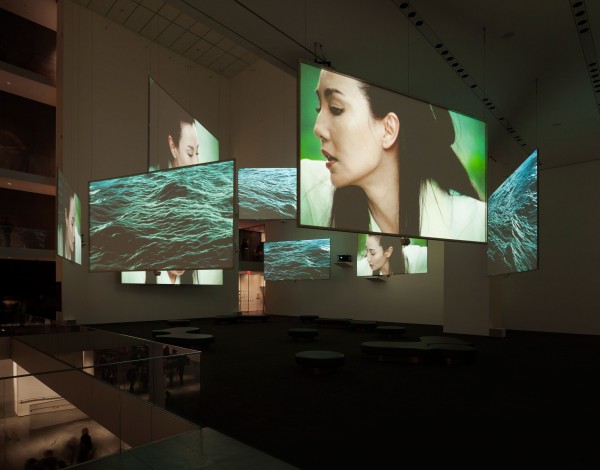
Isaac Julien’s striking TEN THOUSAND WAVES floats across MoMA’s atrium (photo by Jonathan Muzikar)
TEN THOUSAND WAVES
Museum of Modern Art, the Donald B. and Catherine C. Marron Atrium
11 West 53rd St. between Fifth & Sixth Aves.
Through February 17
Museum admission: $25 ($12 can be applied to the purchase of a film ticket within thirty days)
212-708-9400
www.moma.org
www.isaacjulien.com
Comfy Ottomans are arranged throughout MoMA’s Donald B. and Catherine C. Marron Atrium, but visitors aren’t meant to grab a seat and settle in while watching Isaac Julien’s dazzling nine-screen immersive installation, Ten Thousand Waves. To get the full effect, wander around the space, and even check out the upper levels for a view from above. That would fit with some of Julien’s central themes, involving motion, migration, and technological change. The London-born Julien has previously installed the piece on Cuckatoo Island, for the Sydney Biennale; at the Kunsthalle Helsinki; and in Shanghai during the Shanghai Expo, but it is being shown at MoMA in a unique configuration, with the nine screens hanging from the atrium ceiling at different angles and heights, making it feel like a more arduous journey. The inspiration for Ten Thousand Waves came from the 2004 Morecambe Bay tragedy, when nearly two dozen migrant Chinese cockle pickers from Fujian Province drowned in a terrible accident. Julien retells that story with actual footage of the recovery attempt while incorporating elements of the folk legend “The Tale of Yishan Island,” about sixteenth-century fishermen facing disaster on the sea. He also re-creates scenes from Wu Yonggang’s 1934 silent film, The Goddess, with Zhao Tao (wife and muse of Sixth Generation director Jia Zhangke) playing a desperate prostitute (as well as Goddess actress Ruan Ling-yu, who came to a fateful end herself) making her way through the colorful streets of old and new Shanghai (and the Shanghai Film Studios). Overseeing it all is Mazu (Chinese superstar Maggie Cheung), the Goddess of the Sea, who floats through the air in a flowing white costume. The multiple abstract narratives, visual style, sets, and soundtrack (by Jah Wobble and the Chinese Dub Orchestra and composer Maria de Alvear) combine with Gong Fagen’s calligraphy and Wang Ping’s specially commissioned poem, “Small Boats” (other collaborators include multimedia artist Yang Fudong and cinematographer Zhao Xiaoshi), to examine the interplay of commerce and capital in both ancient and modern-day China. Like much of Julien’s oeuvre (Fantôme Afrique, True North), the fifty-minute Ten Thousand Waves is a visually stunning meditative work that offers up no easy answers while warranting multiple visits. In conjunction with the exhibit, MoMA has published a deluxe intellectual biography of Julien, Riot, which features illuminating text by Paul Gilroy, bell hooks, Mark Nash, Laura Mulvey, Christine Van Assche, Julien, and others, including several chapters on Ten Thousand Waves and Playtime, which can currently be seen at Metro Pictures.
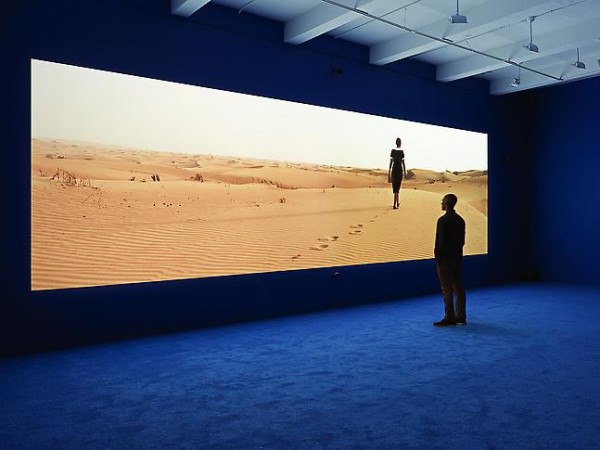
Julien’s PLAYTIME follows a series of characters dealing with the financial crisis in very different ways (photo courtesy Metro Pictures)
PLAYTIME
Metro Pictures
519 West 24th St. between Tenth & Eleventh Aves.
Through December 18, free, 10:00 am – 6:00 pm
212-206-7100
www.metropicturesgallery.com
In Chelsea, Julien’s latest installation at Metro Pictures, Playtime, continues through December 18, exploring some of the same concepts as Ten Thousand Waves, albeit much more directly, as seen through the Collector, the Houseworker, the Artist, the Auctioneer, and the Reporter, each of whom is based on real people. The centerpiece of Playtime is a three-chapter film, projected onto a long, horizontal screen, that looks at the financial crisis in three cities. In London, a vibrant young man (James Franco) speaks adoringly about collecting art and leads viewers to an auction being led by Simon de Pury. In Dubai, where there appears to have never been a financial crisis, a Filipina woman (Mercedes Cabral) cleans a wealthy man’s multimillion-dollar apartment, gazing out at one of the wealthiest cities on the planet while wondering if she will make enough money to have her life back and reunite with the rest of her family. And in Reykjavik, where the financial crisis began in 2008, a photographer (Ingvar Eggert Sigurðsson) looks over a vast, barren landscape. The exhibit also includes Kapital, a two-channel video in which Julien and social theorist David Harvey, author of such books as Spaces of Global Capitalism: Towards a Theory of Uneven Geographical Development and The Enigma of Capital and the Crises of Capitalism, discuss class, Marxist philosophy, social structure, and more with a specially invited group of men and women at London’s Hayward Gallery. And in another video, de Pury sits down for a craftily staged interview with a journalist (Cheung), claiming that the financial crisis actually ended up being a boon to the art market. Although some of the points Julien is making here are rather obvious and far from new, the work still fascinates with its visual acuity and infectious pacing. Perhaps Julien titled it Playtime in tribute to Jacques Tati and his Monsieur Hulot onscreen alter-ego, a charming, dapper man who seems to be living in a different era than everyone else, with few of their cares and worries.

A three-minute clip from Isaac Julien’s PLAYTIME will screen throughout Times Square this month (photo by Ka-Man Tse for @TSqArts)
MIDNIGHT MOMENT: ISAAC JULIEN
Times Square
Nightly at 11:57 through December 30
www.timessquarenyc.org
In conjunction with the shows at MoMA and Metro Pictures, Times Square Arts and the Times Square Advertising Coalition is presenting a three-minute clip from Julien’s Playtime every night at 11:57 on seventeen electronic billboards in Times Square through December 30 as part of the ongoing “Midnight Moment” project, which has previously shown work by such artists as Ryan McGinley, Robert Wilson, Tracey Emin, Jack Goldstein, and Björk and Andrew Thomas Huang. It’s rather fitting, of course, that Playtime, which deals so much with art, commerce, and capitalism, can be seen in the heart of one of the planet’s most commercial locations. And it’s difficult to pass up the opportunity to see James Franco hovering over the Crossroads of the World. Julien will be back at MoMA on February 10 for the Modern Mondays presentation “An Evening with Isaac Julien,” sharing film clips and talking about his career.
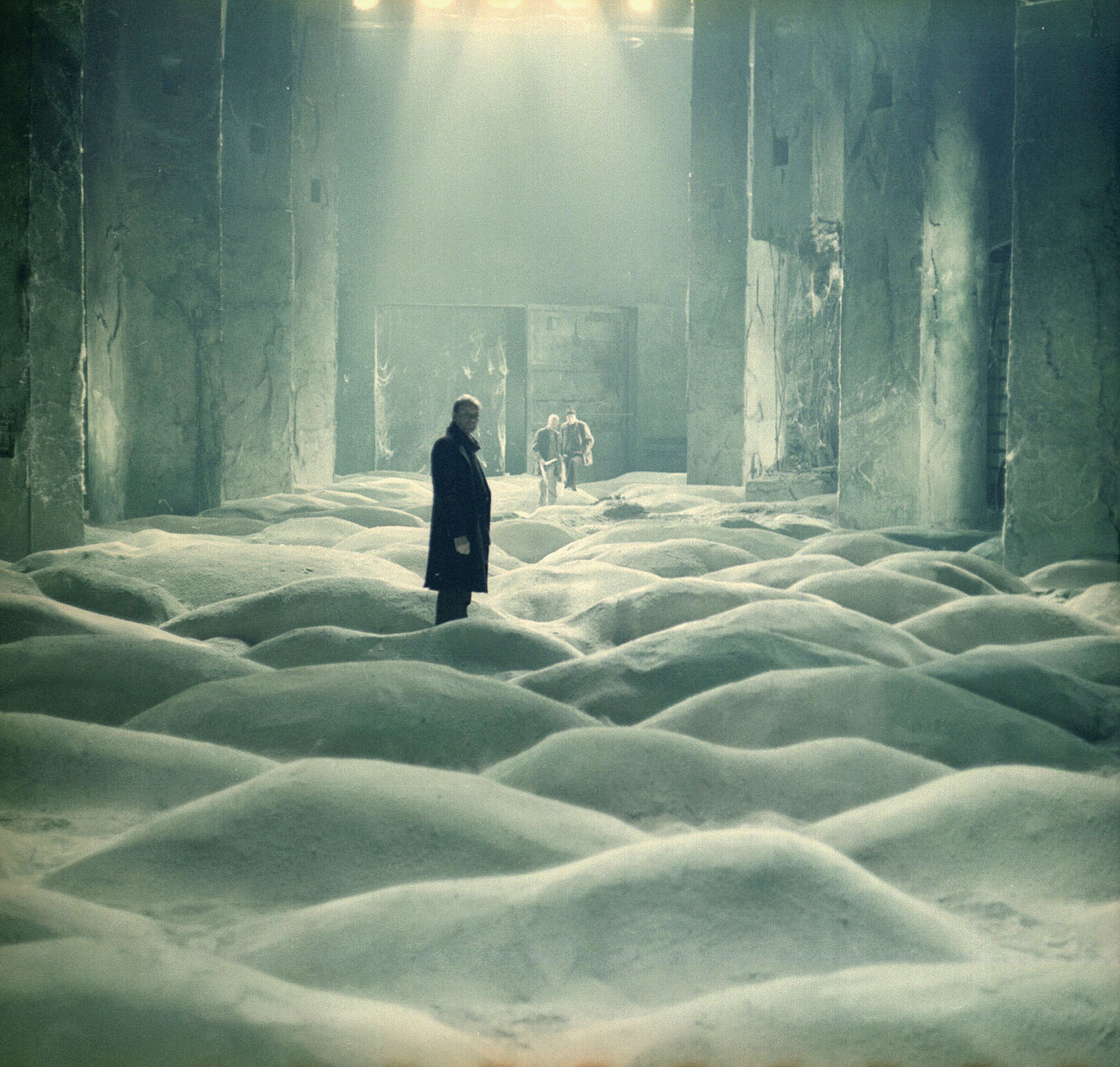
 Set in a seemingly postapocalyptic world that is never explained, Andrei Tarkovsky’s Stalker is an existential work of immense beauty, a deeply philosophical, continually frustrating, and endlessly rewarding journey into nothing less than the heart and soul of the world. Alexander Kaidanovsky stars as Stalker, a careful, precise man who has been hired to lead Writer and Professor (Tarkovsky regulars Anatoli Solonitsyn and Nikolai Grinko, respectively) into the forbidden Zone, a place of mystery that houses a room where it is said that people can achieve their most inner desires. While Stalker’s home and the bar where the men meet are dark, gray, and foreboding, the Zone is filled with lush green fields, trees, and aromatic flowers — as well as abandoned vehicles, strange passageways, and inexplicable sounds. The Zone — which heavily influenced J. J. Abrams’s creation of the island on Lost — has a life all its own as past, present, and future merge in an expansive land where every forward movement is fraught with danger but there is no turning back. An obsessive tyrant of a filmmaker, Tarkovsky (Andrei Rublev, Solaris) imbues every shot with a supreme majesty, taking viewers on an unusual and unforgettable cinematic adventure. (For our 2012 twi-ny talk with Geoff Dyer, the author of Zona: A Book about a Film about a Journey to a Room, which offers quite a unique take on Stalker, go here.)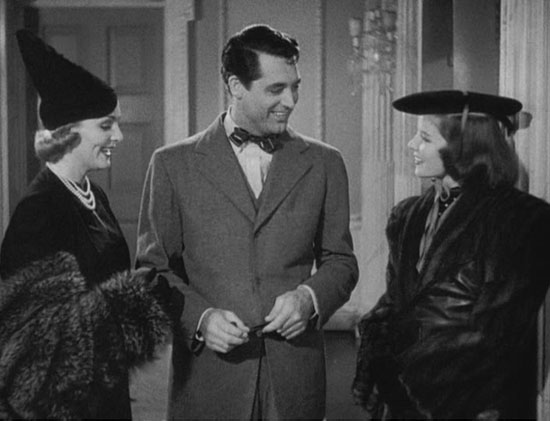
 Although the screwball romantic comedies are perhaps best loved for their madcap antics and fast-paced dialogue, there was also a fascinating underlying motif to many of them — as America came out of the Great Depression and WWII beckoned, the films tackled the theme of the growing disparity between the rich and the poor. George Cukor’s 1938 classic, Holiday, however, looks at the world from a slightly different perspective, pitting the rich vs. the super-rich. Based on the Broadway play by Philip Barry, which was turned into a 1930 film featuring Ann Harding, Mary Astor, Edward Everett Horton, Hedda Hopper, Robert Ames, and William Holden, Cukor’s version stars Cary Grant as Johnny Case, a self-made humble financial wizard who dreams of making just enough money to be able to afford to leave the business and go find himself. Following a whirlwind ten-day courtship with Julia Seton (Doris Nolan) while on vacation in Lake Placid, Johnny is shocked to find out that his fiancée is a member of the Seton clan, one of the richest families in America. Julia’s father, Edward (Henry Kolker), is not about to let his beloved daughter marry just anyone, so he puts Johnny through the ringer. Meanwhile, Johnny bonds with Julia’s sister, the black sheep Linda (Katharine Hepburn, who was the understudy for Linda on Broadway), who is desperate to live her own life but seems trapped in a fantasy, receiving only marginal support from their brother, Ned (Lew Ayres), who is never without a drink and a cynical word about the family, washing away his failure in cocktail after cocktail. “Walk, don’t run, to the nearest exit,” he advises Johnny. Honest, dependable, and a surprisingly good gymnast, Johnny finds solace from the crazy Setons in his longtime friends, Nick (Horton, reprising his role from the earlier film) and Susan (Jean Dixon), simpler folk with a fine sense of humor and little time for high society. As midnight on New Year’s Eve approaches, the main characters’ lives come together and fall apart in hysterical yet serious ways. Holiday is not your average screwball comedy, instead seeking to take on more personal, psychologically intimate issues and succeeding wildly, continually defying expectations and turning clichés inside out. Grant is as cool as ever, but he adds a seldom-seen vulnerability that adds to his charm. Holiday is screening December 18 as part of the Film Society of Lincoln Center series “The Discreet Charm of George Cukor,” which runs through January 7 and consists of all fifty of the Lower East Side native’s films, from Keeper of the Flame and Heller in Pink Tights to Our Betters and Tarnished Lady as well as such unforgettable classics as Sylvia Scarlett, Pat and Mike, It Should Happen to You, Camille, Gaslight, and many others.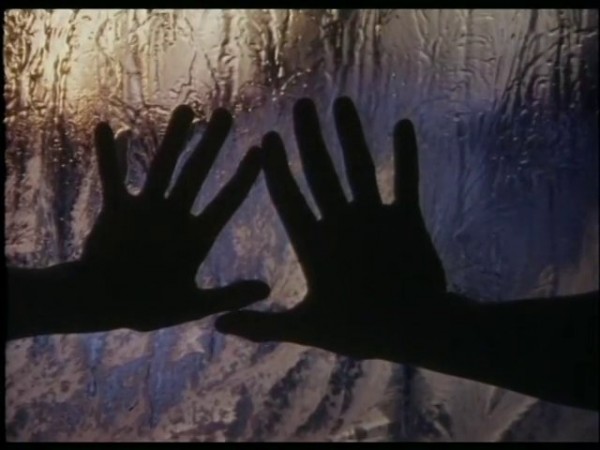
 “I left all my troubles in Poland, all the duties that occupied my days,” Malgosia says at the beginning of 1998’s The Siberian Lesson. “I really wanted to leave them all behind. I wanted a break.” As it turns out, spending a year in Usolye-Sibirskoye does not end up being much of a break for Malgosia, who arrives in a town out of time, looking more like 1956 than 1996. Malgosia has traveled to Siberia to teach her native language to the descendants of Polish exiles who fled the country during tsarist rule, men, women, and children who know little of their homeland; she is joined by her boyfriend, recent Polish Film Academy graduate Wojciech Staroń, who is documenting it all with his 16mm camera. Malgosia, who narrates the film in a dry monotone, immediately discovers that life is extremely difficult for this tight-knit community; the teachers are on strike, and poverty is rampant, the food of survival the potato, which she is told everyone must grow for themselves in order to make it through the hard winter. She meets some rather unique characters during her stay, including Tatar gym owner Zinat, Father Ignacy, and a night watchman named Walery who has dedicated his life to translating the Bible from Polish into Russian. Meanwhile, students of all ages come to her classes, seeking something they can’t otherwise find in their daily existence. Malgosia is also searching for something in her own life, and she finds it in her growing love for Wojciech, who adds beautifully poetic shots of the vast Siberian landscape to accompany Agata Steczkowska’s nearly elegiac piano score.