Mike Kelley, “Deodorized Central Mass with Satellites,” plush toys sewn over wood and wire frames with styrofoam packing material, nylon rope, pulleys, steel hardware and hanging plates, fiberglass, car paint, and disinfectant, 1991/1999 (photo by twi-ny/mdr)
MoMA PS1
22-25 Jackson Ave. at 46th Ave.
Sunday, February 2, $18 in advance, $20 day of show, 4:00
Exhibition continues through February 2, suggested admission $10 (free with paid MoMA ticket
within fourteen days), 12 noon – 6:00 (9:00 on Saturday)
718-784-2084
www.momaps1.org
A few weeks ago, an art-world friend who was at MoMA PS1 posted on Facebook, “OK, sell me on Mike Kelley.” Most of the respondents agreed with her that they just didn’t get all the hullabaloo over the influential multimedia artist who committed suicide on February 1, 2012, while in the midst of participating in his career retrospective, which posthumously took over all of the Long Island City institution on October 13, 2013. The show, the largest at MoMA PS1 since 1976, features more than 250 works by the Detroit-born Kelley, who was an original member of the punk band Destroy All Monsters while at the University of Michigan before moving to Los Angeles and studying at CalArts under such teachers as John Baldessari, Laurie Anderson, Jonathan Borofsky, and Douglas Huebler. On February 2, the last day of the show, Sonic Youth cofounder and visual artist Kim Gordon and German artist, musician, and critic Jutta Koether are creating a special farewell event in the VW Dome that may or may not help sell yet more people on Kelley. The two women have previously collaborated on such projects as “Her Noise”; Kelley created the cover image for Sonic Youth’s Dirty album, while the band contributed music to his “Plato’s Cave, Rothko’s Chapel, Lincoln’s Profile” performance piece. “Mike dug a huge hole, but his sculptures, videos, recordings, writings, and drawings fill it in, heaped so high that they stand like a formidable mountain of gifts, rewards, like a monument to getting out from under,” Gordon, a close friend of Kelley’s, wrote in Artforum a few months after his death.

Kim Gordon and Jutta Koether will bid farewell to Mike Kelley exhibit with special performance at MoMA PS1
The sprawling exhibition contains sculptures, videos, recordings, writings, drawings, and more, offering many different types of rewards. It all begins in the courtyard VW Dome, where Kelley’s nearly-three-hour epic, Day Is Done, screens continuously, a subversive spectacle that sets the tone for the rest of the show, highlighting Kelley’s obsessions with childhood imagery and pop culture, his unique spirituality, his repurposing of found objects, and the low-budget, DIY nature of his work, which can often have an amateurish feel that turns off viewers. Inside the former school, there is art everywhere, from the hallways to the boiler room, displaying Kelley’s vast range. His Kandor series consists of numerous multicolored, glowing versions of the Krypton city from the Superman comics, each one existing in a glass bottle hooked up to a kind-of life-support system, with accompanying video. “Pay for Your Pleasure” is a narrow corridor with banners on either side containing portraits of writers and philosophers, along with a quote from each one about art, crime, law, and civilization; at the end is an artwork by a local murderer.
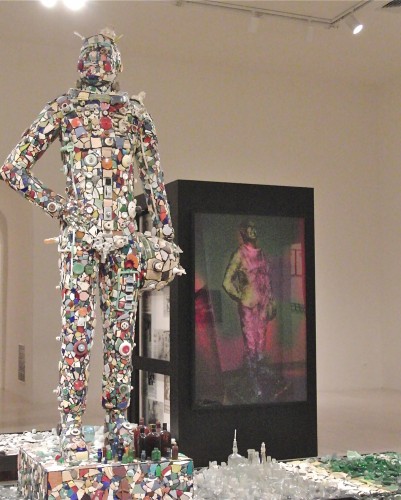
Mike Kelley, “John Glenn Memorial Detroit River Reclamation Project (Including the Local Culture Pictorial Guide, 1968-1972, Wayne/Westland Eagle),” mixed media, 2001 (photo by twi-ny/mdr)
One large gallery space is dedicated to several of Kelley’s “Extracurricular Activity Projective Reconstruction” installations, in which he starts with a photograph from a high school yearbook and turns it into a short film, screened on a set with architectural elements echoing what is happening in the imagined story. (“Extracurricular Activity Projective Reconstruction #1 [A Domestic Scene]” is also being shown at MoMA in Midtown.) “John Glenn Memorial Detroit River Reclamation Project” is centered by a tall mosaic statue of astronaut John Glenn made out of broken glass, pottery, plates, ceramic figures, and other detritus, delving into another regular subject of Kelley’s, repressed memory syndrome. In “Deodorized Central Mass with Satellites,” colorful stuffed animals have been formed into orbs that hang from the ceiling like a planetary system as futuristic wall pieces shoot out disinfectant. Two small crawlspaces allow non-claustrophobics to wind their way to a peephole where they can see the famous locker-room peeping scene from Porky’s. And “Horizontal Tracking Shot of a Cross Section of Trauma Rooms” consists of videos of traumatic scenes taken from the internet, then shown on monitors attached to the back of a wall of fence posts of different colors and sizes. Not everything will work for everyone, but there’s bound to be at least a handful that any person would at least find fascinating and intriguing, thought-provoking and challenging. In response to our friend’s Facebook request, we proffered, “The Michigan-born multimedia artist created fantastical worlds using found objects that reexamined mass culture through DIY installations that can be playful and nonsensical as well as cutting and poignant.” At the end of the thread, she readily admitted that having seen the show, she has a greater appreciation for his work. And sometimes, that’s all one can ask for.

 For twenty years, Baltimore has been defined by such television series as Homicide: Life on the Street, The Corner, and The Wire, shows filled with rampant violence and drugs. This past November, the U.S. Census Bureau released data showing that the poverty rate from 2010 to 2012 in the city of Baltimore was more than twenty-five percent. During that same period, debut filmmaker Lofty Nathan embedded himself with a group of teens and young twentysomethings who ride two- and four-wheel dirt bikes through the streets and parks of Charm City, popping vertical wheelies that point up at the sky. Nathan documents their activities in 12 O’Clock Boys, offering an inside look at this dangerous phenomenon (which has spread to other inner cities as well). “This is our tradition, our culture, this is what we do. Can’t nobody take it from us. This is our release,” one rider says as he puts on a mask. “Baltimore City Sunday: F@ck city council, f@ck the police. I pity them that try to stop us. This is our sh*t.” Indeed, the police are rarely far away, either in marked cars or helicopters, but they are limited in how they can chase the riders because of public safety concerns. Nathan focuses in on twelve-year-old Pug, a tough-talking, smart street kid who starts skipping school, instead dedicating his every waking moment to trying to become a Twelve O’Clock Boy. Meanwhile, there’s little his mother, Coco, a former exotic dancer raising five children on her own, seems to be able to do to stop him. It’s sad to see Pug make this choice, turning his back on education while declaring the police to be the enemy, but Nathan makes no moral judgments about him or any of the other boys and men who take part in this illegal activity, which seems to exist primarily to fight authority. He also doesn’t delve into the political, socioeconomic, and racial factors that have impacted the rise of such a scenario. Instead, he lets Pug, Superman, Shawn Sean, Wheelie Wayne, and Albert Lemon — a former copy now running a regional security outfit — speak for themselves. And it’s a scary story, one that, regardless of which side you’re on, can only have a tragic outcome if something isn’t done about it.
 Sound and image meld together beautifully in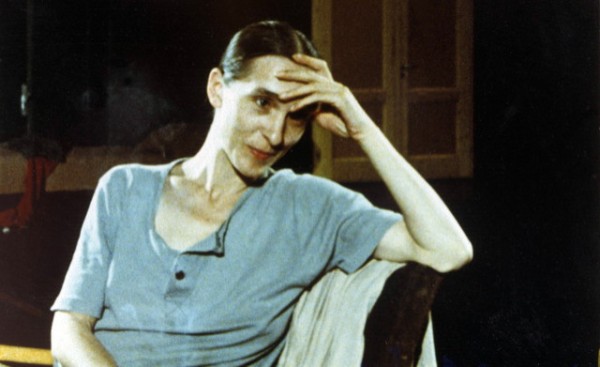
 In 1982, Belgian filmmaker Chantal Akerman followed Pina Bausch’s Tanztheater Wuppertal on a five-week tour of Europe as the cutting-edge troupe traveled to Milan, Venice, and Avignon. “I was deeply touched by her lengthy performances that mingle in your head,” Akerman says at the beginning of the resulting documentary, “One Day Pina Asked…,” continuing, “I have the feeling that the images we brought back do not convey this very much and often betray it.” Akerman (Jeanne Dielman, 23 Quai du Commerce, 1080 Bruxelles; Je tu il elle) needn’t have worried; her fifty-seven-minute film, made for the Repères sur la Modern Dance French television series, is filled with memorable moments that more than do justice to Bausch’s unique form of dance theater. From 1973 up to her death in 2009 at the age of sixty-eight, Bausch created compelling works that examined the male-female dynamic and the concepts of love and connection with revolutionary stagings that included spoken word, unusual costuming, an unpredictable movement vocabulary, and performers of all shapes, sizes, and ages. Akerman captures the troupe, consisting of twenty-six dancers from thirteen countries, in run-throughs, rehearsals, and live presentations of Komm Tanz Mit Mir (Come Dance with Me), Nelken (Carnations), 1980, Kontakthof, and Walzer, often focusing in on individual dancers in extreme close-ups that reveal their relationship with their performance. Although Bausch, forty at the time, is seen only at the beginning and end of the documentary, her creative process is always at center stage. At one point, dancer Lutz Förster tells a story of performing Gershwin’s “The Man I Love” in sign language in response to Bausch’s asking the troupe to name something they’re proud of. Förster, who took over as artistic director in April 2013, first performs the song for Akerman, then later is shown performing it in Nelken. (Bausch fans will also recognize such longtime company members as Héléna Pikon, Nazareth Panadero, and Dominique Mercy.)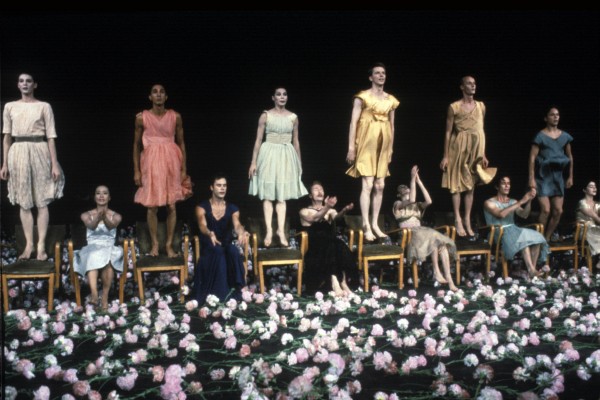
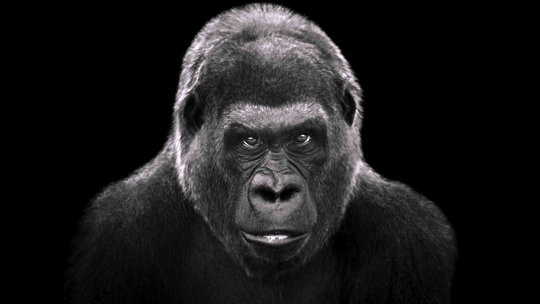
 Concept trumps execution in Godfrey Reggio’s latest cinematic collaboration with composer Philip Glass and editor Jon Kane. For his first film in more than ten years — his last feature was 2002’s Naqoyqatsi: Life as War, the follow-up to 1988’s Powaqqatsi: Life in Transformation and 1982’s Koyaanisqatsi: Life out of Balance — Reggio has set his sights on the people who live on a planet that is facing destruction. Visitors consists of seventy-four shots in eighty-seven minutes, from close-ups of men, women, children, and Bronx Zoo female gorilla Triska against stark black backgrounds to scenes of massive garbage dumps, tall buildings, the moon and the earth, and the swamps of Reggio’s home state, Louisiana. His goal is to affect viewers’ sensation, emotion, and perception while revealing a new order of the ages: novus ordo seclorum, as it says right on the dollar bill. Unfortunately, his grand plans fall severely short, as Visitors ends up being a slow-moving, repetitious, and rather dull journey through often inexplicably linked scenes. Reggio is hoping for viewers to create their own individual narrative — there are no spoken words or descriptive text in the film, only Glass’s wonderful score, which the composer developed by joining Reggio and Kane at many of the shoots — but it’s all too disjointed and scattered. There are some spectacular moments — especially when Triska stares directly into the camera for several minutes — but it never comes together to form a unified whole, evoking the odd triumvirate of 2001: A Space Odyssey, Godley and Crème’s 1985 video for “Cry,” and even a little bit of Mummenschanz. Visitors is currently playing at the Landmark Sunshine; you can catch the Quatsi trilogy and a pair of short works, Anima Mundi and Evidence, from January 13 through March 14 in the Museum of Arts and Design film series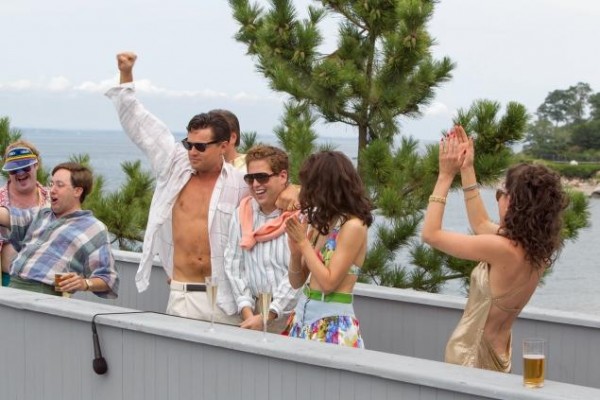
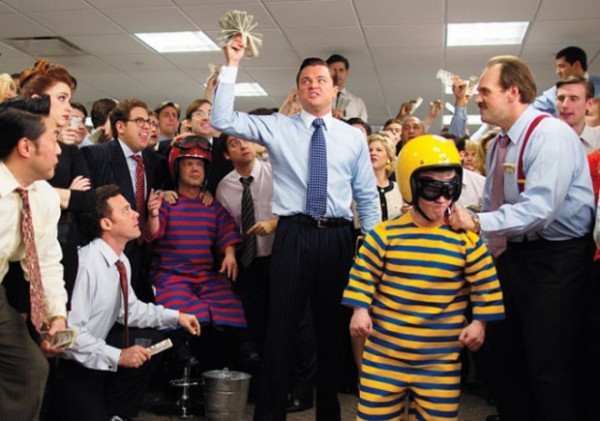
 Based on Jordan Belfort’s 2007 memoir, The Wolf of Wall Street relates the rise and fall of a fast-talking, high-living stockbroker, played to the hilt by an impressive Leonardo DiCaprio. But Martin Scorsese’s picture, his fifth starring DiCaprio, has trouble walking that fine line between glorifying Belfort’s money, drugs, and women lifestyle and portraying him as a greedy con man who ransacked innocent people’s savings and ruined their lives. In 1987, Belfort gets a job working for rather strange LF Rothschild trader Mark Hanna (Matthew McConnaughey) and immediately gets a taste for the business; however, Black Monday strikes, and he soon finds himself selling penny stocks with a rag-tag group of losers out of a Long Island storefront run by a man named Dwayne (Spike Jonze). But he’s able to excel at the job, taking home big bucks and eventually opening his own firm, Stratton Oakmont, with right-hand man Donnie Azoff (Jonah Hill). Nearly instant success leads to endless partying, strippers, prostitutes, dwarf tossing, cocaine, ludes, and absurdly lavish expenses that enrage Belfort’s father, Max (a hysterical Rob Reiner), when he goes over the books. But nothing can stop Jordan and Donnie as they rake in the dough and do whatever they want, seemingly without consequence, even when the Feds, led by FBI agent Patrick Denham (Kyle Chandler), start sniffing around. Even when it does come crashing down, it still doesn’t seem to have too much of an effect on Belfort and his buddies, who keep feeling invincible.