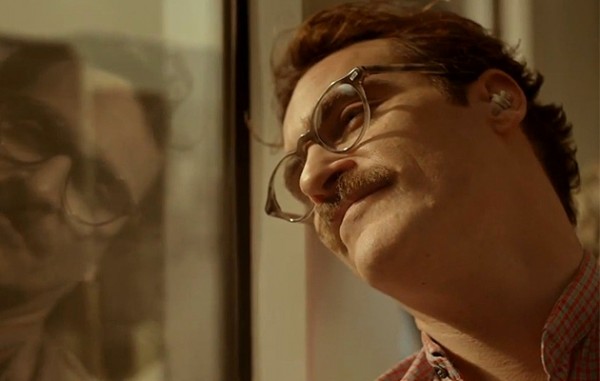
Super-nerd Theodore Twombly (Joaquin Phoenix) falls in love with an AI operating system in dazzling Spike Jonze romance
her (Spike Jonze, 2013)
Opened December 18
www.herthemovie.com
 The brilliant mind of Spike Jonze dazzles again with the spectacularly original romance her. In the very near future, geeky nerd Theodore Twombly (a radiant Joaquin Phoenix) makes his living writing personally commissioned letters for Handwritten Greeting Cards, developing relationships with the people he writes for, considering them family. Meanwhile, he and his wife, Catherine (Rooney Mara), are divorcing, although he is hesitant to sign the final papers. His life takes an unexpected turn when he buys the world’s first AI operating system and slowly falls in love with her during an extremely romantic twenty-first-century-style courtship. The talking OS (the sexy, gravelly voice of Scarlett Johansson), who names herself Samantha, wants to experience the world, so she and Theodore go everywhere together, including on a double date that is pure genius. When he shares his news with his best friend, Amy (Amy Adams), she doesn’t act the slightest bit concerned for his sanity, instead showing true happiness for his blossoming relationship. But as their love grows, so does their need for something more from each other, which doesn’t always work out quite as planned.

Stunning apartment is one of many beautiful sets in Oscar-nominated film
Jonze’s fourth film as director and first solo screenplay (he cowrote Where the Wild Things Are with Dave Eggers, while Charlie Kaufman wrote Being John Malkovich and Adaptation.), her is a beautifully rendered love story filled with humor and heart. Phoenix shows a whole new, freer, playful side of himself as Theodore, particularly during a rousing scene in which he spins Samantha through a carnival. Wearing his pants way up high, as all men seem to do in Jonze’s vision of the future L.A., Theodore — who must make quite a lot of money at his job, considering his extremely large apartment with its amazing views of the city — serves both as an endearing protagonist and a warning about the importance of human connection. “Are you social or antisocial?” the new program asks him before initiating Samantha. As unique as the film is, it does echo themes found in a pair of Twilight Zone episodes; in “From Agnes — with Love,” a supercomputer falls in love with her creator (played by Wally Cox), while in Ray Bradbury’s “I Sing the Body Electric,” a robot grandmother (Josephine Hutchinson) has the ability to grow emotionally with the family she takes care of. Watching her is like falling in love all over again, not only with the story but with the movies themselves.
Nominated for five Academy Awards: Best Picture, Best Original Screenplay, Best Original Score (Owen Pallett and Arcade Fire’s William Butler), and Best Original Song (Karen O’s “The Moon Song”), and Best Production Design (K. K. Barrett and Gene Serdena)
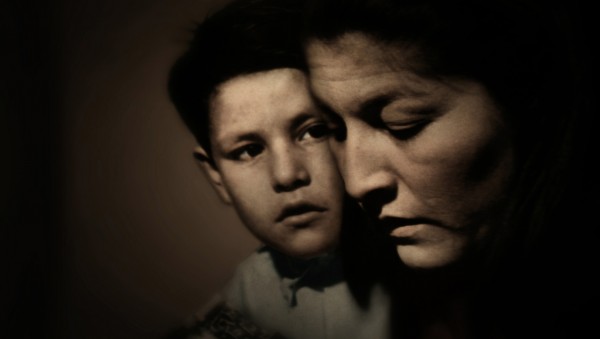
 The life and career of Grammy-winning Argentine folk singer and activist Mercedes Sosa is celebrated in the dutiful yet intimate documentary Mercedes Sosa: The Voice of Latin America. “I used to say Mercedes was our Mick Jagger, that Mercedes was our Paul McCartney,” explains musician León Gieco early in the film. “She was the Rolling Stones and the Beatles all together.” Among the other musicians who sing Sosa’s praises are Pablo Milanés, David Byrne, Milton Nascimento, Chico Buarque, Victor Heredia, and Isabel Parra. Director Rodrigo H. Vila (The Hero of Two Sisters Mountain, Project Huemul: The Fourth Reich in Argentina) combines archival footage — much of which unfortunately is of very low audio and visual quality — with new interviews, primarily discussions between Sosa’s son, narrator Fabián Matus, and people who knew his mother, from her brothers to fellow musicians to psychiatrist Dr. Juan David Nasio. The choppy story follows Sosa, who was also known as La Negra, from her childhood to her initial success to her exile from her home country for speaking out against the military dictatorship and in favor of freedom and helping the poor. “If you are ordered to shut up / don’t be afraid / don’t be afraid / Unsheathe the cry / step on it / I say, step on it,” she sings as the crowd roars its approval. Among the songs — seen only in snippets — featured in the film are “Vidala de la Soledad,” “Canción con Todos,” “Antiguos Dueños de las Flechas,” “Cuando Me Acuerdo de Mi País,” and “Gracias a la Vida,” but they never really give the true sense of Sosa’s power. In addition, the overly worshipful documentary glosses over the last half of her career, following her triumphant performance at el Teatro Ópera de Buenos Aires in 1982. While Mercedes Sosa: The Voice of Latin America is likely to be treasured by Sosa’s loyal fans, it doesn’t quite bring it all together for those less familiar with this South American superstar.
 There’s something always lurking just beneath the surface of Mitsuo Yanagimachi’s 1985 drama, Himatsuri, and when it finally arrives, it’s shocking and explosive. In the small coastal village of Nigishima, the fishermen are at odds with the lumberjacks. Someone is dumping oil in the water, killing the fish, and the chief suspect is Tatsuo (Kinya Kitaoji), a strong woodsman who chops down trees, raises dogs to hunt down wild boars, shoots monkeys, cheats on his wife with a former girlfriend turned hussy (Kiwako Taichi), and is the only villager who refuses to sell his property to a company intent on building a marine park there. He both cavorts with and defies nature and the local spiritual beliefs, at one point swimming naked in the waters leading to a sanctuary. “Only I can make the goddess feel like a woman,” he proclaims. Carefully watching and worshiping Tatsuo is young Ryota (Ryota Nakamoto), who also oversteps boundaries, using sacred branches in animal traps, and is forced to expose himself to the goddess in retribution. Soon a storm comes, transforming Tatsuo and leading to a horrific conclusion. Set in the area where the Japanese creation myth takes place, Himatsuri is a strange creature indeed, with confusing plot twists, bizarre transitions, and some very weird scenes, with a creepy score by Tōru Takemitsu and lush photography by Tamura Masaki. Yanagimachi’s tale, written by Kenji Nakagami, is no mere clarion call to save the environment; instead, it’s an examination of man’s inhumanity to nature, the disregard for the trees, the oceans, the animals (while also commenting on religion, homosexuality, and contemporary society). Yanagimachi (God Speed You! Black Emperor; Ai ni tsuite, Tokyo) mixes genres, from horror to thriller to romance to musical, as he tells the story of one man who just can’t stop himself.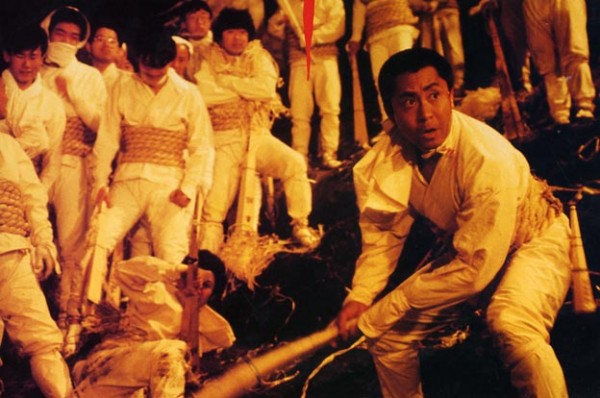
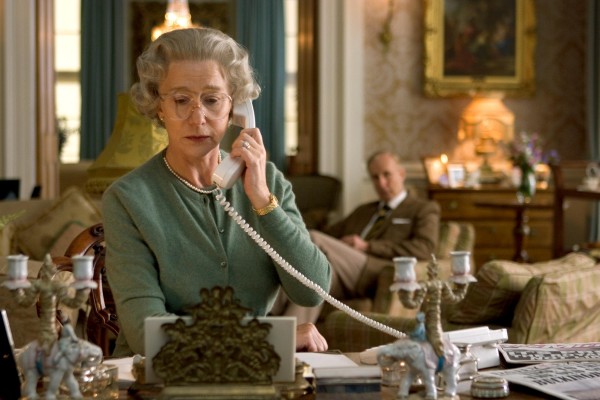
 It’s tradition versus modernization in Stephen Frears’s re-creation of the Royal Family’s reaction to the death of Princess Diana on August 31, 1997. While the world mourns, Queen Elizabeth II (a stoic Helen Mirren), Prince Philip (an acerbic James Cromwell), and the Queen Mum (Sylvia Syms) just continue their daily routine as if nothing has happened. They take Diana and Prince Charles’s (Alex Jennings) children up to Balmoral to hunt stag, refusing to publicly acknowledge the tragedy. Meanwhile, Tony Blair (Michael Sheen, reprising the role from Frears’s 2003 British television movie THE DEAL) has been swept into the office of prime minister in a landslide victory for forward-thinking change. Noting the public response to Diana’s death, Blair implores the queen to respond, but protocol, pride, and dignity get in the way. Frears cleverly, if obviously, displays the differences between the old and the new in depicting the simple home life of the Blairs against the opulence of the Royal Family, each way of life representing the ever-growing gap in British society. Through exhaustive research, screenwriter Peter Morgan imagines the relationship between Blair and the queen, including numerous private conversations held over the phone and in person, and as intriguing as they are, there’s just no way to know how much of it really happened. (A similar fate befell The Last King of Scotland, in which cowriter Morgan imagined conversations Idi Amin had with a made-up character.) Nominated for six Oscars including Best Picture, Best Director, and Best Original Screenplay, The Queen is a compelling film, with solid acting (Cromwell is a screaming riot, and Mirren won an Oscar for Best Actress for her stellar performance) and appropriately calm direction, but it never quite reaches the heights it aspires to. The Queen is screening January 18 at 3:00 as part of the Museum of the Moving Image series “Stephen Frears: The Chameleon,” being held in conjunction with the success of the director’s most recent work, Philomena, which has been nominated for four Academy Awards, including Best Picture and Best Actress (Dame Judi Dench).